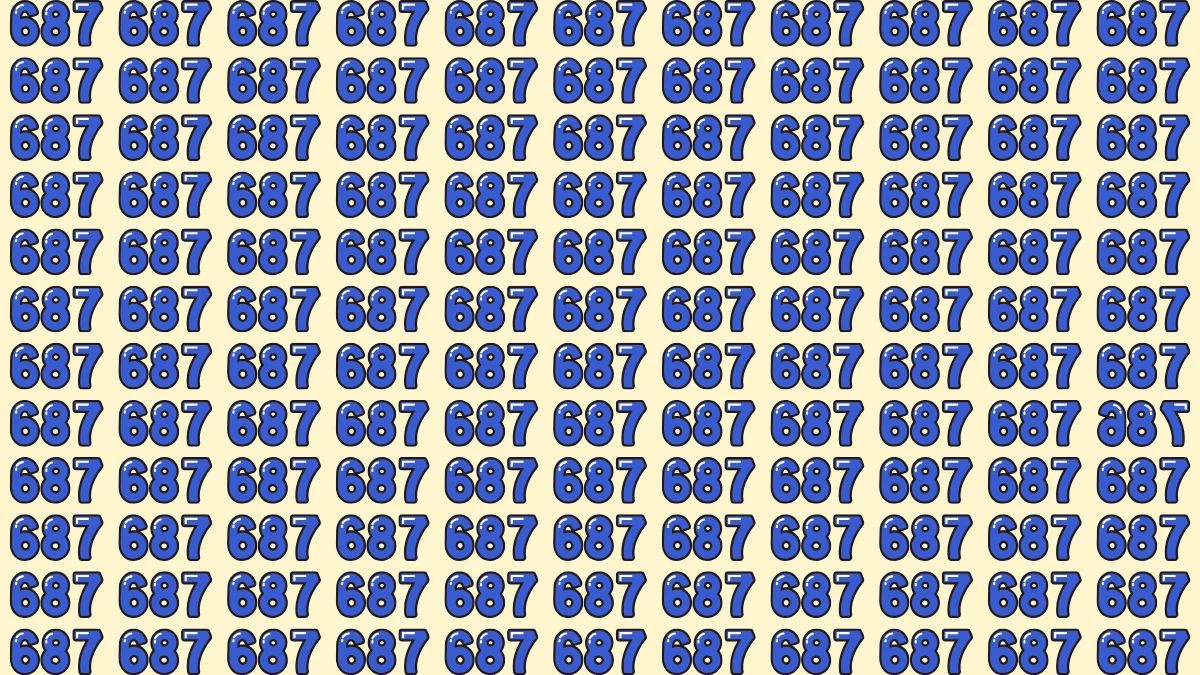
Optical illusions have fascinated people for centuries, tricking our eyes and brains into seeing things that aren't quite as they appear. Today, we bring you an exciting eye test challenge: spot the inverted 687 hidden among a sea of regular 687s and you have just 7 seconds to do it!
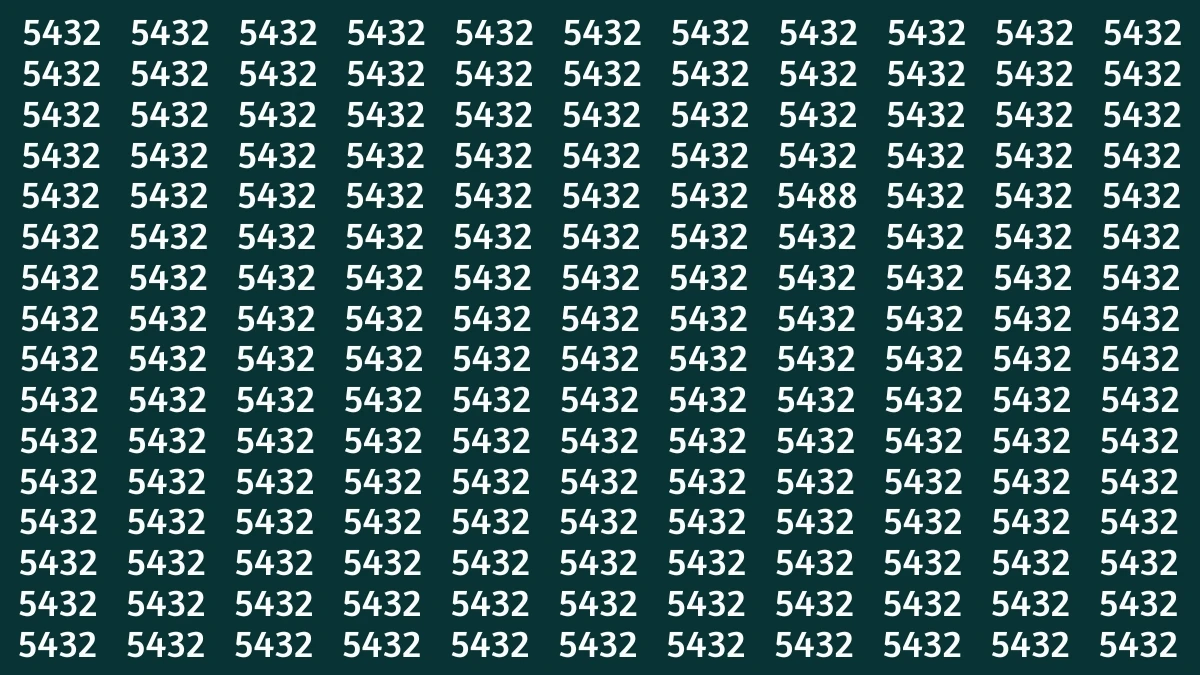
This visual puzzle consists of rows and columns filled with the number "687" repeated over and over. At first glance, everything looks identical. But hidden somewhere in the grid is one "687" that is inverted essentially upside down, appearing as "987" if rotated 180 degrees, but cleverly disguised in orientation. Only those with sharp observation skills and keen visual acuity can spot it quickly. Ready to test your eyes? Scroll down to the puzzle image and start the timer!
Why It's Challenging
This illusion is particularly tough because it exploits the uniformity of repetition. The human eye tends to group similar patterns together, a phenomenon known as the Gestalt principle of similarity. When hundreds of "687"s are arranged in neat rows, your brain quickly categorizes them all as the same, glossing over minor details like orientation.
The numbers themselves are designed with rotational ambiguity digits like 6 and 9 are mirrors/rotations of each other, and 8 is symmetric. Turning "687" upside down makes it look like "987" (since 6 becomes 9, 8 stays 8, 7 doesn't rotate nicely but in stylized fonts can blend). But here, the "inverted" one is rotated 180 degrees, making it stand out only if you notice the flipped direction. The dense packing and identical coloring add to the camouflage, forcing your visual system to work overtime. Most people scan randomly and miss it under time pressure, as 7 seconds isn't enough for a thorough search.
Brain Science Explanation
From a neuroscience perspective, this challenge highlights how our visual processing works in layers. The primary visual cortex (V1) detects basic features like edges and orientations, but higher areas like V4 and the inferior temporal cortex handle object recognition.
In repetitive patterns, the brain employs "pop-out" search for differences if something contrasts sharply (e.g., color), it's easy. But here, it's a conjunction search: the anomaly is in orientation among identical shapes. This requires serial attention, shifting focus one by one, guided by the lateral prefrontal cortex.
Additionally, perceptual constancy makes us ignore rotations we recognize "687" regardless of angle in daily life. Overcoming this requires top-down attention from the frontal lobes. Studies on visual search (like Treisman's feature integration theory) show such tasks take longer, especially under time constraints, explaining why quick spotters have superior attentional control and possibly better developed parietal lobes for spatial awareness.
How to Solve It
To crack this puzzle efficiently, avoid random scanning. Start with a systematic approach: divide the grid mentally into quadrants and scan row by row, left to right, like reading a book. This engages guided search rather than haphazard looking.
Focus on key differences look for numbers where the "6" appears on the right (as a "9" would when inverted) or the curve directions reverse. Squinting slightly can reduce detail overload, helping anomalies pop out via reduced acuity paradox.
Another trick: tilt your head or imagine rotating the image mentally. Practice peripheral vision often, differences catch your side eye before central focus. Finally, relax; stress narrows attention tunnels. With practice, you'll train your brain's attentional spotlight to widen and sharpen.
Solution Revealed
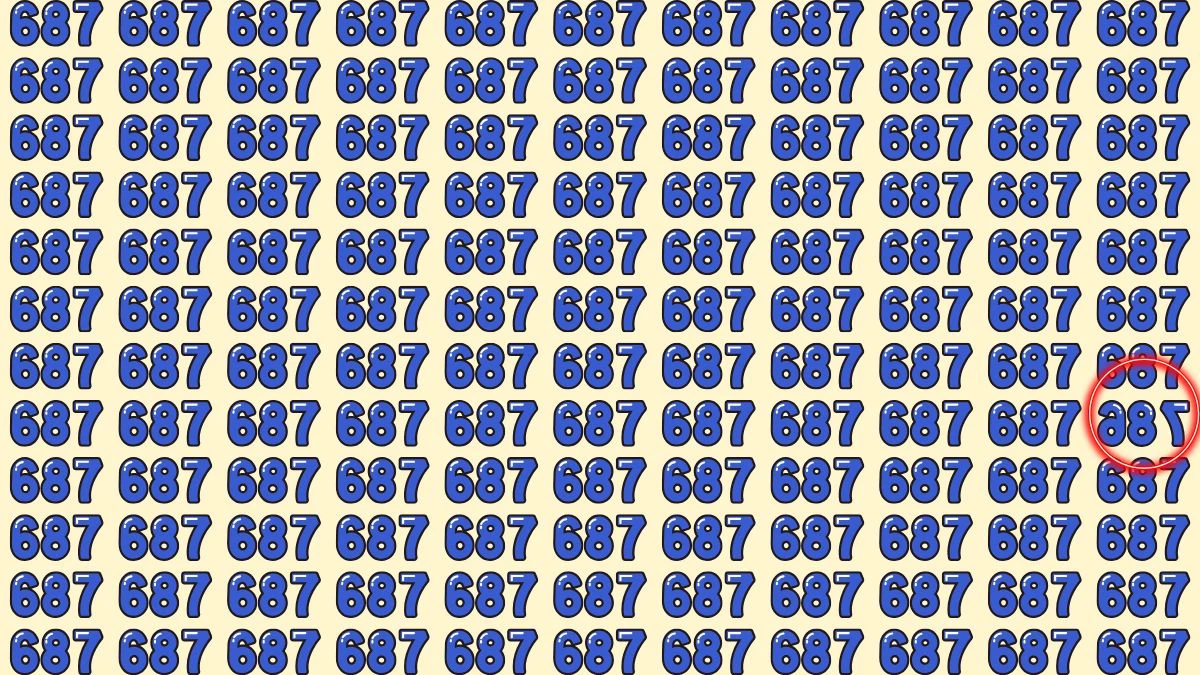
Time's up! Did you find it? The inverted 687 is located in the lower-middle section of the grid, towards the right side.
In the puzzle, it's cleverly placed where casual scanning might skip. When rotated 180 degrees, it reads as "987" due to the digit transformations (6→9, 8→8, 7 stylized to blend but flipped). Here's the marked version for clarity
What It Reveals About You
Performing well on this challenge says a lot about your cognitive strengths. Quick spotters often have excellent visual processing speed and strong selective attention, traits linked to higher fluid intelligence and better performance in fields like aviation, surgery, or graphic design.
It may indicate robust executive function the ability to override automatic perceptions (like constancy) with deliberate analysis. Research from psychology journals suggests frequent puzzle-solvers have reduced cognitive decline risk with age, as these exercises strengthen neural pathways in the visual and frontal cortices.
On the flip side, struggling doesn't mean poor eyesight; it's often about attentional style some are holistic scanners, others detail-oriented. If you found it instantly, you might have a "eagle-eyed" perceptual style. Overall, it reveals how adaptable your brain is to overriding illusions.
Tips for Improvement
Want to get better at these eye tests? Start with daily practice: apps like Lumosity or Peak offer visual search games. Train with progressively denser grids.
Improve focus through mindfulness meditation studies show it enhances attentional control. Get enough sleep; fatigue impairs visual discrimination. Exercise your eyes with near-far focusing or tracking moving objects.
Challenge yourself by timing attempts and gradually reducing time limits. Vary puzzles: try hidden objects in scenes next. Finally, stay curious approaching illusions playfully reduces frustration and boosts dopamine, aiding learning. With consistent effort, you'll notice improvements in real-life observation, like spotting details in crowds or errors in text.