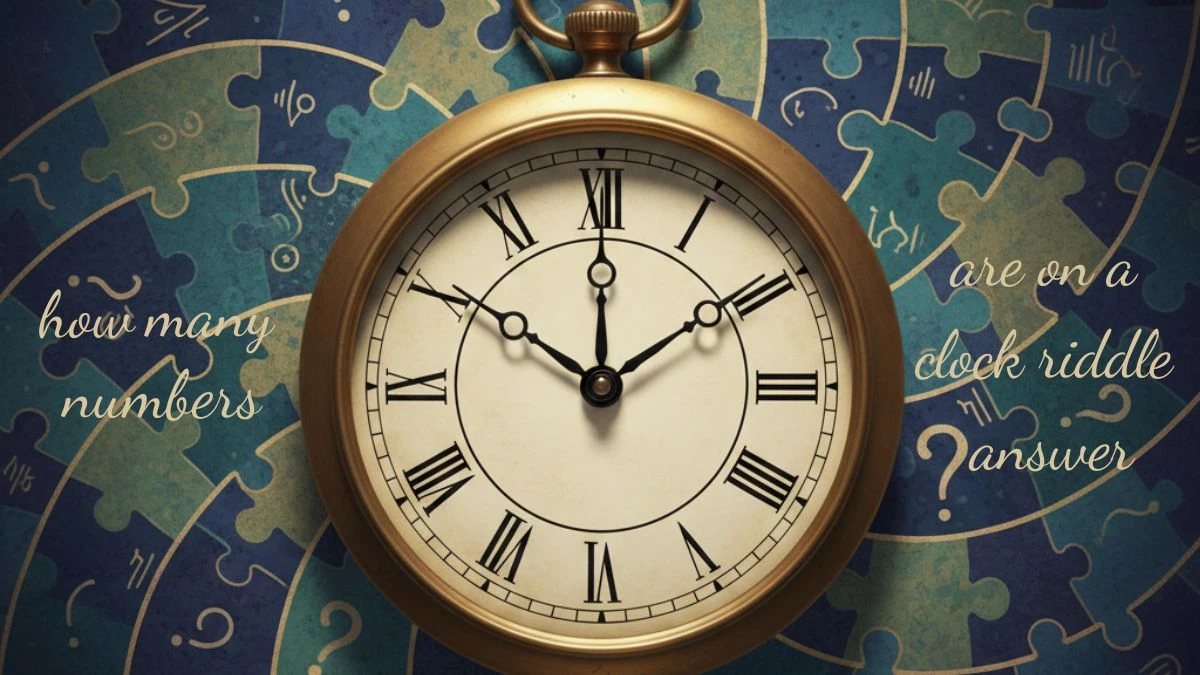

Riddles have been a popular form of entertainment and mental challenge for centuries. They often involve a play on words or concepts, designed to make you think outside the box. Riddles can be both fun and thought-provoking, and they’re a great way to exercise your brain. Some riddles are straightforward, while others require a little more creative thinking. In this blog, we’ll look at a popular riddle that has stumped many: "How many numbers are on a clock?" While this may seem simple at first, it hides a tricky twist.
Question: How Many Numbers Are on a Clock?
The riddle asks a seemingly simple question: How many numbers are there on a clock? A common first response might be 12, considering that traditional clocks display the numbers from 1 to 12 around the dial.
Answer:
Surprisingly, the answer is 15.
Explanation:
The answer may seem puzzling, but let’s break it down logically. A standard clock displays the numbers 1 through 9 in the first section of the dial, which accounts for 9 numbers. However, the riddle is not just referring to the typical 1-12 range; it cleverly includes the numbers found in the spaces between the usual 1 to 9. This means the numbers 10, 11, and 12 must also be counted separately.
Thus, there are 6 additional numbers between 10, 11, and 12 that we often overlook. If you add these to the original 9 numbers (1 to 9), you get a total of 15.
Therefore, the answer is 15 numbers in total on a clock, considering not only the regular 1-9 but also including the numbers 10, 11, and 12.
Disclaimer:
The answer provided for the riddle "How many numbers are on a clock?" is based on a playful interpretation and may not align with the traditional understanding of a clock's design. This explanation is meant for entertainment purposes and to encourage creative thinking in solving riddles.