
What is Yuva.ai?
Yuva.ai is a government-backed, mobile‑first AI literacy and skills platform designed to help young people in India understand and use artificial intelligence in everyday life.
Launched under the Kaushal Rath initiative and aligned with the broader IndiaAI Mission, it focuses on making AI education accessible beyond big cities, reaching students, job‑seekers, and early professionals who may only have a basic smartphone and mobile internet.
Instead of being a heavy, technical “course” that feels intimidating, Yuva.ai is positioned more like a friendly companion app that walks users through what AI can do, where it is already used (from finance apps to social media filters), and how to handle it responsibly.
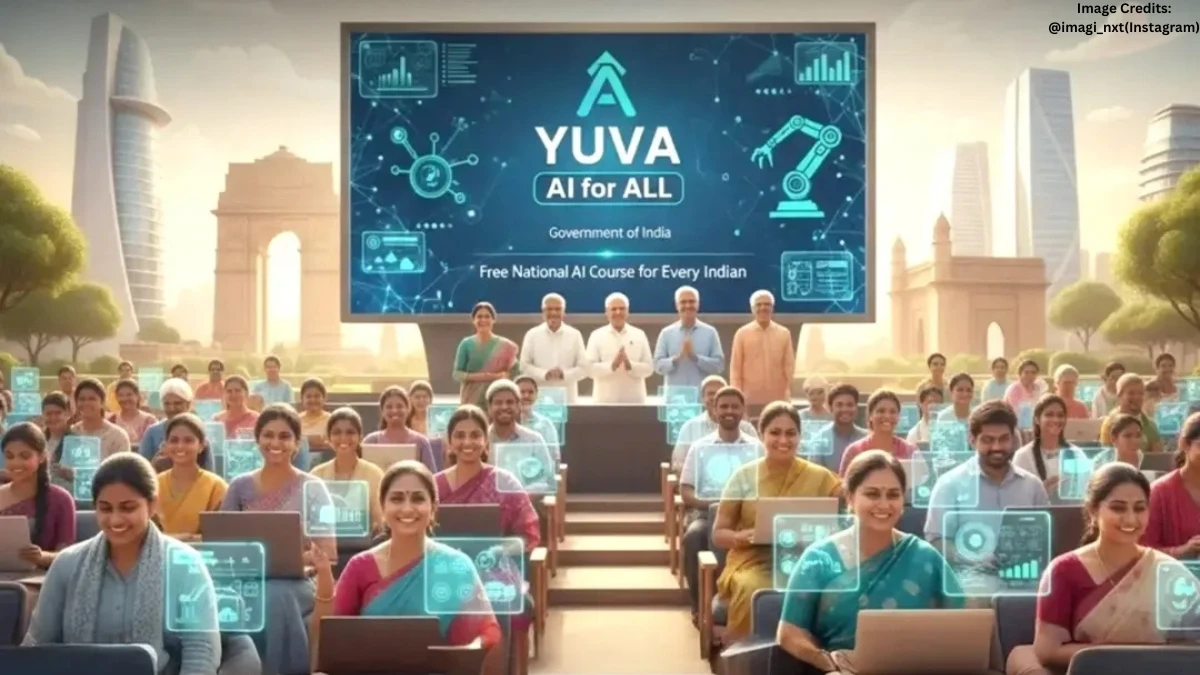
There is also a related free course framework called “Yuva AI for All,” which offers structured modules on AI basics, applications, ethics, and responsible use, all under the same IndiaAI umbrella.
Together, Yuva.ai and Yuva AI for All form a sort of national on‑ramp into AI for youth: one side is the platform and outreach (buses, events, mobile app), the other is structured learning content that can be completed at the learner’s own pace.
When Was Yuva.ai Launched, and What is Happening Right Now?
Yuva.ai was publicly announced by the Government of India on 11 February 2026 as part of a fresh push to bring AI awareness directly to young people.
As of Thursday, 12 February 2026, 3:21 AM PST (which is Thursday afternoon in India), the initiative is in its early rollout phase, tied closely with the ongoing “Yuva AI for All” mobile literacy drive and Kaushal Rath outreach activities.
Recent announcements talk about buses travelling across regions, AI demo events, and plans to train one million youth using this ecosystem of courses and tools.
This timing aligns with broader IndiaAI Mission milestones such as new AI/ML policies in states like Rajasthan and upcoming AI labs in ITIs and polytechnics, which are meant to give learners who start on Yuva.ai a path into deeper study or skilling.
Key Features of Yuva.ai and “yuva Ai for All”
Yuva.ai itself is framed as a mobile‑first skills and literacy platform, while “Yuva AI for All” is the structured course layer sitting under the IndiaAI Mission. Both share a few core ideas that matter for real users:
-
Free or low‑barrier access: positioned as a free national AI literacy effort so that cost does not block entry.
-
Short, modular learning: lessons are broken into small, self‑paced modules (around 4.5 hours in total for the core course) rather than long, textbook‑style chapters.
-
Beginner‑friendly design: content assumes no prior technical background and focuses on simple language, examples from Indian life (UPI payments, local languages, routine tasks), and practical prompting tips.
-
Responsible and ethical AI: there is repeated emphasis on safe, inclusive, and human‑centric AI usage, not just “how to get faster outputs.”
In practice, that means a learner might open the app or course after college, complete two short modules in an evening, experiment with a generative AI tool via guided prompts, and walk away with at least a basic sense of what AI can and cannot do.
How Does Yuva.ai Fit Into the IndiaAI Mission?
Yuva.ai is one of the public‑facing arms of the IndiaAI Mission, which is managed by the Ministry of Electronics and Information Technology (MeitY) to boost AI capacity across the country.
While the mission talks about big infrastructure like high‑end compute, AI data labs, and startup support, Yuva.ai and the Yuva AI for All course focus on the “last‑mile”: ordinary citizens, especially youth, who need to understand AI before they can benefit from those bigger investments.
The initiative also connects with earlier youth‑oriented AI efforts such as YUVAi (Youth for Unnati and Vikas with AI), which ran challenges and bootcamps for school students from classes 8–12 to design AI‑based solutions for sectors like agriculture, healthcare, and education.
Together, these programmes show a pattern: contests and challenges for students who want to build things, plus literacy platforms and short courses for broader awareness.
Who is Yuva.ai meant for?
Yuva.ai and the Yuva AI for All ecosystem target a wide band of learners:
-
School students (from middle school to higher secondary) who are just starting to hear about AI in news, social media, or classes.
-
College students and fresh graduates looking for an entry‑level understanding of AI tools that appear in internships, tech support roles, or digital jobs.
-
Working professionals and job‑seekers who may not be from an engineering background but still need to understand AI for productivity, customer service, or basic analytics tasks.
The tone of the course descriptions and press releases suggests a very “plain‑spoken” aim: help one crore (10 million) citizens become comfortable with AI, not turn everyone into researchers overnight. That means more emphasis on AI literacy understanding concepts, limitations, and responsible use than on advanced coding or model‑building.
Why does Yuva.ai matter right now?
Yuva.ai matters because AI tools are reaching people faster than formal AI education, especially outside large metros. When a government‑led platform and a free national course promise simple explanations, local examples, and a clear focus on safe use, it lowers the barrier for first‑time learners who might otherwise be left to random videos or confusing tutorials.
From a policy angle, initiatives like Yuva.ai, Yuva AI for All, and related programs such as YUVAI and the Kaushal Rath roadshows are signals that AI literacy is being treated like basic digital literacy was a decade ago something that needs scale, structure, and a long‑term plan rather than scattered workshops.
For learners, it offers a starting point: a way to understand AI in clear, everyday language, at a time when the technology is becoming part of almost every sector in India.
Disclaimer: The information shared above is for general educational and informational purposes about Yuva.ai and related initiatives, and may change with future updates or policy decisions. It should not be treated as official government communication; readers are advised to verify key details from authorised government or programme websites before making any decisions.