
Wuthering Heights Ending Explained
The 2026 Wuthering Heights ends with Cathy dead, Heathcliff shattered beside her body, and then a hard cut back to their childhood that reframes everything you’ve just watched.
Instead of continuing into the second generation like Emily Brontë’s novel, Emerald Fennell stops the story at the exact moment Heathcliff realises he has run out of time; he arrives too late, clings to Cathy’s corpse, and begs her to haunt him for the rest of his life.
Right after that, the film throws us back to the night when young Heathcliff crawls into Cathy’s bed after Mr Earnshaw has beaten him, quietly confessing that he loves her while he thinks she’s asleep; Cathy keeps her eyes closed, but gives that tiny, knowing smile.
That smile is the key: it suggests she has always understood the depth (and maybe the danger) of his devotion, and that their adult tragedy is rooted in that warped idea of love born in violence and fear.
To me, the ending is less “tragic romance” and more “origin story of two people who never learned a healthy way to love each other.”
The circular structure, opening in that brutal household, ending back there after all the sex, bile, and betrayal, underlines Fennell’s point: love, in this world, is cyclical, obsessive, and not really something you “grow out of.”
Even death doesn’t feel like closure; it’s just another turn of the same painful loop. No cosy afterlife reunion, no redemption arc. Just a man clutching a dead body and a memory of a girl who smiled in the dark.
Does Cathy Die in Wuthering Heights?
Yes, Cathy dies at the end of the 2026 movie, and her death is the final line in the story rather than the midpoint like in the novel. The film builds to that inevitability slowly: her marriage to Edgar, the rekindled affair with Heathcliff, the jealousy, the self‑destruction, all piling up until her body simply can’t take it anymore.
What’s interesting is that the film makes Cathy’s death feel both intensely physical and strangely mythic. On one hand, it’s about miscarriage, sepsis, starvation, and depression, very literal consequences of terrible choices and even worse communication.
On the other hand, Heathcliff’s reaction turns it into this almost operatic moment: he doesn’t just grieve; he demands that she haunt him, that their connection never end, even if it destroys him. I walked out of the cinema thinking, “Yep, this is the kind of romance that looks epic on screen and absolutely unlivable in real life.”
Who Wrote Wuthering Heights?
The original Wuthering Heights was written by Emily Brontë and published in 1847, and she only ever wrote this one novel. It was a pretty wild book for its time, structurally strange, morally messy, and full of people behaving horribly while insisting it’s all in the name of love.
The 2026 film is written and directed by Emerald Fennell, who clearly isn’t trying to do a neat, museum‑piece adaptation. Instead, she grabs the core of what Brontë was doing, love as obsession, violence, and possession, and drags it into a more modern, visceral register.
You can feel her taking risks: shifting focus to Cathy and Heathcliff, trimming the generational saga, and leaning hard into the idea that cruelty and desire are tangled together. It won’t satisfy purists, but it absolutely has a point of view.
How Does Catherine Die in Wuthering Heights?
Catherine dies from complications following a miscarriage and untreated sepsis, after locking herself away and slowly spiralling into self‑neglect.
In Fennell’s version, Cathy is pregnant with Edgar’s child; when Heathcliff realises the baby isn’t his, their relationship fractures, and he marries Edgar’s sister Isabella out of spite, dragging her into a toxic, masochistic marriage.
While this is happening, Cathy retreats into her bedroom, refusing food and company, growing weaker as grief, guilt, and jealousy eat away at her.
Nelly, who has been burning Heathcliff’s letters in a misguided attempt to “protect” everyone, initially assumes Cathy is exaggerating and even doubts the miscarriage.
By the time Nelly realises Cathy is genuinely dying, it’s too late: sepsis has set in, Edgar falls asleep at her bedside, and wakes to find she has bled to death.
Nelly finally races to tell Heathcliff, who gallops back only to find Cathy already dead. He clings to her body and begs her to haunt him, essentially cursing himself to a lifetime of grief.
It’s brutal because you can see all the points where one honest conversation, one letter delivered instead of burned, might have changed the outcome, and the film refuses to give anyone that mercy.
Wuthering Heights Director 2026
The 2026 Wuthering Heights is directed by Emerald Fennell, who also wrote the screenplay. If you’ve seen Promising Young Woman or Saltburn, you’ll recognise the instincts: she likes stories that look lush and romantic on the surface but are actually about power, cruelty, and the uglier corners of desire.
Here, she leans into gothic melodrama with a modern edge, less windswept, noble yearning and more mud, blood, and bad decisions.
Reviews have called the film “psychedelic” and “playing by its own rules,” which feels right; it’s not shy about making bold changes to the book, especially in how it frames Cathy as the emotional centre and treats everyone, including Nelly, as morally compromised.
Watching it, you get the sense Fennell isn’t asking, “Is this romantic?” so much as, “Why do we keep mistaking this kind of damage for romance?”
Wuthering Heights Cast 2026
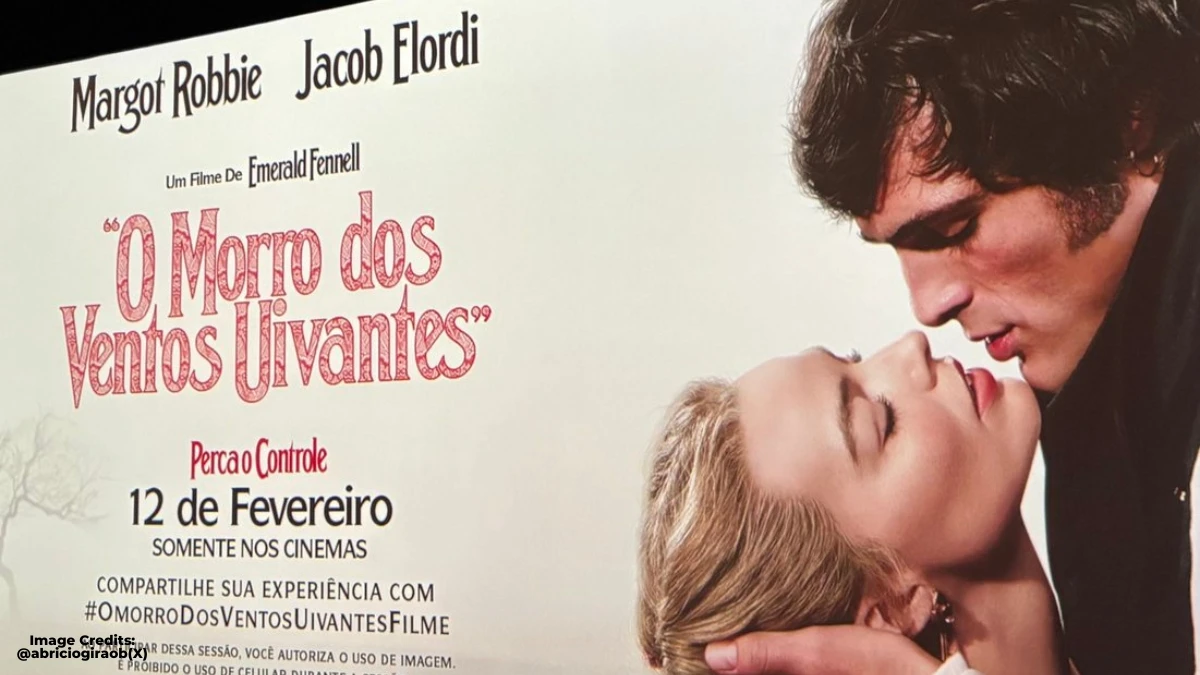
The 2026 cast is stacked with familiar faces, led by Margot Robbie and Jacob Elordi. The main players:
-
Margot Robbie as Catherine “Cathy” Earnshaw
-
Jacob Elordi as Heathcliff
-
Hong Chau as Nelly Dean
-
Shazad Latif as Edgar Linton
-
Alison Oliver as Isabella Linton
-
Martin Clunes as Mr Earnshaw
-
Ewan Mitchell as Joseph
Younger versions of Cathy, Heathcliff, and Nelly were played by Charlotte Mellington, Owen Cooper, and Vy Nguyen.
Robbie and Elordi carry most of the emotional weight, obviously, and early reactions have really zeroed in on their chemistry, messy, volatile, sometimes genuinely hard to watch in a good way.
Hong Chau’s Nelly is also worth calling out: she isn’t just a warm, loyal housekeeper here, but a complicated figure whose choices actively shape the tragedy.
Where to Watch Wuthering Heights?
Right now, Wuthering Heights (2026) is primarily playing in theatres, with its wide release landing around February 13, 2026, very on brand for a Valentine’s Day “romance” that might ruin your date night in the best way. If you want the full, big‑screen moor‑and‑thunder experience, that’s the way to go.
For streaming, things are a bit more staggered. As a Warner Bros. release, it’s expected to land on Max (formerly HBO Max) after its theatrical run, likely a couple of months after release, with a digital purchase/rental window in between.
Some third‑party aggregators list it as eventually heading to platforms like Netflix or Prime Video in certain regions, but those line‑ups change often, so it’s worth double‑checking nearer the time.
If you’re the type who likes to rewatch tragic endings just to emotionally wreck yourself all over again, keeping an eye on Max’s “coming soon” slate is probably your best bet after the cinema run winds down.
Does Wuthering Heights Have A Post Credit Scene?
No, the 2026 Wuthering Heights does not have a post‑credits scene. Once the ending with Heathcliff grieving over Cathy cuts to credits, you’re safe to leave the theatre without missing any bonus or mid‑credits footage.
Disclaimer:
This article is based on publicly available information, early reviews, and a narrative interpretation of the film. Plot details, character arcs, and thematic explanations reflect critical analysis and viewer perspectives and may vary by interpretation. Release schedules, streaming availability, and casting details are subject to change based on official studio announcements.