This optical illusion is a quick but effective test of visual attention and mental focus. At first glance, the image appears simple and repetitive. Rows of the number 45 are neatly arranged across the screen, all in the same color, font, and size. Nothing seems out of place.
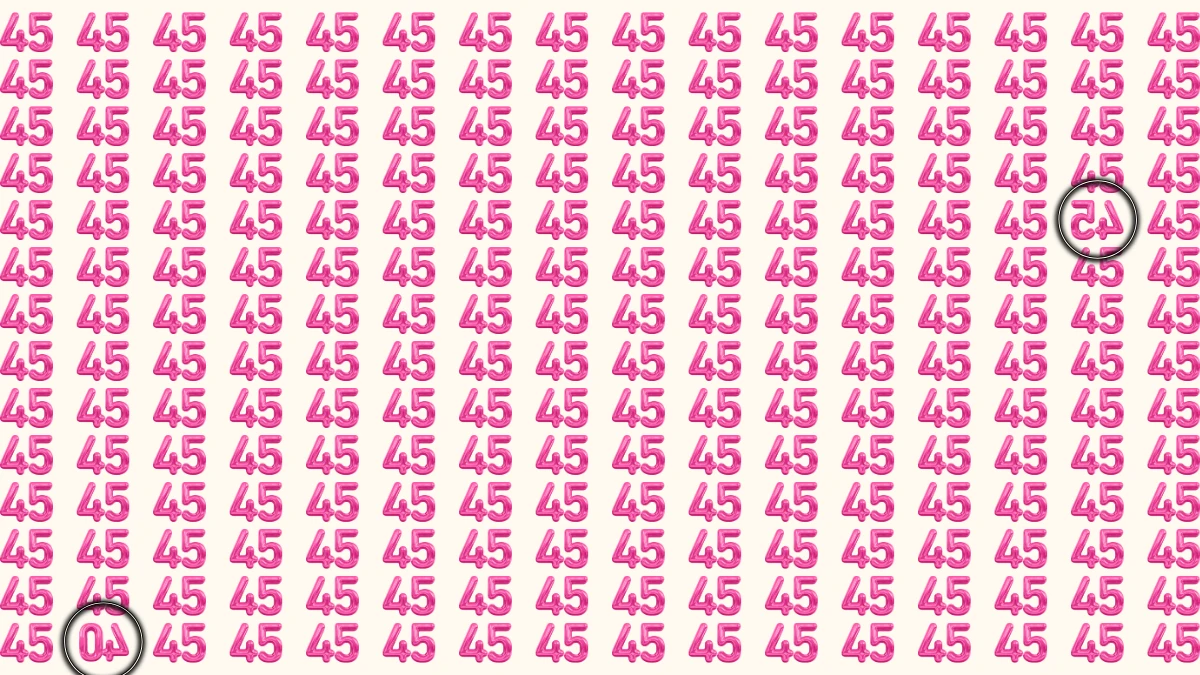
But this optical illusion is designed to challenge that first impression. Hidden within the pattern are two subtle anomalies. One number 45 is inverted. Another number 40 is also inverted. Your task is to find both within 9 seconds.
Optical illusion puzzles like this are popular because they reveal how the brain processes information under time pressure. They are short, engaging, and surprisingly difficult.
Eye Test Challenge: Within 7 Seconds Spot The Number 72 and 75 among 76
The Optical Illusion Challenge
Take a careful look at the image.
Everywhere you scan, you see 45 repeated again and again.
That repetition is intentional.
Somewhere in the grid:
- One 45 is flipped upside down.
- One 40 is flipped upside down.
Both are surrounded by identical-looking numbers. There are no arrows or clues. The only way to solve this optical illusion is through focused observation.
Set a timer for 9 seconds and begin scanning.

Why This Optical Illusion Tricks the Brain
This optical illusion relies on a well-known cognitive shortcut called pattern completion. When the brain detects repetition, it stops analyzing each element individually. Instead, it assumes everything follows the same rule.
Several factors make this illusion especially challenging:
- The font and color are identical throughout.
- The spacing between numbers is uniform.
- The inverted numbers maintain the same visual weight.
Because the changes are subtle, the brain overlooks them unless attention is deliberately slowed down.
This is why many people confidently scan the image and still miss both answers.
Psychology Behind Optical Illusion Puzzles
Optical illusion tests like this highlight the difference between seeing and perceiving. Seeing is passive. Perceiving requires effort.
Your brain prefers efficiency. When it recognizes a repeating pattern, it switches into autopilot. That helps in daily life, but it becomes a disadvantage in optical illusion challenges.
To improve performance:
- Avoid reading the numbers automatically.
- Look for orientation changes rather than values.
- Scan sections instead of the entire image at once.
These small adjustments can significantly improve detection speed.
Common Mistakes People Make
Many viewers make the same errors when attempting this optical illusion:
- They scan too quickly.
- They focus only on the center of the image.
- They assume the numbers are all identical.
Another common mistake is expecting the inverted numbers to stand out clearly. In reality, the illusion works because the differences are minimal.
Solution Reveal
If you didn’t find both numbers within 9 seconds, don’t worry. This optical illusion is designed to be deceptive.
In the solution image:
- The inverted 45 is located on the right side of the grid.
- The inverted 40 appears near the bottom-left area.
Once highlighted, the differences become obvious. Without guidance, however, they blend seamlessly into the surrounding pattern.
This delayed recognition is exactly what makes the optical illusion effective.
Optical Illusion Challenge: Only a Person with High IQ Level Can Spot the Hidden Number 165
What This Optical Illusion Says About You
Finding both inverted numbers quickly suggests strong visual discrimination and attention to detail. Taking longer doesn’t mean poor observation. It simply means your brain trusted the pattern too much.
Optical illusion puzzles are not about intelligence alone. They measure how flexible your perception is when expectations are challenged.
This optical illusion demonstrates how repetition can override conscious observation. Even obvious differences can go unnoticed when the brain assumes uniformity.
Challenges like this are entertaining, fast, and mentally stimulating. They also train the mind to slow down and question what it sees.