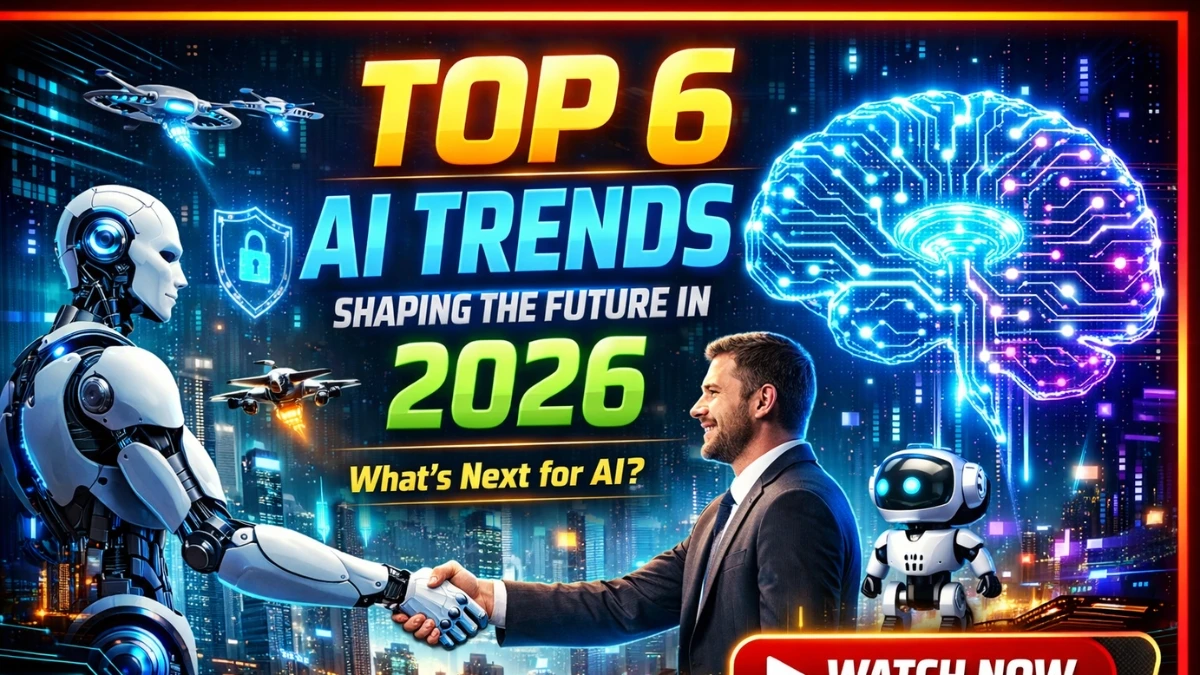

Top 6 AI Trends Shaping the Future in 2026
If 2023–2025 were the years when AI knocked on the door, 2026 is when it moved in, rearranged the furniture, and started cooking dinner. Everywhere you look, in offices, hospitals, warehouses, or even your phone’s photo app, AI isn’t a tool anymore. It’s a teammate.
The way we build, manage, and even think about work has changed, and this shift is led by six megatrends shaping how artificial intelligence actually lives in our world today.
1. Autonomous AI Agents Take the Wheel
Forget chatbots that just answer questions, 2026 belongs to agentic AI, the type that sets goals and acts on them. These systems plan, execute, and adapt like digital coworkers who oddly never ask for a coffee break.
Picture this: an e-commerce brand runs a single AI agent that watches inventory, tweaks ad spend, updates product prices, and fires off customer emails, all without human touch. It sounds futuristic, but it’s already happening.
Companies are building these “agents” to handle customer support, compliance tracking, and logistics, not just suggesting tasks but doing them. For many, it’s a bit surreal to see AI CC itself in an email thread, but that’s the new normal.
2. Multimodal AI Becomes the Default
Let’s be honest, talking to AI via plain text feels a bit vintage now. The latest systems aren’t just reading sentences; they’re watching videos, analyzing sound, parsing charts, and responding intelligently to all of it.
Multimodal AI means a single model can understand text, images, audio, and video in one flow. You could drop a product photo in your marketing chat and ask, “Can you make this ad more Gen-Z-friendly?”, and the AI will rewrite the copy, generate a caption, even create a matching TikTok clip.
These models power everything from smarter medical imaging tools to video-editing apps that can trim scenes, adjust voiceovers, and color-correct on their own. It’s wild, but in 2026, that’s not science fiction, just Tuesday.
3. AI Is Everywhere — and It’s Measuring Everything
A couple of years ago, companies treated AI like glitter, fun but messy, best used sparingly. Now it’s part of the enterprise bloodstream. Over 80% of big organizations use AI across departments, HR, finance, operations, marketing, and they’re not guessing about its impact anymore.
Most report double-digit efficiency bumps and measurable ROI. For example:
-
Customer support teams use AI to triage tickets and speed response time.
-
Finance units run fraud checks and compliance audits automatically.
-
Marketing arms run 24/7 personalization engines that adapt in real time.
At this point, not using AI in business is like refusing to use email in the 2000s; it is technically possible, but career-limiting.
4. Privacy, Regulation, and the Rise of Sovereign AI
Here’s the tension: the more powerful AI gets, the more we worry about who’s peeking at our data. 2026 has seen a hard pivot toward privacy-first and sovereign AI, basically, "AI that minds its own business."
Instead of shipping data to global servers, companies and governments are building region-specific models that keep information local. Hospitals, for instance, now train models entirely on-premises to protect patient records. Banks do the same for transaction data.
It’s not just legal compliance, it’s trust. Europe and parts of Asia are leading the “sovereign AI” movement, while startups are responding with out-of-the-box private AI solutions that integrate securely into existing stacks. In short, AI’s going domestic.
5. Physical AI: When Robots Join the Workforce
Digital intelligence is finally stepping into the physical world. Whether it’s warehouse bots that coordinate like an ant colony or drones surveying crop health between monsoons, physical AI is taking off.
After years of optimizing text and code, the focus is shifting back to embodied AI, machines that can learn and adapt in the real world.
Manufacturing lines run on predictive maintenance, logistics firms deploy fleets of autonomous movers, and healthcare facilities are experimenting with robotic assistants that actually understand context, not just commands.
Still, safety and transparency remain big concerns. No one wants rogue robot headlines. So every serious deployment includes airtight audit trails, human override systems, and constant monitoring, just in case someone teaches a factory bot sarcasm.
6. The AI-First Workforce: Humans and Machines, Side by Side
Here’s the thing no one’s pretending anymore: every job now has an AI angle. Whether you’re an accountant, teacher, or content creator, you’re designing workflows with AI built in. It’s not an “add-on skill”, it’s the new grammar of work.
I spoke to a designer recently who said, “I’m not fighting AI; I’m co-directing with it.” That’s the shift. Workers aren’t being replaced wholesale; they’re being rewired.
Reskilling programs now teach prompt design, workflow automation, and AI ethics before traditional coding. Roughly two-thirds of jobs require some form of AI fluency. It’s a culture change, part curiosity, part necessity, and it’s happening fast.
Looking Ahead
So where’s all this heading? Probably toward a world where “AI integration” stops being news. In a few years, we’ll just call it “work.” Agentic tasks, multimodal reasoning, edge processing, sovereign AI models, and real-world robotics will fade into the background, much like the internet did.
But right now, in 2026, we’re still awake to it, still wide-eyed watching digital agents talking to robots, AI tools editing entire films, and executives bragging about their sovereign models like vintage cars.
It’s chaotic, inspiring, and sometimes absurd… but that’s exactly what a technological revolution is supposed to feel like.
Disclaimer:
The information in this article reflects current AI trends and projections for 2026. While we strive for accuracy, AI advancements are rapidly evolving, and some details may change as new developments emerge. The content provided here is for informational purposes only and should not be interpreted as definitive predictions.