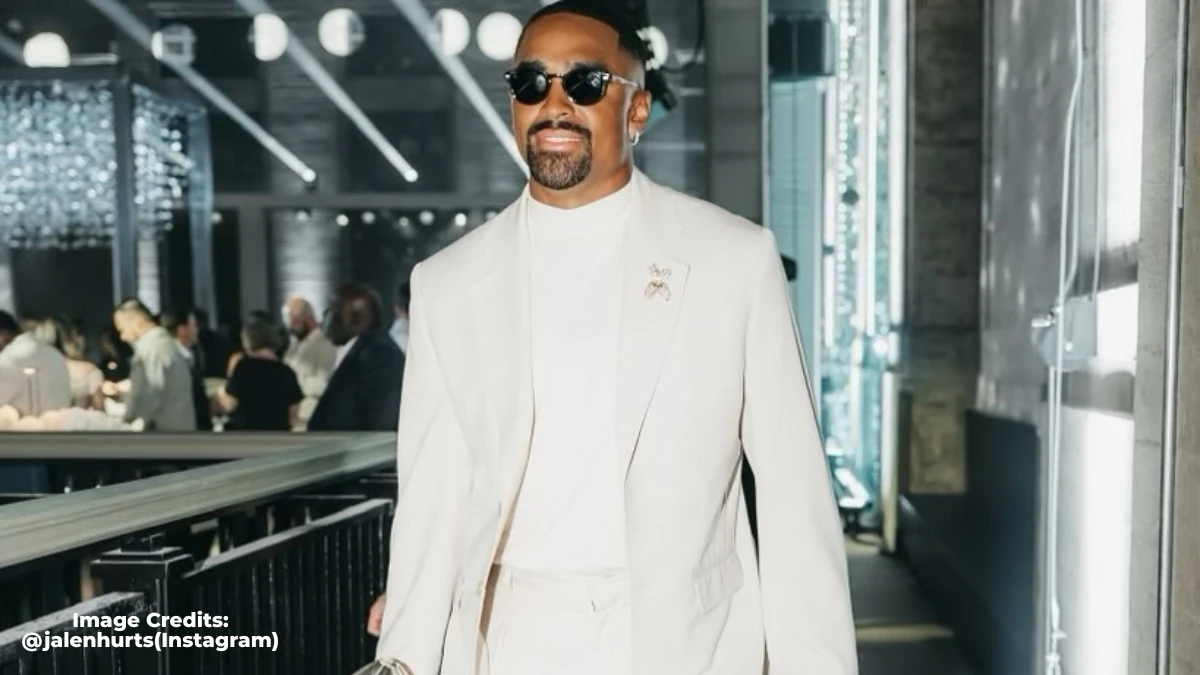

Jalen Hurts had a nightmare night against the Chargers because he mixed bad reads, shaky decision-making, and constant pressure into one of the sloppiest games of his career. It wasn’t just “one bad pick”, it was a full-on unraveling that turned into a weird kind of NFL history and, yes, a fantasy football horror story.
What Happened To Jalen Hurts?
Jalen Hurts melted down in prime time, committing three first-half turnovers and finishing with multiple interceptions and a lost fumble in a 22–19 overtime loss to the Chargers.
At halftime, his line looked rough enough: 10-of-19 for 95 yards, two picks, one lost fumble, and just 9 rushing yards on three carries, basically the opposite of the dual-threat, MVP-caliber version of Hurts fans are used to.
What made it feel even worse was how visible the struggle was. He wasn’t seeing the field clearly, he was late on throws, and he kept drifting into pressure instead of climbing the pocket.
You could almost feel the frustration through the TV, those little head shakes, the slow walk back to the sideline, the quick glance at the tablet that says, “Yeah, that one’s on me.”
The Wild “Two Turnovers On One Play” Moment
Yes, that actually happened: Hurts became the first player on record to be charged with two turnovers on the same play. Midway through the second quarter, he threw an interception over the middle to Chargers defensive lineman Da’Shawn Hand, who had dropped into coverage.
During the return, Hand fumbled, Hurts hustled back to recover it… and then he fumbled it away again, with the Chargers finally falling on the ball.
For normal box scores, that’s just a bizarre sequence; for fantasy football, it was brutal. Most leagues dock 2 points for an interception and another 2 for a lost fumble, so that one chaotic moment basically gave Hurts a -4 on a single play.
If you’ve ever stared at your fantasy app and wondered how your QB’s score went backwards that fast, this was that play.
Why Is Hurts Struggling So Much This Season?
Hurts is struggling because he’s not seeing the field cleanly, he’s late on progressions, and the offense around him isn’t helping enough.
Analysts have pointed out that he’s often locking onto his first read, coming off it slowly, and missing open receivers underneath or breaking free late across the middle. That’s how you end up with tipped balls, throws into traffic, and that “wait, who was that even to?” feeling.
- The Chargers were generating steady pressure and winning enough at the line to keep him uncomfortable.
- Eagles receivers weren’t consistently separating, so passing windows were tighter than usual.
- When Philly did get momentum, penalties and negative plays kept stalling drives.
Put all that together, and you don’t just get a bad half, you get a game that spirals into four total turnovers (three picks and a lost fumble) and a passer rating in the 30s through three quarters.
Is This Just One Bad Game Or A Bigger Problem?
It’s both a one-game disaster and a snapshot of wider issues in the Eagles’ offense. On one hand, the Chargers game will probably go down as one of Hurts’ worst-ever performances, five total turnovers by the end of the night, including the overtime interception that killed a potential game-tying or game-winning drive in field-goal range.
On the other hand, the warning signs have been there all season: more turnover-worthy plays, more hesitation, less of that calm command he showed in his best years. The weird thing is, the Eagles’ defense actually played well enough to win. They kept the Chargers to field goals, generated pressure, and forced turnovers of their own.
But when your quarterback keeps handing the ball back, including in overtime, eventually the dam breaks. That OT pick, tipped and snagged when Philly was already in range to at least tie it, felt like the football gods saying, “Yeah, not your night.”
Where Does Hurts Go From Here?
Hurts needs a reset, mechanically, mentally, and schematically, but this isn’t some career-ending collapse. Quarterbacks go through ugly stretches; what matters is how quickly they stabilize. The Eagles can help him by:
- Leaning into simpler reads early in games: more quick-game, RPOs, and defined half-field concepts.
- Using his legs in a controlled way to rebuild confidence without putting him in constant harm’s way.
- Letting the run game and defense carry the load for a bit, instead of forcing “hero ball” on every drive.
From a human angle, nights like this are rough. Social media piles on, fantasy managers rage, and every throw gets micro-analyzed in slow motion.
But Hurts has already shown in past seasons that he’s resilient, detail-obsessed, and wired to respond, not sulk. This game will sting, maybe for a long time, yet it can also be the kind of low point that quarterbacks later point to and say, “Yeah, that’s when everything had to change.”
Disclaimer: The analysis above reflects general commentary and interpretation based on available game information and public reporting. It is not affiliated with the NFL, the Philadelphia Eagles, Jalen Hurts, or any official organization. Player performance evaluations are subjective and may not represent the views of teams, analysts, or league personnel. For official updates, refer to team statements or accredited NFL sources.