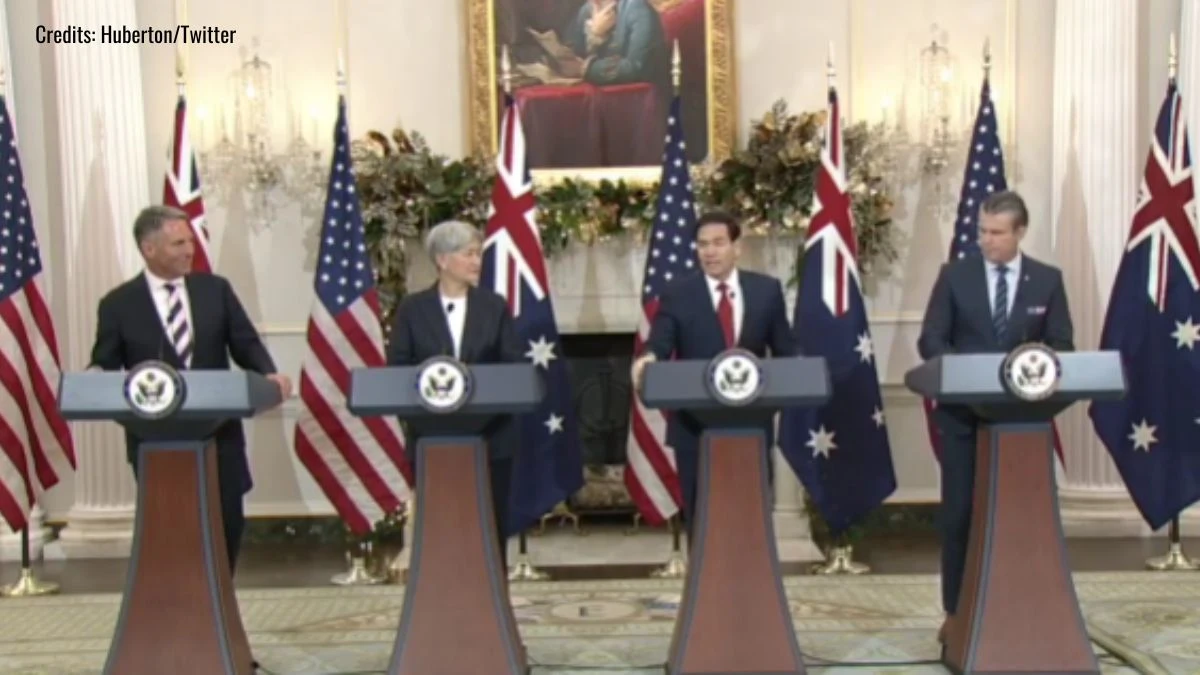

Washington, Dec 8 (AP) Secretary of State Marco Rubio and Defence Secretary Pete Hegseth met their Australian counterparts Monday in Washington for annual talks focused on Indo-Pacific security and countering China's increasing assertiveness in the region, including in the South China Sea and directed at Taiwan.
Rubio, Hegseth, Australian Foreign Minister Penny Wong and Defence Minister Richard Marles gathered at the State Department, with many eyes also on the Russia-Ukraine war, a fragile ceasefire in Gaza and US military strikes against alleged drug traffickers in the Western Hemisphere that have raised questions about the use of force there.
“This is a very strong partnership, it's a strong alliance, and what we want to do is continue to build on it. We think we have a lot of momentum behind this alliance,” Rubio said, hailing cooperation between Washington and Canberra on critical minerals, defense production and troop deployments.
None of the four mentioned China by name in their brief comments to reporters before the formal meeting began, but the challenges posed by Beijing throughout the Pacific and elsewhere have been a central theme of the US-Australia relationship for years.
In a separate one-on-one meeting after the four-way talks, the State Department said Rubio and Wong “discussed their shared commitment to a free and open Indo-Pacific, emphasizing cooperation to combat online scam operations and supporting further strategic infrastructure projects across the Pacific.” President Donald Trump and Australian Prime Minister Anthony Albanese signed a critical minerals deal at the White House in October after China imposed tougher rules on exporting its own critical minerals, used in technology from cellphones to fighter jets and of which Beijing is the top producer and processor.
After Trump and Chinese leader Xi Jinping met later that month, Beijing said it would pause those rules for a year.
“We have to have critical mineral supplies and supply chains that are reliable, and that are diverse, and not overly invested in one place where they can be used as leverage against us or our partners of the world,” Rubio said.
One element of the broader relationship is the AUKUS pact, a Biden administration-era agreement under which the US, Britain and Australia committed to building an Australian fleet of submarines powered by US nuclear technology. Rubio met later Monday with British Foreign Secretary Yvette Cooper but neither spoke to reporters.
“The alliance has always been to ensure it delivers concrete benefits for our security and prosperity and for that of the United States. And AUKUS is central to that: a win for Australia, a win for the US and a win for the United Kingdom,” Wong said. “We are full steam ahead.” Hegseth echoed her comments, saying that “as we move full steam ahead on AUKUS, we applaud Australia's upcoming delivery of an additional $1 billion to help expand U.S. submarine production capacity. We're strengthening AUKUS so that it works for America, for Australia and for the UK.” Marles agreed and reaffirmed the centrality of the alliance with the United States to Australia's security.
“We are living in a much more contested world, where it really matters to be doubling down with friends and allies and, obviously, America is front and centre and foremost for Australia in that respect,” he said.
This report includes content sourced from Press Trust of India (PTI), edited for clarity and context.