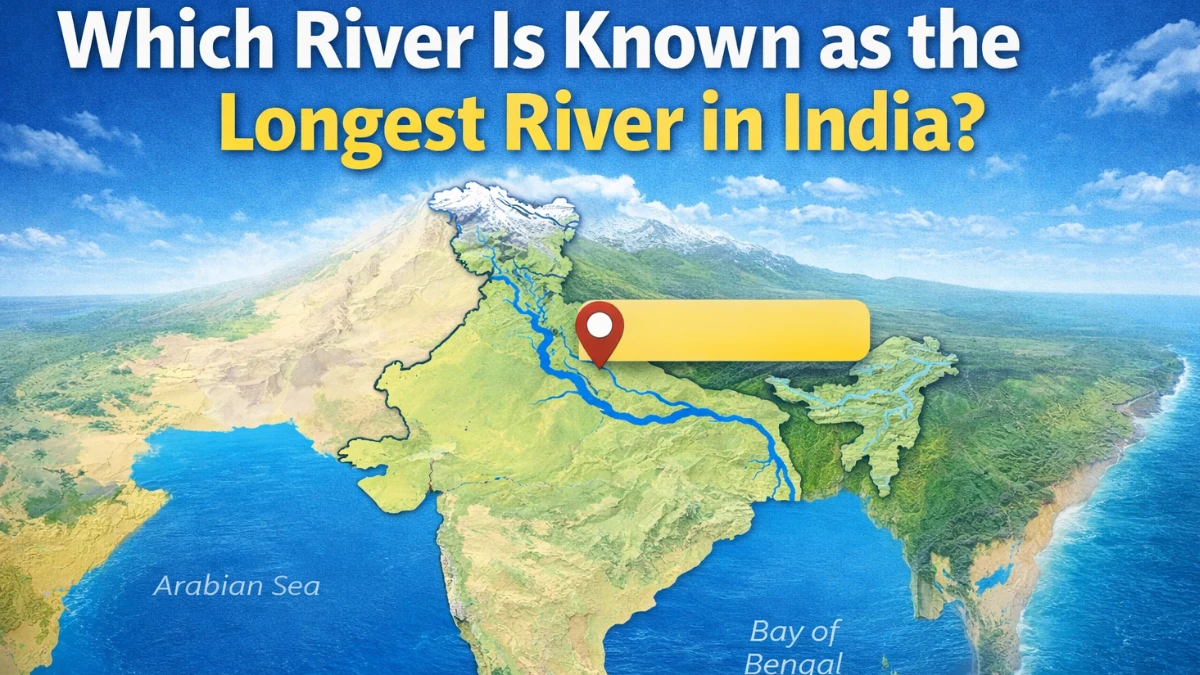

Which River Is Known as the Longest River in India?
If you've ever wondered about India's rivers—maybe for a school quiz, competitive exam, or just out of curiosity—the answer is straightforward: the Ganga (also called the Ganges) holds the title as the longest river entirely within Indian territory.
People ask this question a lot because rivers spark debates: some are longer overall but flow mostly outside India, while others dominate our maps and daily life. The Ganga stands out not just for length, but for its deep role in our culture, economy, and environment.
Quick Answer – The Longest River in India Is the Ganga
The Ganga is the longest river in India, stretching approximately 2,525 km entirely within the country's borders. It flows from its source in the Himalayas all the way to the Bay of Bengal.
Rivers like the Indus (total ~3,180 km) and Brahmaputra (total ~2,900 km) are longer in their full course, but only a fraction runs through India (Indus ~1,114 km in India, Brahmaputra ~916 km in India). When we talk about length within India, the Ganga takes the top spot—clear and undisputed in most geography references, textbooks, and official sources.
Basic Facts About the Ganga River
Origin, Length, and Course
The Ganga begins high in the western Himalayas, specifically in the Gangotri region of Uttarakhand. The main headstream is traditionally the Bhagirathi River, which emerges from the Gangotri Glacier (though the Alaknanda is longer hydrologically and joins it at Devprayag to form the Ganga proper).
From there, it flows roughly 2,525 km southeast through the northern plains. It passes through five major states: Uttarakhand, Uttar Pradesh, Bihar, Jharkhand, and West Bengal. Finally, it empties into the Bay of Bengal via a vast delta shared with Bangladesh (where it's called the Padma in parts).
The river's basin is enormous—covering about one-fourth of India's land area—and supports hundreds of millions of people through fertile alluvial soil.
Major Cities and Regions Along the Ganga
The Ganga's banks are home to some of India's most historic and vibrant cities:
- Haridwar and Rishikesh (Uttarakhand) — gateways to the Himalayas, famous for ashrams and rafting.
- Kanpur, Allahabad (Prayagraj), and Varanasi (Uttar Pradesh) — industrial hubs and spiritual centers.
- Patna (Bihar) — ancient Pataliputra, a major political and trade center.
- Kolkata (West Bengal) — the cultural capital near the delta.
These places thrive because of the river: trade, agriculture, pilgrimage, and festivals all revolve around it.
Top 5 Longest Rivers in India (By Length Within India)
Here's a quick ranking of the major ones, measured by their flow inside Indian territory:
Ganga — ~2,525 km
Godavari — ~1,465 km
Krishna — ~1,400 km
Yamuna — ~1,376 km
Narmada — ~1,312 km
These lengths come from consistent sources like government references and geography studies.
Comparison Table of Major Rivers
| River | Approx. Length in India (km) | Origin Region | Empties Into |
|---|---|---|---|
| Ganga | 2,525 | Gangotri Glacier, Uttarakhand | Bay of Bengal |
| Godavari | 1,465 | Trimbakeshwar, Maharashtra | Bay of Bengal |
| Krishna | 1,400 | Mahabaleshwar, Maharashtra | Bay of Bengal |
| Yamuna | 1,376 | Yamunotri Glacier, Uttarakhand | Joins Ganga at Prayagraj |
| Narmada | 1,312 | Amarkantak, Madhya Pradesh | Arabian Sea |
Why the Ganga Is Considered India’s Longest River
Length Within India vs. Total International Length
The key distinction is simple: "longest in India" means the longest stretch flowing through Indian land. The Ganga does this fully—no international borders to cut its Indian course short.
The Indus starts in Tibet, flows through India (mostly Jammu & Kashmir and Punjab), then into Pakistan. The Brahmaputra originates in Tibet, enters India in Arunachal Pradesh and Assam, then continues to Bangladesh. Their impressive total lengths don't count fully here.
Geographic and Hydrological Significance
The Ganga's basin is one of the most fertile on Earth, supporting massive agriculture (rice, wheat, sugarcane) and providing water for irrigation to millions. It has a huge discharge volume and sustains biodiversity in wetlands and floodplains. Economically, it's a lifeline for transportation, fishing, and industry along its course.
Cultural and Religious Importance of the Ganga
Sacred Status in Indian Traditions
For Hindus, the Ganga is more than water—it's Goddess Ganga, descended to Earth to purify sins. Bathing in it, especially at sacred spots, is believed to cleanse karma and lead to moksha. Cremation ashes immersed here ensure liberation.
Pilgrimage Cities and Festivals on the Ganga
- Haridwar — Ganga Aarti at Har Ki Pauri draws crowds.
- Varanasi — Daily aartis at Dashashwamedh Ghat, evening lamps floating on the river—mesmerizing.
- Prayagraj — Hosts the massive Kumbh Mela every 12 years, where the Ganga, Yamuna, and mythical Saraswati meet.
These events bring millions together, blending faith, community, and tradition.
Environmental Challenges Facing the Longest River in India
Pollution and Conservation Efforts
The Ganga faces severe pollution from industrial waste, sewage, agricultural runoff, and urban discharge. Despite its sacred status, stretches near cities have high coliform levels, affecting health and ecosystems.
Major efforts include the Namami Gange programme (launched 2014), which focuses on sewage treatment plants, river surface cleaning, afforestation, and monitoring. It's an ongoing, multi-billion-rupee national mission involving central and state governments.
Why Protecting the Ganga Matters for India
Over 40% of India's population depends on the Ganga basin for drinking water, irrigation, and livelihoods. Pollution threatens fisheries, agriculture, and public health. Biodiversity (like the Ganges river dolphin) is at risk. A healthier Ganga means cleaner water, resilient farming, and preserved cultural heritage for future generations.