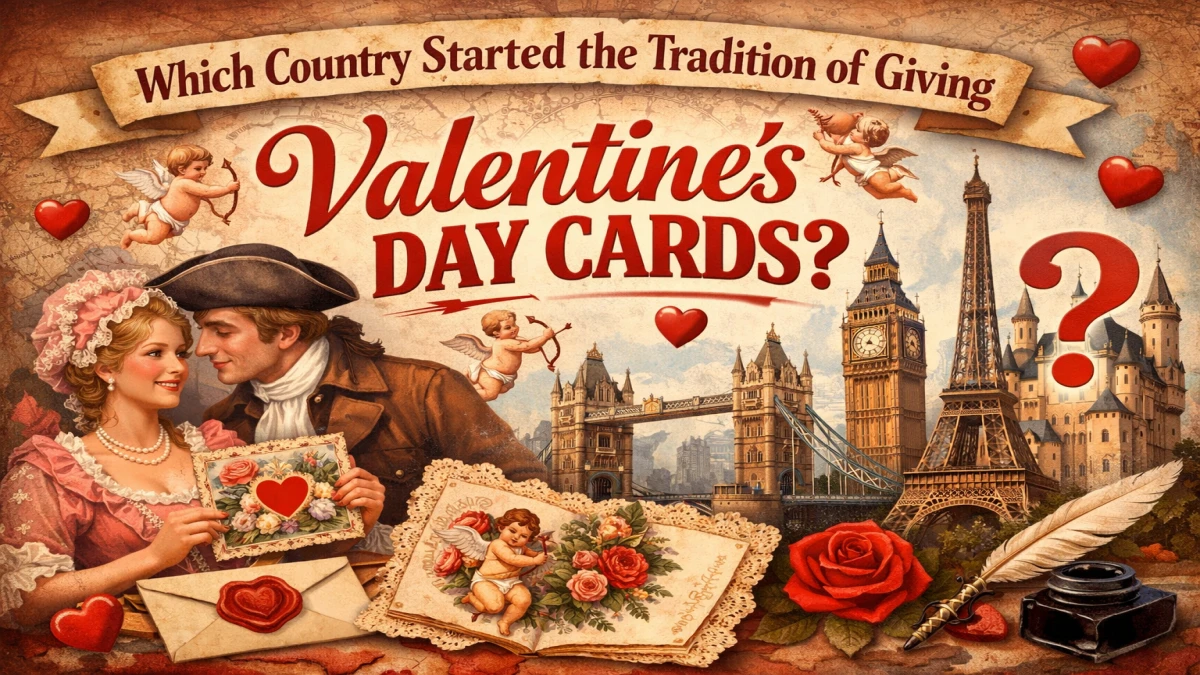

Which Country Started the Tradition of Giving Valentine’s Day Cards?
Every February, people across the world exchange Valentine’s Day cards filled with hearts, romantic notes, and promises of affection. But have you ever wondered which country actually started this tradition? While the very first known Valentine’s note came from a French duke in the 15th century, it was England that turned the act of sending romantic messages into the Valentine’s card-giving custom we know today.
Did Valentine’s Day Cards Really Start in England?
Yes, England is credited as the birthplace of Valentine’s Day cards.
The custom of sending Valentine greetings took shape during England’s late medieval and early modern period, when courtly love poetry was popular among the nobility. One of the earliest known Valentine messages comes from Charles, Duke of Orléans, who in 1415 wrote a poetic letter to his wife while imprisoned in the Tower of London after the Battle of Agincourt. That heartfelt letter, written in French verse, is preserved today in the British Library and often considered one of the first recorded “Valentines” in history.
As literacy grew and paper became more accessible, English lovers began to exchange personal love notes each February 14 — inspired both by romantic poetry and the celebration of St Valentine’s Day.
Early Valentine Messages in Medieval Europe
In the 14th and 15th centuries, Valentine’s messages were part of a larger “courtly love” tradition in both France and England. Aristocrats and poets, like Geoffrey Chaucer, wrote verses linking love with St Valentine’s feast day. These early written expressions weren’t yet “cards” as we know them, but they planted the cultural seeds for the practice.
The oldest surviving example remains the 1415 letter from Charles, Duke of Orléans, which shows that even during wartime, people longed to express affection through words. Over time, such poetic exchanges became common among Europe’s educated classes.
From Handwritten Notes to Valentine’s Day Cards in England
By the 18th century, Valentine’s correspondences had become a popular English pastime. People — especially among the middle and upper classes — crafted handmade valentines decorated with lace, flowers, ribbons, and small paintings.
These cards often included short romantic poems or clever puns, and it was common for senders to deliver them secretly, slipping them under doorways or leaving them unsigned for an air of intrigue. The art of personalizing Valentine notes was highly valued, with each card seen as a one-of-a-kind sentimental keepsake.
Victorian Britain and the Rise of Mass-Produced Valentine Cards
The turning point came in 19th-century Victorian Britain, when industrial printing techniques made it easier to produce cards in bulk. Advances in color printing and the availability of cheap paper allowed Valentine cards to be mass-produced for the first time.
Then came the Penny Post, introduced in 1840, which drastically lowered postage costs and encouraged everyday people to send cards far and wide. Historian sources and greeting card archives note that by the mid-1800s, millions of cards were exchanged annually in Britain. The Valentine craze became a true cultural phenomenon — a mix of romance, creativity, and growing consumerism.
Some Victorian valentines were elaborate works of art featuring lace, embossed paper, feathers, and hidden flaps revealing messages. Others poked gentle fun at love or society’s quirks — a sign that Valentine’s cards had evolved beyond the elite into a broader, playful tradition.
How the Valentine Card Tradition Spread to the United States and Beyond
As British settlers and cultural trends crossed the Atlantic, the Valentine custom found new life in the United States. One woman in particular Esther A. Howland of Massachusetts played a major role in popularizing ornate, handcrafted Valentine cards in America during the 1840s and 1850s.
Howland’s beautiful embossed designs were inspired directly by English cards, and she is often called “the Mother of the American Valentine.” Her work helped launch an entire industry that would eventually lead to commercial card companies like Hallmark in the 20th century. From there, the exchange of Valentine’s cards spread quickly throughout Europe, North America, and beyond, becoming a worldwide tradition of affection and artistry.
Common Myths About Who Invented Valentine’s Cards
- Myth 1: St Valentine himself started the custom.
There’s no evidence that the 3rd-century St Valentine exchanged cards or love notes. His association with romance came long after his death, through medieval literature. - Myth 2: Hallmark invented Valentine’s Day.
Hallmark only began producing Valentine’s cards in the early 20th century — centuries after handwritten and printed cards were already common in England. The real roots of the Valentine card lie firmly in English and French romantic traditions, not corporate marketing.