Optical illusions continue to captivate and challenge us by revealing the clever tricks our brains play on our eyes. In this latest eye test challenge, your mission is to spot the single inverted "500" hidden among hundreds of normal "500"s all in just 7 seconds!
The grid is packed with repeating "500" in bold blue font on a pale background. Everything appears uniform at first glance, but one of them is rotated 180 degrees, turning it upside down. When flipped, it looks strikingly different due to the asymmetry of the digits. Only those with exceptional visual sharpness and quick pattern recognition can find it in time. Ready? Take a deep breath, start your timer, and dive into the puzzle below!
Why It's Challenging
This puzzle is notoriously difficult because it relies on extreme visual repetition and subtle orientation differences. The brain loves efficiency, so when it sees rows of identical "500"s, it quickly assumes uniformity and stops examining each one closely a process called perceptual grouping.
The digits in "500" are not rotationally symmetric: flipping it 180 degrees turns the "5"s into awkward shapes and the "0" remains round, but the overall form becomes obviously alien. Yet the dense arrangement and identical color scheme create perfect camouflage. Under the 7-second limit, most people resort to frantic scanning, which rarely works. The anomaly doesn't "pop out" easily because the difference is in orientation, not color or size, making it a classic example of a hard-to-detect feature in visual search tasks.

Brain Science Explanation
Neuroscientifically, this challenge demonstrates the two-stage model of visual processing. Early stages in the primary visual cortex detect basic features like edges and curves automatically and in parallel across the field. However, detecting a rotated object among upright ones requires focused attention and higher-level processing in areas like the parietal and temporal lobes.
According to Anne Treisman's Feature Integration Theory, simple differences (e.g., color) allow pre-attentive "pop-out," but conjunctions of features here, shape plus specific orientation demand serial attention, scanning one item at a time. The frontal eye fields and superior colliculus guide this spotlight. Additionally, object constancy makes us tolerant to rotations in everyday life, so we must consciously override that bias. People who solve it quickly often have stronger top-down control from the prefrontal cortex.
How to Solve It
Success depends on strategy, not luck. Avoid random eye movements; instead, use a systematic grid search: scan left to right, row by row, like reading text. This maximizes coverage in limited time.
Focus on diagnostic features look for where the open part of the "5" faces the wrong direction or the overall shape appears "backwards." Slightly defocusing your gaze or squinting can help reduce fine-detail overload and make orientation differences more apparent.
Another effective technique: briefly glance at the entire grid with peripheral vision, as anomalies sometimes register there first. Mentally divide the image into quadrants to narrow your search. Practice relaxing under pressure tension narrows your attentional field and slows processing.
Solution Revealed
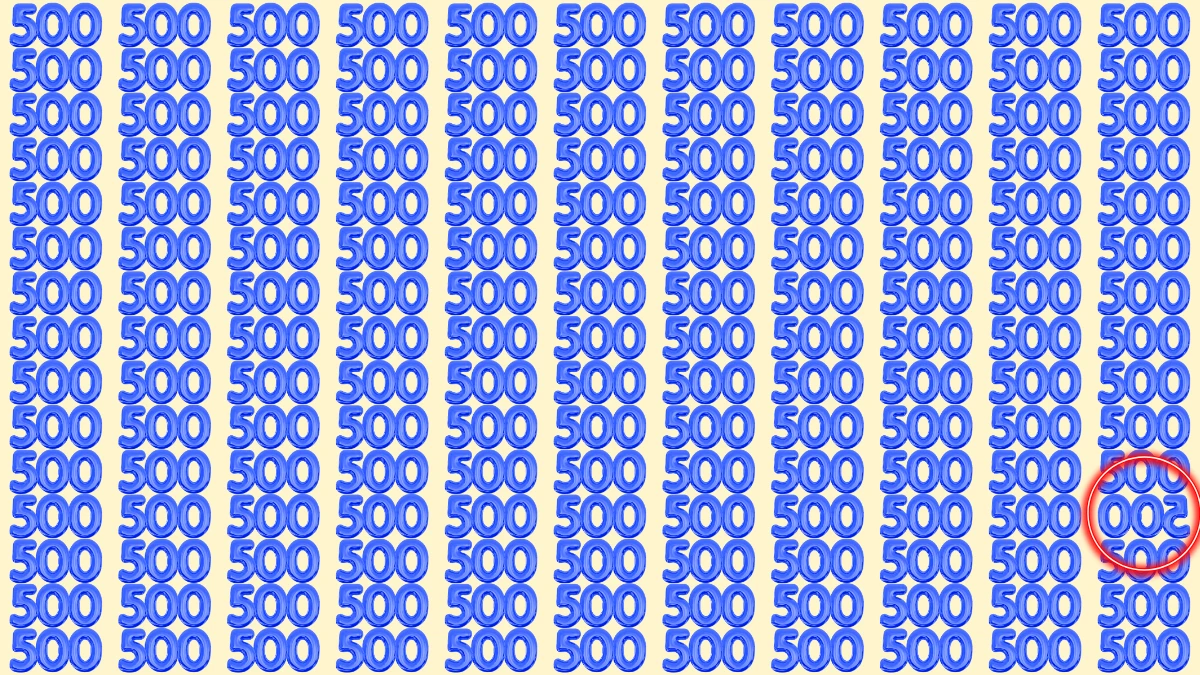
Did you spot it within 7 seconds? The inverted "500" is hidden toward the bottom right of the grid.
When rotated 180 degrees, the normal "500" becomes a distinctly different shape that stands out once highlighted. Here's the same image with the odd one clearly circled for confirmation:
If you found it fast, give yourself a pat on the back that's impressive visual acuity!
What It Reveals About You
Spotting the inverted "500" quickly suggests strong visual discrimination skills and efficient attentional allocation. These traits correlate with higher performance in professions requiring acute observation, such as radiology, quality control, or piloting.
It also indicates good inhibitory control your ability to override the brain's tendency to see everything as the same. Research links frequent engagement with such puzzles to enhanced cognitive flexibility and delayed age-related decline in visual processing speed.
Those who struggle often have a more global processing style rather than detail-oriented, which is equally valuable in creative fields. Ultimately, success here highlights how well your brain can shift from automatic, effortless perception to deliberate, effortful analysis when needed.