
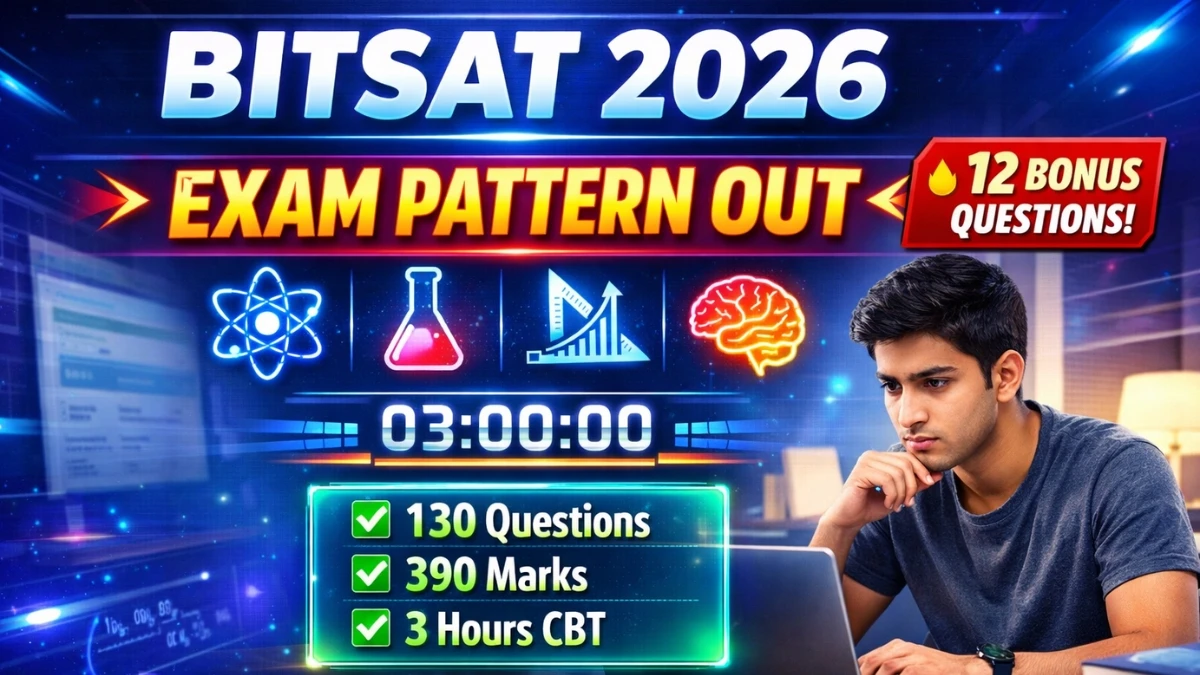
BITSAT Exam Pattern 2026 is an online, computer-based test with multiple-choice questions across Physics, Chemistry, Mathematics/Biology, English Proficiency, and Logical Reasoning, following the pattern used in recent sessions of the Birla Institute of Technology and Science Admission Test (BITSAT). The paper is usually 3 hours long with a fixed number of questions in each section, a total of 390 marks, and a strict negative marking scheme, so understanding the exact structure is critical for planning speed, accuracy and topic-wise preparation.
BITSAT 2026 will be conducted by Birla Institute of Technology and Science (BITS), Pilani, as a computer-based entrance test for admission to integrated first-degree programmes at BITS campuses. The test is objective in nature, with a single paper divided into four parts and a fixed time limit of 3 hours, with no scheduled break.
BITSAT 2026 – Overview
| Particulars | Details (BITSAT Exam Pattern 2026) |
|---|---|
| Exam Name | Birla Institute of Technology and Science Admission Test (BITSAT) 2026 |
| Conducting Body | Birla Institute of Technology and Science (BITS), Pilani |
| Exam Mode | Online Computer-Based Test (CBT) |
| Question Type | Objective Multiple Choice Questions (MCQs) |
| Sections in Exam | Physics, Chemistry, Mathematics/Biology, English Proficiency, Logical Reasoning |
| Total Number of Questions | 130 questions (as per recent official pattern) |
| Total Marks | 390 marks (3 marks for each correct answer) |
| Exam Duration | 3 hours (180 minutes) |
| Negative Marking | 1 mark deducted for each incorrect answer |
| Extra Questions | Additional questions may be offered after completing all 130 (as per pattern) |
| Official Website | bitsadmission.com |
(Place “BITSAT 2026 Information Brochure / Exam Pattern PDF” and “BITSAT 2026 Apply Online” links right below this table when officially released.)
BITSAT Exam Pattern 2026 – Section-wise Questions and Marks
BITSAT is a single paper divided into four parts. Three parts focus on core science subjects (Physics, Chemistry, Mathematics/Biology), while the fourth part tests English Proficiency and Logical Reasoning. The relative weight of each section is fixed and must guide your preparation.
BITSAT 2026 Exam Pattern – Section-wise Structure
| Part | Subject / Section | Number of Questions | Marks per Question | Total Marks |
|---|---|---|---|---|
| Part I | Physics | 30 | 3 | 90 |
| Part II | Chemistry | 30 | 3 | 90 |
| Part III | English Proficiency | 10 | 3 | 30 |
| Part III | Logical Reasoning | 20 | 3 | 60 |
| Part IV | Mathematics (PCM) / Biology (PCB) | 40 | 3 | 120 |
| Total | 130 | – | 390 | |
BITSAT Marking Scheme 2026
BITSAT uses a high-reward, high-penalty marking system, which heavily influences your attempt strategy.
| Response Type | Marks Awarded |
|---|---|
| Correct answer | +3 marks |
| Incorrect answer | -1 mark |
| Unattempted question | 0 marks |
In recent years, BITS has also allowed extra questions beyond the main 130 questions once a candidate attempts all of them, with the same +3/-1/0 rules. This can boost scores but also raises the risk of losing marks through mistakes, so it should be used only if you are confident and fast.
A few strategy points:
- Avoid blind guessing; attempt questions where you can eliminate at least 2 options.
- Focus on accuracy first, then speed, since negative marking can drag down an otherwise good attempt.
- Use mock tests in full 3-hour format to learn how many questions you can safely attempt at your current accuracy level.
BITSAT 2026 Exam Pattern for PCM and PCB Candidates
The overall structure is identical for PCM (Engineering aspirants) and PCB (Pharmacy or allied) candidates, except for Part IV.
PCM vs PCB Pattern in BITSAT 2026
| Stream Type | Part I | Part II | Part III | Part IV | Total Questions / Marks |
|---|---|---|---|---|---|
| PCM | Physics | Chemistry | English Proficiency + Logical Reasoning | Mathematics | 130 questions / 390 marks |
| PCB | Physics | Chemistry | English Proficiency + Logical Reasoning | Biology | 130 questions / 390 marks |
- PCM candidates mainly target B.E./B.Tech programmes and therefore get Mathematics in Part IV.
- PCB candidates typically target B.Pharm or related programmes and attempt Biology instead of Mathematics.
BITSAT 2026 Exam Duration and Mode
- Duration: The test is of 3 hours (180 minutes) continuous, with no scheduled breaks.
- Mode: BITSAT is held as an online computer-based test at designated test centres.
- Navigation: Candidates can move back and forth between questions and sections, mark questions for review and change answers within the 3-hour timeframe. Effective time management across sections is therefore crucial.
BITSAT Syllabus and Its Link with Exam Pattern 2026
The BITSAT syllabus is broadly based on the NCERT Class 11 and 12 syllabus for Physics, Chemistry, Mathematics and Biology, plus sections on English usage and Logical Reasoning. Because the exam is speed-intensive with many questions, the pattern amplifies your command over core NCERT topics, your ability to apply concepts quickly to objective questions, and your comfort with English comprehension, grammar, vocabulary and puzzle-type reasoning questions.
Download BITSAT Syllabus PDF: Click Here
A good preparation strategy should therefore map the BITSAT syllabus to this pattern: prioritising strong coverage of high-weight topics, regular timed practice, and section-wise mock tests that mirror the actual structure.