
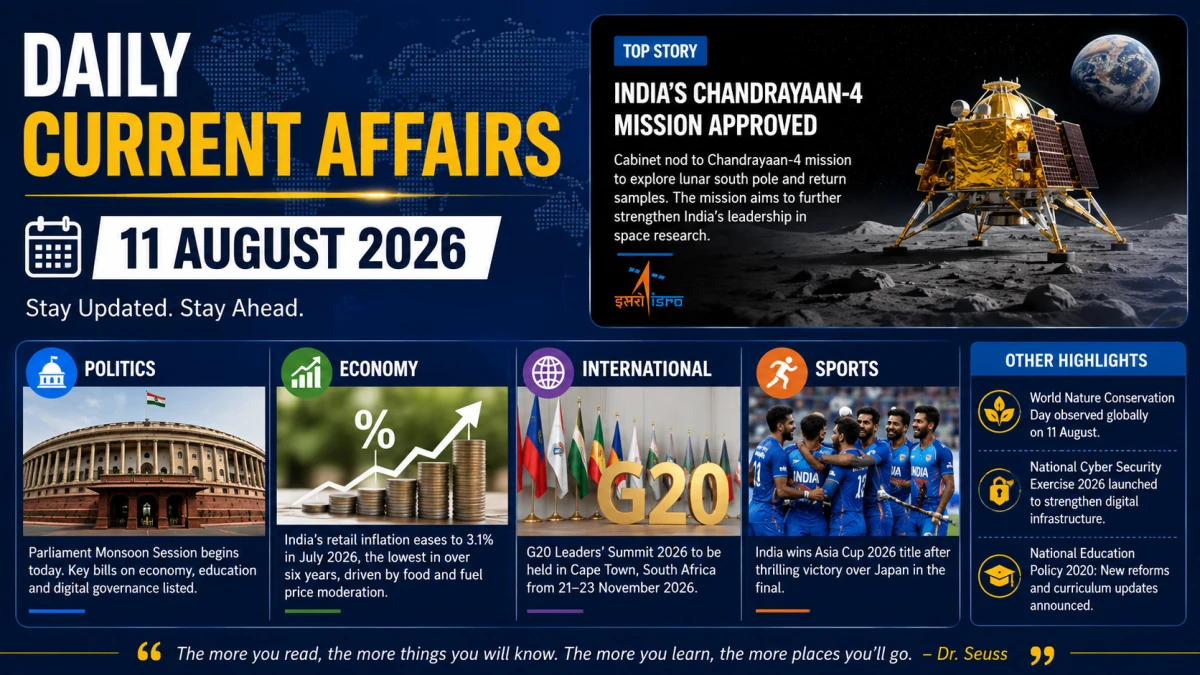
Staying updated with today's current affairs is essential for competitive exam aspirants preparing for SSC, UPSC, Banking, State PSCs, and Railway exams. The 11 August 2026 current affairs cover the Lok Sabha passing the Tribunals Reforms Bill 2026, India's Asiatic Lion population reaching 891 (16th Population Estimation), HAL reviving the Su-30MKI production line at Nashik, Sarla Aviation getting DGCA Design Organisation Approval, Centre opposing creamy layer extension to SCs/STs before the Supreme Court, Chandipura Virus outbreak response in Gujarat and Rajasthan, NASI Young Scientist Award to IIT Bombay's Karthikeyan Lanka, RBI's polymer banknote plan from FY28, Tamil Nadu's paddy-sugarcane procurement incentives, and India's 79th Independence Day countdown important days - Partition Horrors Remembrance Day and Independence Day - that frequently appear in the General Awareness section of government exams.
India – National Current Affairs
- Lok Sabha Passes Tribunals Reforms Bill, 2026 - Proposes Independent National Tribunals Commission – The Lok Sabha passed the Tribunals Reforms Bill, 2026, in New Delhi on 10 August 2026 during the Monsoon Session of Parliament. The Bill proposes the establishment of an independent National Tribunals Commission (NTC) as an umbrella oversight body for all central tribunals in India, addressing longstanding concerns about delayed appointments, inadequate infrastructure, and lack of uniformity in tribunal functioning. Exam importance: India has approximately 45+ central tribunals including NCLAT (National Company Law Appellate Tribunal), SAT (Securities Appellate Tribunal), TDSAT (Telecom Disputes Settlement & Appellate Tribunal), CESTAT (Customs Excise & Service Tax Appellate Tribunal), ITAT (Income Tax Appellate Tribunal), NGT (National Green Tribunal), AFT (Armed Forces Tribunal), and others; the Supreme Court had in various judgments (including the L. Chandra Kumar case, 1997) laid down guidelines for tribunal reforms; the Bill implements several key recommendations from the Madras HC's orders and the Law Commission's 272nd Report on tribunal reforms; the NTC will manage appointments, service conditions, infrastructure, and performance monitoring for all central tribunals; Union Minister of Law and Justice: Arjun Ram Meghwal.
- India's Asiatic Lion Population Reaches 891 in 2025 - Highest Ever; 16th Population Estimation Released – India's Asiatic lion population increased from 523 in 2015 to 891 in 2025, as recorded in the 16th Asiatic Lion Population Estimation released by the Gujarat Forest Department on 10 August 2026. This represents a 70.4% increase over a decade, making the Asiatic lion one of the world's greatest conservation success stories. Exam importance: The Asiatic Lion (Panthera leo persica) is found exclusively in the Gir landscape in Gujarat, India - making Gir the world's last refuge for this subspecies; the lion is classified as Endangered on the IUCN Red List; 2025 census: 891 lions (+6.1% from 2020 census of 674); the 2025 count was conducted in May 2025 covering the Greater Gir area (approximately 30,000 sq km across Gir National Park & Wildlife Sanctuary, Girnar Wildlife Sanctuary, Mitiyala Wildlife Sanctuary, and coastal areas); Project Lion was announced by PM Modi on 15 August 2020; Asiatic Lion is the State Animal of Gujarat; MoEFCC Minister: Bhupendra Yadav; Gir National Park is in Junagadh district, Gujarat.
- HAL Revives Su-30MKI Production Line at Nashik for 12 New Fighter Aircraft – Hindustan Aeronautics Limited (HAL) revived the Su-30MKI production line at its Aircraft Division in Nashik, Maharashtra, covering 12 new Su-30MKI fighter aircraft for the Indian Air Force. Exam importance: The Su-30MKI (Sukhoi Super-30) is India's principal frontline twin-engine multirole fighter aircraft, developed jointly by HAL and Russia's Sukhoi Design Bureau; India has approximately 260+ Su-30MKIs (the world's largest Su-30MKI fleet); the Nashik facility had completed the original production run but is now reviving to produce additional aircraft; the Su-30MKI is armed with BrahMos cruise missiles, R-77 air-to-air missiles, and carries Astra missiles (India's indigenous BVR missile); HAL CMD: C.B. Ananthakrishnan; HAL was established in 1940; HQ: Bengaluru; the revival aligns with India's plans to upgrade the fleet with upgraded AESA radar and new avionics under the MK1A standard.
- Sarla Aviation Receives DGCA Design Organisation Approval (DOA) – Sarla Aviation received Design Organisation Approval (DOA) from the Directorate General of Civil Aviation (DGCA) on 8 August 2026. The approval was handed over by Union Civil Aviation Minister Kinjarapu Ram Mohan Naidu to Sarla Aviation, enabling the startup to design and certify its own aerospace products in India. Exam importance: DOA (Design Organisation Approval) is a regulatory certification granted by DGCA under the Aircraft Act, 1934 and Civil Aviation Requirements (CAR-21) framework; it allows an organisation to design, modify, and certify aircraft and aircraft components; Sarla Aviation is an Indian eVTOL (electric Vertical Take-Off and Landing) and aviation startup focused on developing electric aircraft for regional and urban air mobility; this DOA makes Sarla Aviation one of India's first private aviation startups to receive this regulatory approval; DGCA Director General: Vikram Dev Dutt; Union Minister of Civil Aviation: K. Ram Mohan Naidu.
- Centre Opposes Extending Creamy Layer Principle to Scheduled Castes and Scheduled Tribes Before SC – The Union government told the Supreme Court on 8 August 2026 that the creamy layer principle should not be extended to Scheduled Castes (SCs) and Scheduled Tribes (STs), arguing that SCs/STs face systematic discrimination and socio-economic disadvantages that are distinct from the OBC (Other Backward Classes) category for which the creamy layer principle was established. Exam importance: The Creamy Layer concept was introduced for OBCs following the Indra Sawhney case (1992) where the Supreme Court upheld the 27% OBC reservation but excluded the "creamy layer" (economically advanced within OBCs) from reservation benefits; currently, the annual income threshold for OBC creamy layer is ₹8 lakh per year; the Supreme Court in the Jarnail Singh vs. Lachhmi Narain Gupta (2018) directed states to examine creamy layer for SCs/STs in promotions; the Centre's opposition reaffirms the constitutional position that SCs/STs are a distinct category whose reservation is based on social and historical discrimination rather than backwardness alone; Article 16(4) and 16(4A) provide for reservation and promotion reservation for SCs/STs respectively.
- Health Ministry Deploys NJORT for Chandipura Virus Outbreak in Gujarat and Rajasthan – The Health Ministry deployed NJORT to Gujarat and Rajasthan for the Chandipura virus outbreak. Exam importance: NJORT (National Joint Outbreak Response Team) is a rapid response team deployed by the Union Ministry of Health and Family Welfare (MoHFW) for disease outbreak investigation and containment; Chandipura Virus Disease (CPVD) is a rare but often fatal viral illness caused by Chandipura vesiculovirus, primarily affecting children below 15 years; it was first isolated in 1965 in Chandipura village, Nagpur, Maharashtra; the virus is transmitted through sandfly bites (Phlebotomus sp.) and can also spread through Aedes aegypti mosquitoes; outbreaks have occurred in Gujarat, Maharashtra, and Andhra Pradesh; the 2026 outbreak in Gujarat and Rajasthan is being investigated for its spread; India's Integrated Disease Surveillance Programme (IDSP) under ICMR coordinates outbreak surveillance; fatality rate can be very high (up to 75%+ in children).
- Centre Launches 'SAATHI' Scheme for Textile Workers' Social Security – Union Minister Giriraj Singh (Textiles) launched the SAATHI (Supporting Advancement of All Textile and Handloom Industries) scheme on 10 August 2026 to provide comprehensive social security coverage - including health insurance, life insurance, and pension benefits - to all workers in the textile and handloom sector, including power loom, handloom, and apparel workers, who are often employed in the informal sector. Exam importance: India's textile sector employs approximately 4.5 crore people directly and 6 crore indirectly; most are unorganised/informal workers without formal social security; SAATHI integrates with EPFO, ESIC, and PM-SYM (Pradhan Mantri Shram Yogi Maandhan) to provide comprehensive coverage; Union Minister of Textiles: Giriraj Singh; this complements the PLI Scheme for Textiles and the National Textile Policy target of USD 100 billion textile exports by 2030.
11 August 2026 Current Affairs - Download Free PDF Now
Economy & Banking
- RBI Plans to Introduce Polymer Banknotes from FY2027-28 – The Reserve Bank of India announced plans to introduce polymer banknotes in India from FY2027-28 (starting April 2027), initially for the ₹10 and ₹20 denominations, as part of a pilot programme to assess durability, counterfeiting resistance, and public acceptance before a full-scale national rollout. Exam importance: Polymer banknotes use a biaxially oriented polypropylene (BOPP) substrate rather than cotton-linen paper; they are more durable (approximately 4x longer lifespan), harder to counterfeit, and can be recycled; countries that use polymer notes: Australia (first, 1988), UK, Canada, New Zealand, Singapore, and approximately 22 other countries; India's current banknotes are made from cotton-linen composite paper; RBI previously piloted polymer notes in 2013 (₹10 denomination) but the pilot was discontinued; RBI Governor: Sanjay Malhotra; India prints approximately 16-20 billion banknotes annually at the Security Printing and Minting Corporation of India Limited (SPMCIL) and the Bharatiya Reserve Bank Note Mudran Private Limited (BRBNMPL) facilities.
- IIT Bombay's Prof. Karthikeyan Lanka Wins NASI Young Scientist Platinum Jubilee Award 2026 in Earth Sciences – Prof. Karthikeyan Lanka of IIT Bombay was honoured with the National Academy of Sciences India (NASI) Young Scientist Platinum Jubilee Award 2026 in Earth Sciences for his research on the role of soil moisture in shaping Indian monsoon patterns, heatwaves, and agricultural droughts. Exam importance: The NASI Young Scientist Platinum Jubilee Award is conferred annually by the National Academy of Sciences, India (NASI) - India's oldest science academy, established in 1930 in Allahabad; his research involves developing a subseasonal drought forecasting system with the Mahalanobis National Crop Forecast Centre (MNCFC); IIT Bombay was established in 1958; Director: Shireesh Kedare; the award is highly significant for competitive exams as it highlights cutting-edge Indian science.
- India's Organic Products Exhibition at India Expo Centre Mart (6–8 August 2026) Concludes – The event was held from August 6 to 8 at the India Expo Centre and Mart. Over 200 companies and 35 international buyers participated in the exhibition. The APEDA pavilion showcased organic products from various Indian states and FPOs. Structured buyer-seller meets aimed to boost exports and global market linkages. Exam importance: India is the world's largest producer of certified organic produce in terms of the number of producers (approximately 22 lakh producers); India's organic food export was USD 1.5 billion in FY26 (target: USD 5 billion by 2030); APEDA (Agricultural and Processed Food Products Export Development Authority) is under the Ministry of Commerce and Industry; National Programme for Organic Production (NPOP) and Participatory Guarantee System (PGS-India) are India's two organic certification frameworks.
Science & Technology
- IIT Guwahati Develops 'E-Eye' Toxicant Sensor for Rapid Water Contamination Detection – IIT Guwahati developed the E-Eye toxicant sensor for rapid water contamination detection. The sensor uses AI-powered electrochemical analysis to detect heavy metals, pesticides, and organic pollutants in water samples within minutes, offering an affordable alternative to laboratory-based water quality testing. Exam importance: IIT Guwahati was established in 1994; Director: Devendra Jalihal; the E-Eye sensor addresses India's critical water quality challenge - approximately 60% of India's water bodies are contaminated (CPCB data); the Jal Jeevan Mission (JJM) targets providing safe piped drinking water to all households by 2024 (extended in some states to 2026); the sensor aligns with the Smart Water Supply scheme and FSSAI's water quality norms; key water contaminants in India: arsenic (West Bengal, Bihar, Assam), fluoride (Rajasthan, UP), nitrates (Punjab), and heavy metals (industrial zones).
- Bengaluru City Police Launches Operation Mukta for Illegal Immigrants – The Bengaluru City Police launched Operation Mukta on 8 August 2026 to identify and track suspected illegal immigrants across the city. The drive focused on suspected Bangladeshi nationals. Exam importance: Operation Mukta (Mukta means "free/liberated" in Sanskrit) is a police-led verification drive under Sections 14 and 14A of the Foreigners Act, 1946; it builds on Operation Pushback (2024) and aligns with MHA's National Register of Citizens (NRC) framework; the operation involves local intelligence units, the Foreigners Regional Registration Office (FRRO), and district administration; Bengaluru Police Commissioner: B. Dayananda; illegal migration from Bangladesh is a longstanding concern in eastern and southern India, particularly in West Bengal, Assam, Tripura, and now Karnataka; the Citizenship Amendment Act (CAA), 2019 and NRC are the overarching national frameworks.
- Maharashtra's Punyashlok Ahilyadevi Holkar Shetkari Karj-Mafi Yojana Begins Cash Transfers – Maharashtra began direct cash transfers under the Punyashlok Ahilyadevi Holkar Shetkari Karj-Mafi Yojana on 7 August 2026. The first phase covered more than 6.2 lakh eligible farmer accounts. Exam importance: Punyashlok Ahilyadevi Holkar was a legendary Maratha ruler of the Holkar dynasty (1767-1795) renowned for her administrative brilliance and welfare works; the scheme honours her legacy by providing loan waivers to distressed farmers in Maharashtra; the first phase releases approximately ₹5,000 crore in debt relief to 6.2 lakh farmers; Maharashtra CM: Devendra Fadnavis (BJP-led Mahayuti alliance); Maharashtra has approximately 1.7 crore farmer families; agricultural debt relief schemes have been a recurring political promise in Maharashtra given the state's recurring farmer distress and high suicide rates.
International Affairs
- IIFF 2026 Concludes - 10th India International Footwear Fair – The 10th India International Footwear Fair (IIFF) 2026 was held at Bharat Mandapam, New Delhi, from 6 August to 8 August 2026. The three-day business-to-business exhibition was organised by the Council for Leather Exports (CLE) in association with APEDA. Exam importance: The IIFF is India's flagship footwear and leather goods exhibition; India is the world's 2nd largest footwear producer (after China) and 2nd largest leather goods producer; India's footwear exports: approximately USD 2.4 billion annually; major footwear clusters: Agra (UP), Chennai (TN), Kolkata (WB), Kanpur (UP), and Gurugram (Haryana); CLE (Council for Leather Exports) is under the Ministry of Commerce and Industry; India's leather sector employs approximately 42 lakh people, predominantly from SC/ST communities.
Sports & Important Days
- India's 79th Independence Day Approaching - Har Ghar Tiranga 3.0 (9–17 August) – The nationwide campaign will be conducted from 9 August to 17 August 2026 as part of the Har Ghar Tiranga 3.0 campaign. This edition marks 150 years of Vande Mataram via mass singing events. The Suryapath Tiranga relay will connect Indian Missions globally. Partition Horrors Remembrance Day on August 14 recalls the suffering of millions. Exam importance: India's 79th Independence Day will be observed on 15 August 2026; PM Modi will hoist the national flag at Red Fort, New Delhi, and address the nation; the 150th anniversary of Vande Mataram (composed by Bankim Chandra Chattopadhyay in 1876) is being commemorated through mass singing events; the Partition Horrors Remembrance Day (14 August) was first observed in 2021 to commemorate the pain and suffering inflicted by the partition of India in 1947; the Suryapath Tiranga relay involves Indian diplomatic missions globally carrying the tricolour as a symbol of unity.
- 11 August - Small Industry Day 2026 – National Small Industry Day recognises the role of Small Scale Industries in generating employment, promoting entrepreneurship and strengthening India's economic development. Exam importance: Small Industry Day is observed on 11 August every year, coinciding with the date when the government announced the comprehensive policy package for Small Scale Industries (SSIs) in 2001; the Ministry of MSME oversees small industry development; India has approximately 8.7 crore MSME entities (Udyam portal); MSMEs contribute approximately 30% to India's GDP and 45% to exports; Union Minister of MSME: Jitan Ram Manjhi; Udyam Registration Portal was launched in 2020 replacing the Udyog Aadhaar system.
- 12 August - World Elephant Day 2026 – World Elephant Day is observed annually on 12 August to raise awareness about the conservation of both African and Asian elephants. The 2026 theme is "Guardians of the Green." Exam importance: World Elephant Day was founded in 2012 by Patricia Sims and the Elephant Reintroduction Foundation; first observed on 12 August 2012; there are approximately 3,40,000-3,50,000 African elephants (African bush elephant + African forest elephant) and approximately 40,000-50,000 Asian elephants globally; India has approximately 29,964 wild elephants (2017 census - the most recent official count) - the largest Asian elephant population in the world; the Asian Elephant is classified as Endangered on the IUCN Red List; Project Elephant was launched in 1992 under MoEFCC; Union Minister of Environment: Bhupendra Yadav.