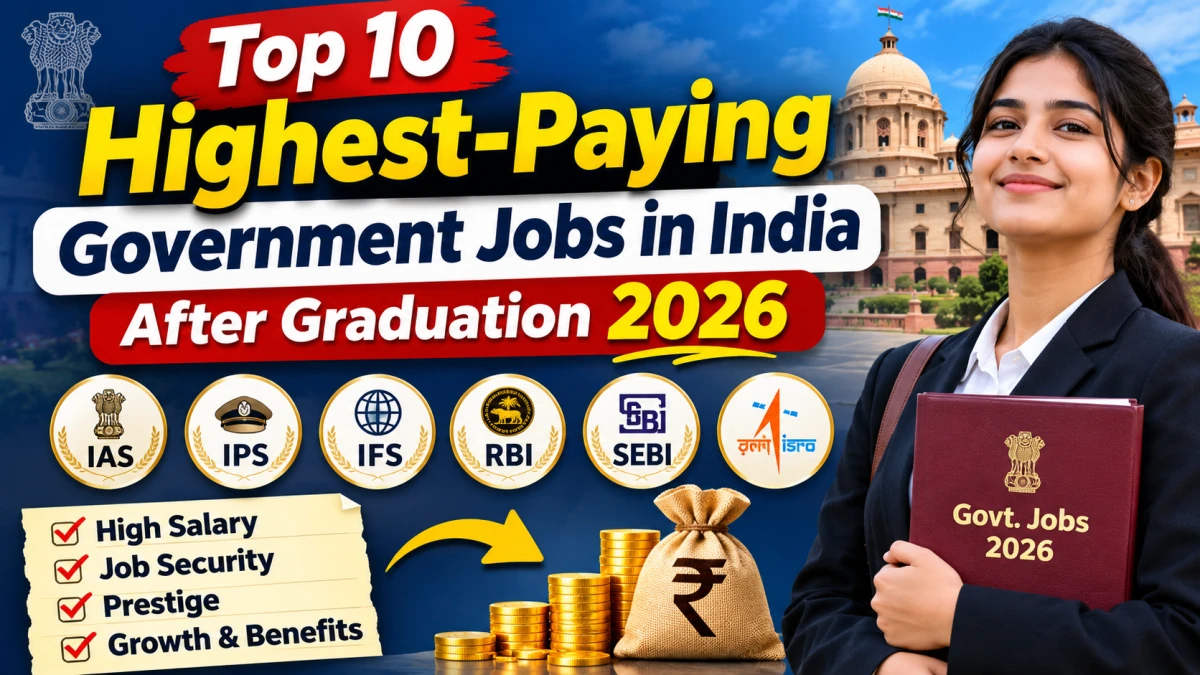
Which government job offers the highest salary after graduation? For thousands of students preparing for competitive examinations in India, this question is just as important as eligibility, job security and career growth. While IAS and IPS remain popular choices, positions in the Reserve Bank of India (RBI), Securities and Exchange Board of India (SEBI), public sector undertakings and scientific organisations also offer attractive starting salaries.
Some of these jobs offer starting basic pay above Rs. 60,000 per month, while total monthly earnings can be considerably higher after adding allowances. However, salary is only one part of the picture. Educational qualifications, selection difficulty, promotions, transfers and job responsibilities also influence whether a particular career is right for a graduate.
Here are 10 high-paying government and public-sector jobs in India in 2026, including their starting basic salaries, educational qualifications, selection procedures, benefits and career prospects. This guide also explains which jobs are suitable for general graduates and which require specialised qualifications.
Important: The salaries mentioned below are starting monthly basic pay figures from published pay scales. Gross salary and take-home salary vary according to allowances, deductions, postings and applicable service rules. Recruitment eligibility must be checked against the latest official notification.
Top 10 Highest-Paying Government Jobs in India 2026: Salary Comparison
Government jobs offer different compensation structures depending on the department, organisation and service. The following table compares selected entry-level positions using their published basic pay rather than mixing basic salaries with gross compensation or CTC.
| Rank | Government Job | Starting Basic Pay (Monthly) | Recruitment / Selection |
|---|---|---|---|
| 1 | RBI Grade B Officer | Rs. 78,450 | RBI Grade B Recruitment |
| 2 | SEBI Grade A Officer | Rs. 62,500 | SEBI Grade A Recruitment |
| 3 | ONGC E1 Executive | Rs. 60,000 | ONGC Recruitment |
| 4 | IAS Officer | Rs. 56,100 | UPSC Civil Services |
| 5 | Indian Foreign Service Officer | Rs. 56,100 | UPSC Civil Services |
| 6 | IPS Officer | Rs. 56,100 | UPSC Civil Services |
| 7 | ISRO Scientist/Engineer-SC | Rs. 56,100 | ISRO Recruitment |
| 8 | IRS Officer | Rs. 56,100 | UPSC Civil Services |
| 9 | SSC CGL Assistant Audit Officer | Rs. 47,600 | SSC CGL |
| 10 | NABARD Grade A Assistant Manager | Rs. 44,500 | NABARD Grade A Recruitment |
How we selected these jobs: This list highlights 10 established government, regulatory and public-sector career options with competitive published entry-level pay. The positions are arranged by starting basic pay, with equal-pay jobs ordered for presentation. It is not an exhaustive ranking of every government job in India. Other specialised services, judicial positions and public-sector roles may also offer competitive compensation.
10. NABARD Grade A Assistant Manager – Salary, Eligibility and Career Growth
The National Bank for Agriculture and Rural Development (NABARD) offers an attractive career for graduates interested in banking, finance, agriculture and rural development. Unlike conventional banking roles, NABARD officers work on projects involving rural credit, financial development, institutional supervision and agricultural infrastructure.
According to the published NABARD Grade A recruitment pay scale, an Assistant Manager begins with a basic salary of Rs. 44,500 per month. The 2025 recruitment notice indicated approximate initial gross monthly emoluments of Rs. 1 lakh, including applicable allowances. Actual remuneration can change with allowances and service conditions.
NABARD Grade A Job Details
- Post: Assistant Manager Grade A
- Starting basic salary: Rs. 44,500 per month
- Qualification: Relevant bachelor's degree, postgraduate degree or professional qualification as specified for the recruitment stream
- Selection process: Preliminary examination, main examination and subsequent assessment/interview stages as notified
- Job responsibilities: Rural finance, project appraisal, development programmes and institutional supervision
- Benefits: Applicable allowances, medical benefits, leave facilities and other institutional benefits
NABARD is worth considering for candidates who want to combine financial knowledge with development-oriented work. Officers can gain experience in rural financing and economic development, with opportunities to progress into senior management roles.
Who should consider this job? Candidates interested in banking, economics, rural development and public finance.
9. SSC CGL Assistant Audit Officer – A High-Paying Central Government Job
The Staff Selection Commission Combined Graduate Level Examination (SSC CGL) is one of India's most popular competitive examinations. It offers recruitment to a wide variety of central government posts, including Assistant Audit Officer positions in the Indian Audit and Accounts Department.
Under the SSC CGL 2026 notification, the Assistant Audit Officer post falls under Pay Level 8, with a basic pay range of Rs. 47,600 to Rs. 1,51,100. The entry-level basic salary is Rs. 47,600 per month, excluding allowances.
SSC CGL Assistant Audit Officer Job Details
- Post: Assistant Audit Officer
- Starting basic salary: Rs. 47,600 per month
- Pay level: Level 8
- Qualification: Recognised bachelor's degree, subject to the official post-specific eligibility rules
- Selection: SSC CGL examination and any applicable additional requirements
- Job responsibilities: Auditing government accounts, financial examination and compliance-related work
- Benefits: Dearness Allowance, House Rent Allowance, Transport Allowance and other eligible benefits
Assistant Audit Officers play an important role in examining the use of public funds. Their work contributes to accountability across government institutions and departments.
This job can appeal to commerce and accounting graduates, but applicants from other eligible disciplines should also examine the qualification requirements in the recruitment notification.
Who should consider this job? Graduates interested in government accounting, auditing and financial administration.
8. Indian Revenue Service (IRS) Officer – Salary and Career Opportunities
The Indian Revenue Service (IRS) is a Group A civil service associated with India's tax and revenue administration. IRS officers serve in functions involving income tax, indirect taxes, customs, investigation and regulatory administration, depending on their service allocation.
The entry-level basic pay for IRS officers under Pay Level 10 starts at Rs. 56,100 per month. Eligible government allowances are provided separately under applicable rules.
IRS Officer Job Details
- Starting basic salary: Rs. 56,100 per month
- Pay level: Level 10
- Qualification: Recognised bachelor's degree
- Selection process: UPSC Civil Services Examination
- Job responsibilities: Tax administration, compliance, investigation and revenue functions
- Career growth: Opportunities to progress into senior revenue administration positions
IRS officers may work on complex financial matters involving tax compliance, enforcement, administration and policy implementation. The role demands analytical skills, professional judgment and a strong understanding of applicable laws.
Although its starting basic pay is similar to several other Group A services, the IRS provides a distinct career path for candidates interested in economics, finance and taxation.
Who should consider this job? Graduates interested in taxation, economics, law and financial administration.
7. ISRO Scientist/Engineer – High-Paying Technical Government Career
The Indian Space Research Organisation (ISRO) is among India's most prestigious scientific organisations. It offers opportunities for engineering and science graduates to contribute to satellites, spacecraft, launch vehicles, remote sensing and other major research and development programmes.
The Scientist/Engineer-SC post generally carries Pay Level 10, with starting basic pay of Rs. 56,100 per month. Applicable allowances and other benefits are provided according to government and organisational rules.
ISRO Scientist/Engineer Job Details
- Post: Scientist/Engineer-SC
- Starting basic salary: Rs. 56,100 per month
- Pay scale: Rs. 56,100 to Rs. 1,77,500
- Qualification: Relevant engineering or other specified technical qualification
- Selection process: Written examination, GATE-based shortlisting and/or interview, depending on the recruitment
- Job responsibilities: Research, development, testing, engineering and technical operations
ISRO scientists and engineers work in highly specialised technical environments. Their assignments may involve developing complex systems, analysing experimental results or supporting national space missions.
Beyond salary, this career offers an opportunity to develop specialised scientific expertise and participate in projects with national importance.
Who should consider this job? Engineering graduates and eligible science professionals interested in space research and advanced technology.
6. Indian Police Service (IPS) Officer – Salary, Benefits and Responsibilities
The Indian Police Service (IPS) is one of India's most recognised civil services. IPS officers occupy leadership positions in policing, public safety, internal security and law enforcement.
An entry-level IPS officer generally starts at Rs. 56,100 basic pay per month under Pay Level 10. The total remuneration depends on the posting, allowances and applicable official facilities.
IPS Officer Job Details
- Starting basic salary: Rs. 56,100 per month
- Qualification: Recognised bachelor's degree
- Selection process: UPSC Civil Services Examination and prescribed medical/physical standards
- Job responsibilities: Police leadership, public safety, investigation oversight and security administration
- Benefits: Eligible allowances, official accommodation and facilities according to service rules
IPS officers may work in district policing, intelligence, specialised investigation, security organisations and senior administrative positions. Their responsibilities can involve managing large teams and making decisions under demanding circumstances.
Prospective candidates should understand that the job can involve challenging assignments, long working hours and high levels of responsibility.
Who should consider this job? Graduates seeking leadership opportunities in law enforcement, security and public service.
5. Indian Foreign Service Officer – Salary and International Career Opportunities
The Indian Foreign Service (IFS) offers graduates the opportunity to represent India internationally. Officers work in Indian embassies, high commissions, consulates, multilateral institutions and the Ministry of External Affairs.
The starting basic salary for a junior-scale Indian Foreign Service officer is Rs. 56,100 per month under Pay Level 10. Officers posted abroad may receive additional foreign allowances and facilities, governed by separate rules and posting conditions.
Indian Foreign Service Job Details
- Starting basic salary: Rs. 56,100 per month
- Qualification: Recognised bachelor's degree
- Selection process: UPSC Civil Services Examination
- Job responsibilities: Diplomacy, international relations, consular services and foreign policy
- Benefits: Applicable domestic allowances and overseas posting benefits
An Indian Foreign Service career can involve negotiating international agreements, assisting Indian citizens abroad, reporting political and economic developments, and strengthening bilateral relations.
Foreign postings and associated benefits can make this an attractive career. However, international assignments may also require frequent relocation, cultural adaptability and demanding professional commitments.
Who should consider this job? Graduates interested in international affairs, diplomacy, languages and foreign policy.
4. Indian Administrative Service (IAS) Officer – Salary and Career Growth
The Indian Administrative Service (IAS) remains one of India's most sought-after career options. IAS officers work across district administration, government departments, public policy, development programmes and senior administrative functions.
The starting basic salary of an IAS officer is generally Rs. 56,100 per month under Pay Level 10. Eligible allowances and official facilities are provided according to the officer's posting and applicable rules.
IAS Officer Job Details
- Starting basic salary: Rs. 56,100 per month
- Pay level: Level 10
- Qualification: Bachelor's degree from a recognised institution
- Selection process: UPSC Civil Services Preliminary Examination, Main Examination and Personality Test
- Job responsibilities: District administration, policy implementation and public programme management
- Career growth: Senior positions in state and central government administration, subject to service rules
IAS officers are often responsible for implementing government programmes, coordinating administrative departments and responding to public needs. The range of responsibilities can expand significantly with experience.
Although IAS does not have the highest starting basic salary among the careers listed here, it offers a distinctive combination of administrative responsibility, public service and career progression.
Who should consider this job? Graduates interested in public administration, governance and leadership.
3. ONGC Executive – High-Paying PSU Career for Graduates
Oil and Natural Gas Corporation (ONGC) is a major public sector energy company offering employment opportunities in engineering, exploration, geology, finance, human resources and other professional functions.
ONGC's published E1 executive pay scale begins at Rs. 60,000 per month, with a scale extending to Rs. 1,80,000. The exact entry grade, compensation and eligibility depend on the recruitment advertisement.
ONGC Executive Job Details
- Entry grade: E1 Executive
- Starting basic salary: Rs. 60,000 per month
- Pay scale: Rs. 60,000 to Rs. 1,80,000
- Qualification: Relevant engineering, technical, scientific or professional qualification
- Selection process: As specified in the applicable ONGC recruitment notification
- Job responsibilities: Energy operations, project development, technical management and specialised corporate functions
- Benefits: Applicable allowances, employee benefits and performance-related compensation
ONGC provides opportunities for employees to work on large-scale energy projects and specialised technical operations. Some positions may involve challenging field locations, while others are based in offices or research establishments.
When comparing PSU careers with civil service positions, candidates should examine the entire compensation package, including benefits, allowances and performance-related components.
Who should consider this job? Engineering, geoscience and specialised professional graduates seeking careers in the energy sector.
2. SEBI Grade A Officer – One of India's Best-Paid Regulatory Careers
The Securities and Exchange Board of India (SEBI) regulates India's securities markets and plays an important role in protecting investors and supporting orderly market development.
SEBI Grade A Assistant Manager is a competitive recruitment option for candidates interested in finance, economics, law, information technology and regulation.
The published SEBI Grade A salary scale begins at Rs. 62,500 per month. Under the 2025 recruitment notification, the approximate gross monthly emoluments at Mumbai were Rs. 1,84,000 without accommodation and Rs. 1,43,000 with accommodation, including applicable pay components and employer contributions. These figures are not equivalent to take-home salary and may change over time.
SEBI Grade A Job Details
- Post: Assistant Manager Grade A
- Starting basic salary: Rs. 62,500 per month
- Published pay scale: Rs. 62,500 to Rs. 1,26,100
- Qualification: Specified postgraduate, professional or eligible bachelor's degree depending on the stream
- Selection process: Online examination phases and interview as notified
- Job responsibilities: Securities market regulation, supervision, financial analysis and compliance
- Benefits: Institutional allowances, medical facilities and other eligible staff benefits
SEBI officers may work on market supervision, compliance, financial analysis, regulatory frameworks and investor protection. The job can provide opportunities to develop knowledge of India's financial markets and regulatory system.
However, a general graduation degree alone does not qualify a candidate for every SEBI Grade A stream. Applicants must carefully examine the degree and professional qualification requirements.
Who should consider this job? Eligible candidates interested in finance, law, securities regulation and economics.
1. RBI Grade B Officer – Highest Starting Basic Pay in This List
The Reserve Bank of India (RBI) is India's central bank and plays an essential role in monetary policy, financial stability, banking regulation and the functioning of the financial system.
RBI Grade B Officer is one of the most attractive public-sector career options for eligible graduates because it combines competitive remuneration with opportunities to work in central banking and financial administration.
Under the RBI Grade B 2026 recruitment notice, selected officers receive a starting basic salary of Rs. 78,450 per month, with the published scale extending to Rs. 1,41,600. Additional allowances apply according to RBI rules.
RBI Grade B Job Details
- Post: Officer Grade B
- Starting basic salary: Rs. 78,450 per month
- Published pay scale: Rs. 78,450 to Rs. 1,41,600
- Qualification: Relevant bachelor's degree or postgraduate qualification, depending on the recruitment stream
- Selection process: Recruitment-specific examination stages and interview
- Job responsibilities: Central banking operations, financial regulation, research and policy-related functions
- Benefits: Applicable allowances, accommodation-related benefits, medical facilities and other institutional benefits
RBI Grade B officers may gain experience in departments associated with financial supervision, central banking operations, economic research, regulation and institutional management.
Another attractive feature is the opportunity for professional growth within an institution that plays a major role in India's financial system.
RBI Grade B is highly competitive, and eligibility varies between streams such as General, DEPR and DSIM. Candidates should check the academic requirements and selection stages before preparing for the examination.
Who should consider this job? Graduates and postgraduates interested in finance, economics, banking regulation and public policy.
Which Is the Best High-Paying Government Job After Graduation?
The best government job depends on a candidate's qualifications and career preferences. Someone interested in administration may prefer IAS, while a finance graduate might be more attracted to RBI or SEBI. Similarly, engineering graduates may find ISRO and specialised PSU roles more suitable.
| Career Interest | Government Jobs to Consider |
|---|---|
| High starting basic pay | RBI Grade B, SEBI Grade A, ONGC E1 Executive |
| Administration and governance | IAS |
| Police leadership and public safety | IPS |
| International relations | Indian Foreign Service |
| Engineering and research | ISRO Scientist/Engineer, eligible PSU positions |
| Tax and revenue administration | IRS |
| Government audit and accounting | SSC CGL Assistant Audit Officer |
| Rural development finance | NABARD Grade A |
Government Jobs After Graduation: Which Degree Is Suitable?
Not every high-paying government job requires the same educational background. Some accept graduates from any recognised discipline, while others require specific technical or professional qualifications.
| Educational Background | Potential Career Options |
|---|---|
| BA or other general bachelor's degree | UPSC Civil Services, eligible SSC CGL posts and other general graduate recruitments |
| BCom | UPSC Civil Services, SSC CGL, eligible banking and financial institution recruitments |
| BSc | UPSC Civil Services, SSC CGL and applicable scientific or research recruitments |
| BTech / BE | ISRO, eligible ONGC executive positions, UPSC Civil Services and applicable regulatory posts |
| Law or professional finance qualification | Eligible SEBI streams, UPSC Civil Services and specialised public-sector recruitment |
| Relevant postgraduate qualification | Applicable RBI, SEBI, NABARD and specialised recruitment streams |
Note: These are potential options, not a declaration of eligibility. Recruitment notices may specify minimum marks, degree disciplines, experience, age limits and additional conditions.
Basic Salary vs Gross Salary vs In-Hand Salary: What Should Graduates Compare?
A common mistake among job aspirants is comparing the basic salary of one government post with the gross compensation of another. The figures can be significantly different, particularly for regulatory bodies and public sector undertakings.
- Basic salary: The fixed starting pay attached to the grade or position, before allowances and deductions.
- Gross salary: The remuneration calculated by adding applicable allowances and other included pay components. Definitions may vary across organisations.
- In-hand salary: The amount paid after applicable deductions such as taxes, employee contributions and recoveries.
- CTC: Cost to company, which may include employer contributions and benefits that are not paid directly as monthly cash salary.
For example, an officer may receive starting basic pay of Rs. 56,100 while the monthly gross remuneration is higher because of applicable allowances. Conversely, deductions can reduce the amount credited to the employee's bank account.
For an accurate comparison, candidates should use the latest official pay scale and calculate expected earnings according to the actual posting, allowance eligibility and deduction rules.
How to Choose a High-Paying Government Job After Graduation
Before choosing a government career, graduates should evaluate more than salary. The following factors can make a substantial difference to long-term job satisfaction and professional growth.
1. Check Your Educational Eligibility
Begin by identifying jobs available with your degree. UPSC Civil Services generally accepts recognised bachelor's degrees, while technical organisations and certain regulatory streams require specific academic qualifications.
2. Understand the Selection Process
UPSC Civil Services, SSC CGL, RBI Grade B, SEBI Grade A and technical recruitment examinations have different syllabuses and assessment patterns. Choose an examination that matches your preparation strengths and available study time.
3. Compare the Full Salary Package
Review starting basic pay, applicable allowances, benefits and deductions. Do not assume that the position with the highest quoted gross compensation will always provide the highest take-home salary.
4. Evaluate Job Responsibilities
An IPS officer, ISRO engineer and RBI Grade B officer perform very different kinds of work. The nature of daily responsibilities should be an important part of your career decision.
5. Consider Transfers and Work Location
Some services require frequent transfers, overseas postings, field assignments or work in remote locations. Candidates should consider whether these conditions match their preferences.
6. Review Long-Term Career Growth
Promotion opportunities, training programmes, specialisation and senior responsibilities can be more significant over a long career than differences in starting salaries.
India offers several well-paid government and public-sector career options for graduates. RBI Grade B, SEBI Grade A and ONGC executive roles stand out for their competitive starting basic pay, while IAS, IPS, Indian Foreign Service and IRS provide opportunities for public service, administration and professional leadership.
Engineering graduates can consider ISRO and specialised PSU positions, while eligible candidates from general degree backgrounds can explore civil services and SSC CGL recruitment.
The best government job is not simply the one offering the highest starting salary. Candidates should compare eligibility, examination requirements, responsibilities, benefits and long-term career opportunities before making a decision.
For the latest government recruitment notifications, examination dates, admit cards, results and career updates, visit FreeJobAlert.com.
Disclaimer: Salary figures are based on published pay scales and recruitment information available as of November 2026. Actual salaries, allowances, recruitment procedures and eligibility requirements may differ or change. Candidates should refer to the latest official notification before applying.