
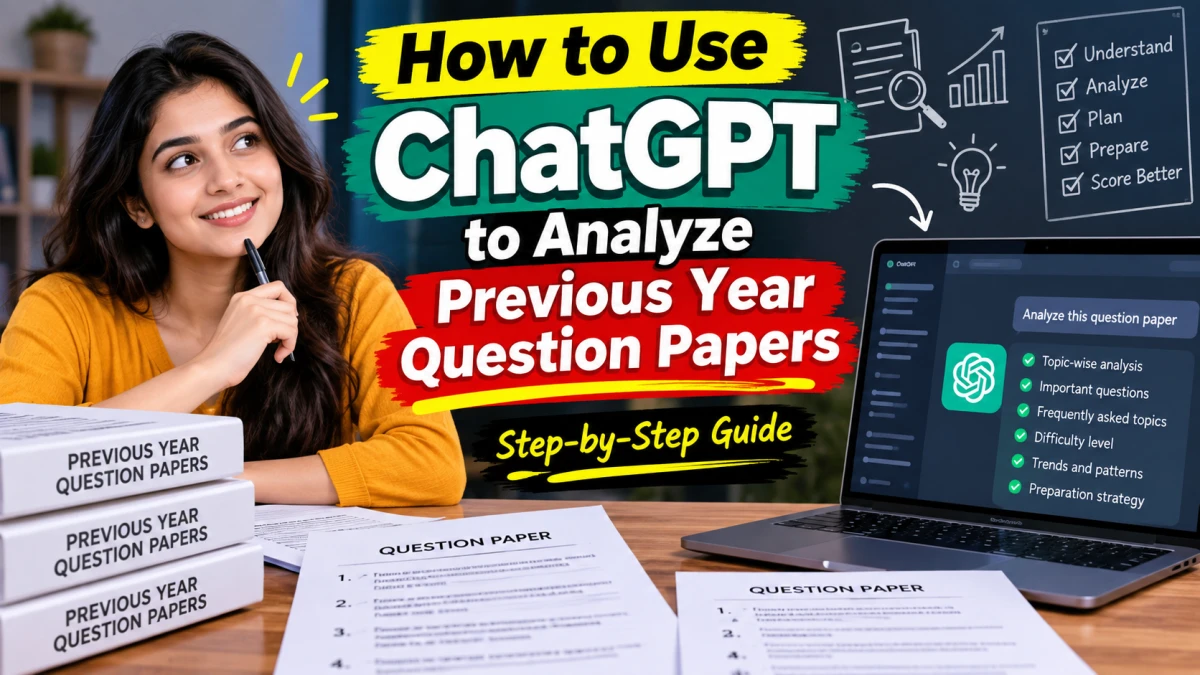
Previous year question papers can help government job aspirants understand the syllabus, question patterns, difficulty level and topics tested in an examination. ChatGPT can make this analysis more organised by helping candidates classify questions, identify recurring topics, analyse mistakes and create practice plans. Here is a step-by-step guide to using ChatGPT with previous year papers for exams such as SSC, UPSC, Banking, Railways and State PSC.
Why Should You Use ChatGPT to Analyse Previous Year Question Papers?
Solving a previous year paper gives you practice, but analysing several papers manually can take considerable time. ChatGPT can help organise the questions into subjects and topics and highlight patterns in the papers you provide.
For example, instead of simply noting that you made mistakes in Quantitative Aptitude, you can ask ChatGPT to identify whether those mistakes are related to Percentage, Ratio, Profit and Loss, Time and Work or another topic.
The key is to give ChatGPT the actual question papers and clear instructions rather than asking a broad question such as "Which topics are important?"
How to Use ChatGPT to Analyse Previous Year Question Papers
Step 1: Collect the Correct Previous Year Question Papers
Start by collecting question papers for the exact examination you are preparing for.
For example:
-
SSC CGL previous year papers
-
SSC CHSL previous year papers
-
IBPS PO or Clerk papers
-
RRB NTPC or Group D papers
-
UPSC Civil Services papers
-
State PSC question papers
Try to use papers from the same examination and, where relevant, the same stage or tier.
If you are analysing SSC CGL Tier-I papers, do not mix them with Tier-II papers and assume that the resulting pattern applies equally to both.
What to Give ChatGPT
You can upload the question paper files or paste the questions into the conversation.
Also provide the year or examination date whenever it is available. This makes it easier to distinguish between different papers.
Step 2: Ask ChatGPT to Extract and Organise the Questions
The first useful analysis is simply to organise the questions according to subject and topic.
Copy-Paste Prompt
I am preparing for [EXAM NAME].
I have uploaded previous year question papers from [YEARS/DATES].
First, analyse the questions in the papers I provided.
Organise the questions into:
1. Subject
2. Topic
3. Sub-topic, where possible
4. Question type
5. Difficulty level
Create a structured table.
Do not add questions that are not present in the papers.
If a question cannot be confidently classified, mark it as "Unclear" instead of guessing.
When to Use It
Use this prompt when you have several papers and want to turn them into an organised topic-wise question bank.
Example Output
ChatGPT may organise the questions like this:
| Subject | Topic | Question Type | Difficulty |
|---|---|---|---|
| Quantitative Aptitude | Percentage | Calculation | Moderate |
| Reasoning | Coding-Decoding | Logic-based | Easy |
| English | Error Detection | Grammar | Moderate |
| General Awareness | History | Factual | Moderate |
Customization Note
Replace the exam name and years with the papers you have provided. Ask ChatGPT to analyse only the supplied papers.
Step 3: Find Recurring Topics Across Previous Year Papers
Once the questions are organised, the next step is to identify topics that appear repeatedly.
Copy-Paste Prompt
Analyse all the previous year question papers I have provided for [EXAM NAME].
Compare the papers topic by topic.
Identify:
- Topics appearing repeatedly
- Topics appearing occasionally
- Topics appearing only once in the supplied papers
- Changes in question patterns across the years
- Topics that require regular practice
Create a table with:
Subject | Topic | Papers in Which It Appeared | Observed Pattern
Do not predict the next examination.
Use only the question papers I provided as evidence.
When to Use It
Use this after organising your papers when you want to understand which topics have appeared repeatedly in the available papers.
Example Output
- Quantitative Aptitude: Percentage and Ratio were observed across multiple supplied papers.
- Reasoning: Coding-Decoding and Series appeared in several of the papers analysed.
The actual topics should be based on the papers you provide.
Customization Note
Upload multiple papers instead of relying on a single previous year paper.
Step 4: Compare the Previous Year Papers With the Official Syllabus
Previous year papers should not be used as a replacement for the official syllabus. Instead, compare both.
This can help you identify syllabus areas that may not have appeared in the papers you analysed.
Copy-Paste Prompt
I am preparing for [EXAM NAME].
I will provide:
1. The official syllabus
2. Previous year question papers
Compare the syllabus with the questions in these papers.
Create a table with:
Subject | Syllabus Topic | Observed in Previous Papers | Frequency/Pattern | Preparation Priority
Also identify syllabus topics that were not present in the supplied previous year papers.
Do not assume that a topic will or will not appear in the next examination.
Do not add topics outside the official syllabus.
When to Use It
Use this when you want to avoid making the mistake of studying only the topics seen in previous papers.
Example Output
- Topic A: Included in the official syllabus and observed in multiple papers.
- Topic B: Included in the syllabus but not observed in the supplied papers.
Action: Continue covering Topic B because its absence from the supplied papers does not mean it can be ignored.
Customization Note
Provide the official syllabus along with the previous year papers for a meaningful comparison.
Step 5: Ask ChatGPT to Analyse Question Difficulty
Candidates often remember a paper as "easy" or "difficult" based on their overall experience. A more useful approach is to examine individual questions.
Copy-Paste Prompt
Analyse the difficulty of the questions in the previous year papers I provided for [EXAM NAME].
For each subject, classify the questions as:
- Easy
- Moderate
- Difficult
Explain briefly what makes the question fall into that category.
Also identify:
- Concept-heavy questions
- Calculation-heavy questions
- Questions requiring lengthy solving
- Questions that can potentially be solved quickly
Do not compare the difficulty with papers that I have not provided.
Base the analysis only on the supplied questions.
When to Use It
Use it when you want to understand where your preparation needs more speed, conceptual understanding or practice.
Example Output
- Quantitative Aptitude: Some questions may be conceptually simple but calculation-heavy.
- Reasoning: Certain puzzle-based questions may require more time than short logical questions.
Customization Note
Analyse complete papers where possible rather than a few selected questions.
Step 6: Use ChatGPT to Create Exam-Level Practice Questions
After analysing previous year papers, you can use the identified concepts to create additional practice.
The goal should be concept-based practice, not asking ChatGPT to predict the next examination.
Copy-Paste Prompt
I am preparing for [EXAM NAME].
Based on the topics and question patterns found in the previous year papers I provided, create 20 original practice questions.
Requirements:
- Stay within the official syllabus
- Follow the general style and difficulty of the supplied papers
- Include different question types observed in the papers
- Include easy, moderate and difficult questions
- Provide four options for objective questions
- Give the correct answer separately
- Explain each answer briefly
Do not copy questions from the supplied papers word-for-word.
Do not claim that these are predicted exam questions.
When to Use It
Use this after identifying the topics where you need additional practice.
Example Output
If the supplied papers show repeated Percentage-based questions, ChatGPT can create a fresh set of Percentage problems using different numbers and situations.
- Practice focus: Percentage → successive changes → comparison-based questions.
Customization Note
Mention the exact topics you want to practise instead of asking for questions from the entire syllabus.
Step 7: Turn Your PYQ Analysis Into a Study Plan
The final step is to convert the analysis into actual preparation.
Copy-Paste Prompt
I am preparing for [EXAM NAME].
Based on the previous year question paper analysis I provided, create a 14-day study plan.
My available study time is ___ hours per day.
My weak topics are:
[LIST TOPICS]
Create a day-wise plan covering:
- Weak topic revision
- Previous year question practice
- New practice questions
- Revision
- Sectional tests
- Mock test
- Mistake analysis
Give higher practice priority to topics where I have made repeated mistakes.
Do not add topics outside the official syllabus.
Keep the plan realistic for my available study time.
When to Use It
Use this when you have completed your PYQ analysis but are unsure how to convert the findings into daily preparation tasks.
Example Output
- Day 1: Percentage concepts + previous year questions
- Day 2: Percentage practice + error analysis
- Day 3: Ratio concepts + previous year questions
- Day 4: Ratio practice + sectional test
Customization Note
Replace the exam name, study hours and weak topics with your actual details.
How to Get Better Results When Using ChatGPT With PYQs
Simply uploading a question paper and asking "Analyse this" may not produce the most useful result. Give ChatGPT a specific task.
1. Provide the Official Syllabus
The syllabus gives ChatGPT a reference for classifying questions and prevents unrelated topics from being included.
2. Use Multiple Papers
One paper may not provide enough information to identify recurring patterns. If possible, analyse several relevant papers.
3. Tell ChatGPT Not to Guess
If a question is unclear or cannot be classified confidently, ask ChatGPT to mark it as unclear rather than inventing a category.
4. Separate Different Exam Stages
Do not automatically combine papers from different tiers, stages or posts. Analyse comparable papers together.
5. Maintain a Personal Mistake Log
After solving PYQs, record questions that you:
-
Answered incorrectly
-
Could not solve
-
Took too long to solve
-
Guessed incorrectly
-
Solved correctly but without confidence
You can then ask ChatGPT to identify patterns in your mistakes.
How to Use ChatGPT to Analyse Your Own PYQ Mistakes
A particularly useful approach is to combine previous year paper analysis with your personal performance.
Copy-Paste Prompt
I am preparing for [EXAM NAME].
Below is my previous year question practice record.
Correct answers: ___
Incorrect answers: ___
Skipped questions: ___
Questions that took too much time: ___
Here are the questions and my answers:
[PASTE QUESTIONS/ANSWERS]
Analyse my performance.
Identify:
1. Topics where I make repeated mistakes
2. Conceptual mistakes
3. Calculation mistakes
4. Time-management problems
5. Topics where my accuracy is good
6. Topics requiring more practice
Then create a 7-day improvement plan.
Base the analysis only on the information I provide.
Example Output
Instead of simply saying:
- "Improve Quantitative Aptitude."
ChatGPT may identify:
- Observed issue: Most errors are from Percentage and Profit & Loss questions, while basic Arithmetic questions are being answered more accurately.
- Next step: Revise the Percentage concepts, solve topic-wise questions and then practise mixed questions under a time limit.
Can ChatGPT Identify the Most Important Topics?
ChatGPT can organise and compare the topics found in the papers you provide, but candidates should be careful with the word "important."
A topic appearing frequently in past papers does not guarantee that it will appear in the next examination.
A better approach is to ask:
- "Which topics appeared most frequently in the papers I provided?"
This gives you an evidence-based summary of the supplied papers rather than a prediction.
Can ChatGPT Predict Questions From Previous Year Papers?
Previous year papers can be used to identify recurring concepts and question formats, but they cannot reliably tell you the exact questions that will appear in a future examination.
For preparation, use PYQ analysis to decide what to practise rather than treating it as a question-prediction tool.
How ChatGPT Can Help Different Government Exam Aspirants
The same approach can be adapted to different examinations.
SSC
Use PYQs to organise topics in Quantitative Aptitude, Reasoning, English and General Awareness.
Banking
Analyse sections such as Quantitative Aptitude, Reasoning, English and other components according to the specific examination.
UPSC
Use previous papers to analyse subjects, question themes, recurring concepts and the way questions are framed.
Railway Exams
Compare previous papers to organise questions by subjects and identify recurring concepts within the relevant examination.
State PSC
Use the same workflow with the relevant State PSC syllabus and previous year papers.
The exact subjects and examination pattern should always be checked against the official notification and syllabus for the particular examination.
Previous year question papers are more useful when candidates analyse them instead of only solving them. ChatGPT can help organise questions by subject and topic, compare multiple papers, identify recurring patterns, explain difficult questions and turn the findings into a practical study plan.
For the best results, provide ChatGPT with the correct previous year papers, official syllabus and your own performance data. Use its analysis to guide your preparation, but continue to verify answers and important examination information using reliable sources.