
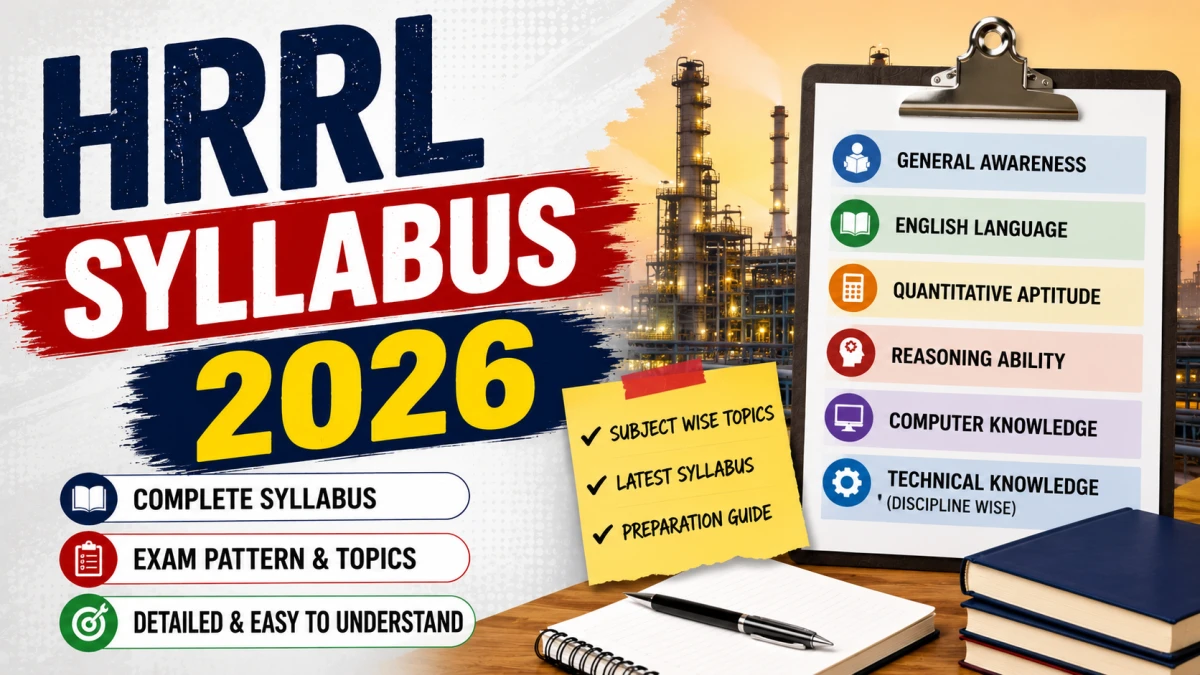
HPCL Rajasthan Refinery Limited (HRRL) has released the detailed syllabus for its Computer-Based Test (CBT) under Advt. No. HRRL/RECT/01/2026, covering nine posts including Assistant Officer (Information Systems), Engineer (Electrical, Mechanical, Instrumentation, Chemical), Assistant Engineer (Instrumentation), Junior Executive (Chemical), Account Officer, and Assistant Accounts Officer. Every CBT follows a common structure: a 2-hour duration, 100 total questions worth 100 marks, objective multiple-choice questions, and no negative marking for wrong answers. This article breaks down the exact syllabus, marks distribution, and topic list for each post so candidates can plan their preparation accurately.
Click Here: HRRL Assistant Officer - Information Systems 2026
Click Here: HRRL Engineer - Electrical 2026
Click Here: HRRL Engineer - Instrumentation 2026
Click Here: HRRL Junior Executive - Chemical 2026
Click Here: HRRL Account Officer 2026
Click Here: HRRL Assistant Accounts Officer 2026
Click Here: HRRL Engineer - Mechanical 2026
Click Here: HRRL Assistant Engineer - Instrumentation 2026
Click Here: HRRL Engineer - Chemical 2026
HRRL CBT Exam Pattern 2026 - Overview
Before diving into post-wise topics, it helps to understand that HRRL uses the same exam framework across all nine posts; only the technical section changes. This section explains the marks split, duration, and marking scheme applicable to every position.
| Exam Detail | Description |
|---|---|
| Total Duration | 2 hours |
| Total Marks | 100 |
| Total Questions | 100 (objective, multiple-choice) |
| Marking Scheme | 1 mark per correct answer; no negative marking |
| Part 1: General Aptitude | 30 marks |
| Part 2: Technical/Professional Knowledge | 70 marks |
Part 1: General Aptitude Syllabus (30 Marks) - Common to All Posts
The General Aptitude section is identical across all HRRL posts and is set at Graduate level (HSC level for Junior Executive - Chemical). It tests reasoning ability, quantitative skills, and English language proficiency, and is divided into four broad areas.
1. Intellectual Potential Test
This part evaluates core cognitive abilities rather than memorized facts, focusing on how quickly and accurately a candidate can process information.
- Distance
- Syllogism
- Logical Operations
- Similarities and dissimilarities
- Verbal Comprehension
- Perpetual (Perceptual) Reasoning
- Working Memory
- Processing Speed
- Fluid Reasoning
2. Logical Reasoning & Data Interpretation
This section combines puzzle-based logical reasoning with data interpretation involving graphs, tables, and charts.
- Seating arrangements and puzzles
- Series - verbal and number
- Relationships, coding-decoding
- Verbal and numerical analogy
- Binary logic
- Games and tournaments, team formations
- Order and ranking, arrangements
- Table and data caselets, column graphs, bar graphs, line charts, pie charts, routes and networks
3. Quantitative Aptitude
This part covers standard mathematics topics commonly seen in competitive exams, testing numerical accuracy and problem-solving speed.
- Number systems, simplification, decimals, fractions
- LCM and HCF, square root, divisibility tests
- Ratio & proportion, percentage, average
- Profit & loss, discount
- Simple and compound interest
- Mensuration, time & work, time and distance
- Algebraic identities, problems on ages, tables & graphs
4. English Language
The English section tests grammar, vocabulary, and reading comprehension through sentence completion, para jumbles, and passage-based questions.
- Grammar: question tags, parts of speech (adjective, adverb, preposition, conjunction, verb) via sentence completion
- Indirect writing: syntax and structure (para jumbles), one-word substitution
- Reading comprehension: appropriate title, central theme, facts, inferences, passage structure, summary, tone, text-to-world connection
- Vocabulary: synonyms, antonyms, word meaning, idioms and phrases, proverbs (word-segment substitution)
Part 2: Technical/Professional Knowledge Syllabus (70 Marks) - Post-Wise Breakdown
The technical section carries the bulk of the marks and is specific to each discipline. Below is the detailed topic list for each of the nine HRRL posts.
1. Assistant Officer - Information Systems (S/G E1)
This syllabus covers core computer science fundamentals typically expected at the graduate/engineering level for IT roles.
- Digital Logic: Boolean algebra, combinational and sequential circuits, minimization, number representation, computer arithmetic
- Computer Organization & Architecture: machine instructions, addressing modes, ALU, data-path, control unit, pipelining, memory hierarchy, I/O interface
- Programming and Data Structures: modern programming concepts (basic Java)
- Algorithms: searching, sorting, hashing, asymptotic complexity, greedy/DP/divide-and-conquer, graph traversals, MST, shortest paths
- Theory of Computation: regular expressions, finite automata, context-free grammars, push-down automata, Turing machines, undecidability
- Operating Systems: system calls, processes, threads, IPC, concurrency, deadlock, scheduling, memory management, file systems, Windows/Linux basics
- Databases: ER-model, relational algebra, SQL, normal forms, indexing (B/B+ trees), transactions, concurrency control
- Computer Networks: OSI/TCP-IP layering, switching, data link layer, routing protocols, IP addressing/CIDR, ARP/DHCP/ICMP/NAT, TCP/UDP, DNS/SMTP/HTTP/FTP/Email
2. Engineer - Electrical (S/G E2)
The Electrical Engineering syllabus spans circuit theory, machines, power systems, and power electronics relevant to refinery operations.
- Electric Circuits: network elements, KCL/KVL, node/mesh analysis, transient and steady-state response, three-phase circuits, power factor
- Electromagnetic Fields: Coulomb's law, Gauss's law, capacitance, Ampere's/Faraday's law, inductance, magnetic circuits
- Electrical Machines: transformers, DC machines, induction machines, synchronous machines, losses and efficiency
- Power Systems: generation, transmission, distribution, load flow, fault analysis, protection, circuit breakers, stability
- Electrical & Electronic Measurements: bridges, instrument transformers, digital meters, oscilloscopes, error analysis
- Power Electronics: thyristor/MOSFET/IGBT, DC-DC converters, rectifiers, inverters, PWM
3. Engineer - Instrumentation (S/G E2) and Assistant Engineer - Instrumentation (S/G E1)
Both instrumentation posts share an extensive syllabus covering measurement, control systems, automation, and emerging technologies like IIoT and machine learning for process control.
- Electrical & Electronics Measurement, Analog and Digital Electronics
- Transducers, sensors, actuators and industrial automation
- Automatic Control Systems and Feedback Control
- Process Loop Components and Hazardous Area Classification
- Microprocessors and Microcontrollers
- Power Electronics and Drives
- Industrial Automation, PLC, SCADA, and Distributed Control Systems
- Analytical Instrumentation and Instrumentation System Design
- Optimization, Process Instrumentation and Control
- Programming Engineering and Project Management (only in Engineer - Instrumentation)
- Industrial Internet of Things (IIoT) and Industry 4.0
- Soft Computing, AI and Machine Learning for Process Control
4. Junior Executive - Chemical (S/G E0)
This entry-level chemical syllabus focuses on hydrocarbons, process equipment, safety, and firefighting basics relevant to refinery operations.
- Hydrocarbons: alkanes, alkenes, alkynes, aromatic compounds, isomerism, benzene structure
- Flammability, explosivity and combustion
- Polymers: types, reactions and properties
- Heat Transfer Equipment: heat exchangers, evaporators, fired heaters
- Process Equipment Operation: pumps, compressors, distillation towers, reactors
- Process Instrumentation and Control Systems
- Process Safety: PSM, JSA, HAZOP, hazard identification and risk assessment
- Firefighting Equipment: fire pumps, gas detectors, extinguishers, foam systems, hoses, ladders
- Utility Systems: air, water, steam, nitrogen
- Chemical Thermodynamics, Fluid Mechanics, Heat & Mass Transfer
- Unit Conversion & Stoichiometry
5. Engineer - Mechanical (S/G E2)
The Mechanical Engineering syllabus is comprehensive, covering core mechanics, thermal sciences, manufacturing, and mechatronics.
- Engineering Mechanics and Mechanics of Materials
- Theory of Machines and Vibrations
- Machine Design
- Fluid Mechanics and Heat Transfer
- Thermodynamics and its industrial applications (IC engines, refrigeration, turbomachinery)
- Engineering Materials
- Casting, Forming and Joining Processes
- Machining, Metrology and Inspection
- Computer Integrated Manufacturing, Production Planning and Inventory Control
- Operations Research
- Power Plant Engineering and Renewable Energy Sources
- Manufacturing, Industrial and Maintenance Engineering
- Mechatronics and Robotics
6. Engineer - Chemical (Process) (S/G E2)
This is the most extensive technical syllabus among all posts, covering core chemical engineering principles along with refinery-specific process knowledge.
- Process Calculations and Thermodynamics
- Fluid Mechanics and Mechanical Operations
- Heat Transfer (including fired heaters and furnace operations)
- Mass Transfer (distillation, absorption, extraction, drying)
- Chemical Reaction Engineering
- Instrumentation and Process Control (DCS, PLC, PID tuning)
- Plant Design and Economics
- Chemical Technology (petroleum refining, petrochemicals, polymers)
- Net Zero Concepts: decarbonization, CCUS, renewable energy
- Process Safety: PSM, hazard identification, emergency response
- Introduction to Petrochemicals Process: cracking, olefins, aromatics (BTX) production
7. Account Officer (S/G E2)
The Account Officer syllabus is based on the CA Foundation, CA Inter, and CA Final curriculum, covering accounting, taxation, auditing, and financial management.
- CA Foundation: Principles and Practices of Accounting, Business Laws, Business Mathematics, Logical Reasoning & Statistics, Business Economics
- CA Inter: Accounting, Corporate & Other Laws, Cost and Management Accounting, Taxation (Income Tax and GST), Advanced Accounting, Auditing and Assurance, Enterprise Information Systems and Strategic Management, Financial Management and Economics for Finance
- CA Final: Financial Reporting, Strategic Financial Management, Advanced Auditing and Professional Ethics, Corporate and Economic Laws, Strategic Cost Management, Risk Management, Financial Services and Capital Markets, International Taxation, Multidisciplinary Case Study, Direct and Indirect Tax Laws
8. Assistant Accounts Officer (S/G E1)
This syllabus focuses on practical financial accounting, cost accounting, taxation, auditing, and company law concepts.
- Financial Accounting: accounting standards, depreciation, inventories, revenue recognition, share capital, bonus/rights shares, ESOPs, buy-back, company final accounts, amalgamation
- Cost Accounting: job costing, process costing, activity-based costing, budgeting, standard costing, variance analysis, responsibility accounting
- Taxation: Income Tax basics, computation of income, set-off and carry forward of losses, deductions, GST provisions
- Auditing: company audit, divisible profits, dividends, tax audit
- Company Law: formation, operation and dissolution of a company
HRRL Syllabus PDF Download Links 2026
Candidates can download the official post-wise syllabus PDFs directly from the HRRL website using the links below.