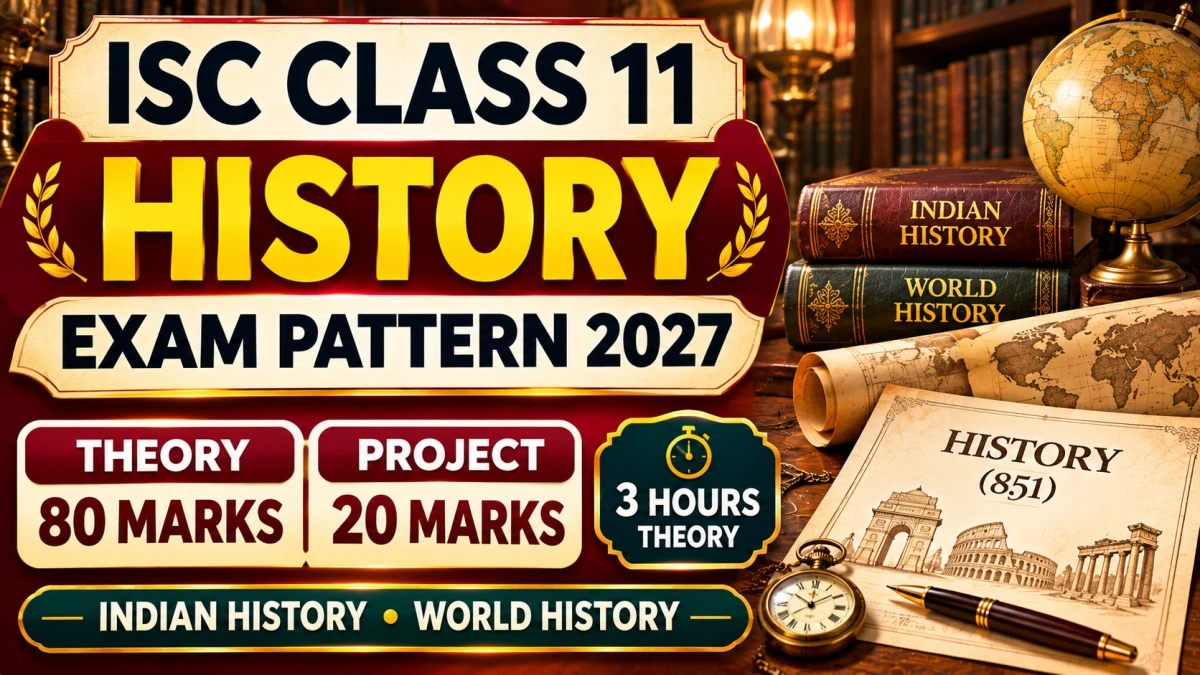
The theory examination has a duration of three hours, making the total assessment worth 100 marks. The ISC Class 11 History syllabus covers two major areas: Indian History and World History. Students will study the colonial economy, social reform movements, the growth of nationalism, Gandhian movements, World War I, the Great Depression and the rise of major political movements in Europe and Asia. The official syllabus also provides a detailed marking scheme for the History project, including research, analysis, presentation and viva voce. Students should check their school's question-paper instructions because the precise distribution of marks among theory question types is not specified in the official syllabus.
ISC Class 11 History Exam Pattern 2027 - Overview
| Board | Council for the Indian School Certificate Examinations (CISCE) |
| Class | 11th (XI) |
| Subject | History |
| Subject Code | 851 |
| Academic Session | 2026-27 |
| Examination Year | 2027 |
| Total Marks | 100 |
| Paper I | Theory - 80 Marks |
| Paper II | Project Work - 20 Marks |
| Theory Examination Duration | 3 Hours |
| Syllabus Sections | Indian History and World History |
| Main Syllabus Topics | 12 |
| Class 11 Examination | Conducted Internally by Schools |
| Official Website | cisce.org |
ISC Class 11 History Syllabus 2027 PDF Download
Students can consult the official CISCE History syllabus for Examination Year 2027 to verify the theory marks, project requirements and prescribed Class XI topics.
Official History Syllabus PDF: Download ISC History Syllabus 2027
Official CISCE Website: Visit CISCE
The published History syllabus contains separate Class XI and Class XII sections. Class 11 students should follow the topics and project rules listed specifically under Class XI.
ISC Class 11 History Marks Distribution 2027
CISCE has prescribed a total of 100 marks for History. The assessment consists of an 80-mark written examination and a 20-mark project.
| Paper | Assessment | Maximum Marks | Duration |
|---|---|---|---|
| Paper I | Written Theory Examination | 80 | 3 Hours |
| Paper II | Project Work | 20 | According to School Instructions |
| Total | History Assessment | 100 | - |
Paper I accounts for 80% of the total marks, while project work contributes the remaining 20%. Students should prepare both components carefully because project assessment forms an important part of the overall History result.
ISC Class 11 History Paper I Exam Pattern 2027
Paper I is the written theory examination carrying 80 marks. The examination lasts three hours and covers the prescribed Indian History and World History syllabus.
The subject requires students to understand historical events, identify important developments, study causes and consequences, examine evidence and explain historical issues using appropriate terminology.
| Particulars | Details |
|---|---|
| Paper Name | Paper I - Theory |
| Maximum Marks | 80 |
| Exam Duration | 3 Hours |
| Syllabus Division A | Indian History |
| Syllabus Division B | World History |
| Exact Question-Wise Marks Distribution | Not Specified in the Official Class XI Syllabus |
| Question Paper Instructions | Refer to the School's Latest Examination Paper or Instructions |
ISC Class 11 History 2027 Question Paper Pattern: Is 16 + 32 + 32 Confirmed?
Some educational websites describe the ISC Class 11 History theory examination as having three compulsory question sections worth 16, 32 and 32 marks.
The reported pattern is shown below for reference.
| Reported Question Section | Question Type | Reported Marks |
|---|---|---|
| Section A | Objective and Very Short-Answer Questions | 16 |
| Section B | Short-Answer Questions | 32 |
| Section C | Long-Answer Questions | 32 |
| Total | Written Theory Examination | 80 |
Verification Note: Although this proposed distribution adds up to 80 marks, the official CISCE Class XI History syllabus does not confirm it as the prescribed question-paper format. It also does not specify the reported question counts, word limits or internal-choice arrangements.
Students should not confuse the Indian History and World History syllabus divisions with the separate question sections described by third-party websites. The actual question-paper format should be confirmed with the school or through an applicable official specimen paper.
ISC Class 11 History Syllabus 2027
The CISCE History syllabus for Class 11 contains 12 main topics divided equally between Indian History and World History.
| Syllabus Division | Number of Main Topics | Coverage |
|---|---|---|
| Section A - Indian History | 6 | Colonial Economy, Social Reform, Resistance, Nationalism and Gandhian Movements |
| Section B - World History | 6 | World War I, Great Depression and Political Developments in Russia, Italy, Germany and Japan |
| Total | 12 | Prescribed Class XI History Topics |
ISC Class 11 History Section A: Indian History Syllabus
Section A of the syllabus focuses on the social, political and economic developments in India during British colonial rule and the Indian National Movement.
| No. | Topic | Important Areas |
|---|---|---|
| 1 | Emergence of the Colonial Economy | Transport and Communication, Revenue Policies, Modern Industries and Colonial Forest Policy |
| 2 | Social Movements | Struggle Against Caste, Social Reformers and Women's Questions |
| 3 | Protest Movements Against Colonial Rule | Indigo Uprising, Deccan Riots and Munda Uprising |
| 4 | Growth of Nationalism | Partition of Bengal, Swadeshi Movement, Boycott Movement and Foundation of the Muslim League |
| 5 | Gandhian Nationalism (1916-1922) | Rowlatt Act, Jallianwala Bagh, Khilafat Movement and Non-Cooperation Movement |
| 6 | Gandhian Nationalism (1927-1937) | Lahore Session, Poorna Swaraj, Civil Disobedience Movement, Gandhi-Irwin Pact and Government of India Act, 1935 |
Important Topics to Prepare in Indian History
Students should understand the economic impact of British rule, social reform movements, resistance against colonial policies and the growth of Indian nationalism.
For Gandhian Nationalism, focus on the causes, major developments and consequences of the movements covered by the syllabus. Prepare chronological timelines to connect the events and understand their historical significance.
ISC Class 11 History Section B: World History Syllabus
The World History section covers important political and economic changes during the early twentieth century, including the First World War and the rise of authoritarian political systems.
| No. | Topic | Important Areas |
|---|---|---|
| 7 | World War I: Causes and Peace Settlements | Alliance System, Imperialism, Militarism, Nationalism, Events Leading to the War and Treaty of Versailles |
| 8 | The Great Depression | Wall Street Crash of 1929, Economic Impact and Roosevelt's New Deal |
| 9 | Rise of Communism Under Stalin in Russia (1917-1939) | Russian Revolution, Lenin's NEP, Stalin's Rise, Collectivisation, Industrialisation and Purges |
| 10 | Rise of Fascism Under Mussolini in Italy (1919-1939) | Post-War Discontent, Mussolini's Rise to Power and Domestic Policies |
| 11 | Rise of Nazism Under Hitler in Germany (1933-1939) | Weimar Republic, Hitler's Rise to Power, Nazi State and Its Policies |
| 12 | Rise of Militarism in Japan (1919-1937) | Reasons for the Rise of Militarism in the 1930s |
Important Topics to Prepare in World History
Students should focus on explaining the causes and consequences of World War I, the economic effects of the Great Depression and the political developments associated with Stalin, Mussolini and Hitler.
Questions may assess understanding of historical developments and the ability to connect political events with economic and social conditions. Students should use the detailed syllabus to determine the precise scope of each topic.
ISC Class 11 History Paper II: Project Work 2027
Paper II consists of project work carrying 20 marks. Students must prepare one History project on a topic connected with India or the world during the eighteenth to twentieth centuries.
The project may focus on political developments, military events, economic history, society and culture or religious ideas and their historical impact.
CISCE permits several project formats, including case studies, field investigations, local history, interviews, oral evidence, book or film reviews, newspaper analysis, posters and historical cartoons.
ISC Class 11 History Project Marking Scheme 2027
The official assessment criteria divide the 20 project marks into four areas.
| Assessment Area | Evaluation Focus | Marks |
|---|---|---|
| Process | Topic Identification, Research Planning and Method | 5 |
| Understanding, Application and Analysis | Historical Explanation, Interpretation and Critical Evaluation | 5 |
| Presentation | Organisation, Format and Referencing | 5 |
| Viva Voce | Answers to Questions Based on the Project | 5 |
| Total | History Project Work | 20 |
Students should focus on original research, accurate historical information and clear analysis. The quality of content and presentation is more important than decorative elements.
ISC Class 11 History Project Format 2027
The CISCE syllabus specifies a written project of approximately 800 to 1,500 words. The project should contain the following sections.
| Project Section | What to Include |
|---|---|
| Introduction | Brief Historical Background and Context |
| Main Body | Detailed Explanation, Research Evidence, Interpretation and Analysis |
| Conclusion | Summary of Findings and Historical Significance |
| Bibliography | List of Books, Websites, Interviews and Other Sources Used |
| Appendix, If Needed | Additional Material Essential to Understanding the Project |
Students should use reliable sources, acknowledge the material they consult and avoid plagiarism. Their projects should demonstrate personal understanding and original work.
ISC Class 11 History Project Topics 2027
Students may select a suitable historical topic after discussing its scope and availability of research material with their teachers.
Possible areas for a project include:
- Economic consequences of colonial policies in India
- Social reform movements in nineteenth-century India
- Role of the Swadeshi Movement in Indian nationalism
- Important developments in the Non-Cooperation Movement
- Historical impact of the Treaty of Versailles
- Causes and consequences of the Great Depression
- Political and economic policies under Stalin
- Rise of Fascism in Italy
- Growth of Nazism in Germany
- Local history based on historical records and oral evidence
These are illustrative areas for selecting a project. Students should obtain their teacher's approval before beginning their research.
ISC Class 11 History Viva Voce 2027
The project viva voce carries 5 marks. Students may be asked questions about the topic they selected, the sources they used and the conclusions reached through their research.
To prepare for the viva, students should read their completed project carefully and be ready to explain the research process and key historical findings in their own words.
ISC Class 11 History Passing Marks and Promotion Rules
The Class 11 final examination is conducted internally by schools rather than as the central ISC Class 12 board examination.
The general CISCE Class XI promotion requirements referenced in the supplied examination update include an overall cumulative average of at least 35% in five subjects, including English or Modern English, and a minimum attendance requirement of 75%.
These are general promotion requirements and should not be interpreted as a separately verified 35% passing threshold for History alone. Students should consult their school for the applicable promotion and internal assessment rules.
How to Prepare for ISC Class 11 History Exam 2027?
1. Understand the Complete Syllabus
Begin by checking all six Indian History topics and six World History topics. Use the detailed CISCE syllabus to identify the required events, personalities and historical developments.
2. Prepare Chronological Timelines
Create timelines for the Indian National Movement, World War I, the Great Depression and developments in Europe during the interwar period.
3. Practise Historical Explanations
When preparing written answers, focus on the causes, course, consequences and significance of important events. Use clear explanations supported by appropriate facts.
4. Study Historical Evidence
Practise interpreting historical documents, extracts, political cartoons and other relevant source material included in classroom learning.
5. Revise Indian and World History
Divide revision time between the two major syllabus areas. Do not ignore an entire section simply because the school has not yet announced its question-paper format.
6. Complete the History Project Early
Choose a suitable project topic, collect credible references, organise the evidence and complete the written assignment according to the prescribed format.
7. Prepare for the Project Viva
Understand the evidence used in your project and practise explaining your findings. The viva voce accounts for five marks.
8. Follow Your School's Question Paper Instructions
Confirm the applicable question types, internal choices, reading time and answer requirements with your school before the final examination.
ISC Class 11 History Exam Pattern 2027 - Important Links
| Particulars | Official Links |
|---|---|
| ISC History 2027 Theory and Project Scheme | View Official Syllabus |
| ISC Class 11 History Project Assessment | Check Project Instructions |
| CISCE Official Website | Visit Official Website |
| Join WhatsApp | Click Here |
| Join Telegram | Click Here |
| Download App | Click Here |