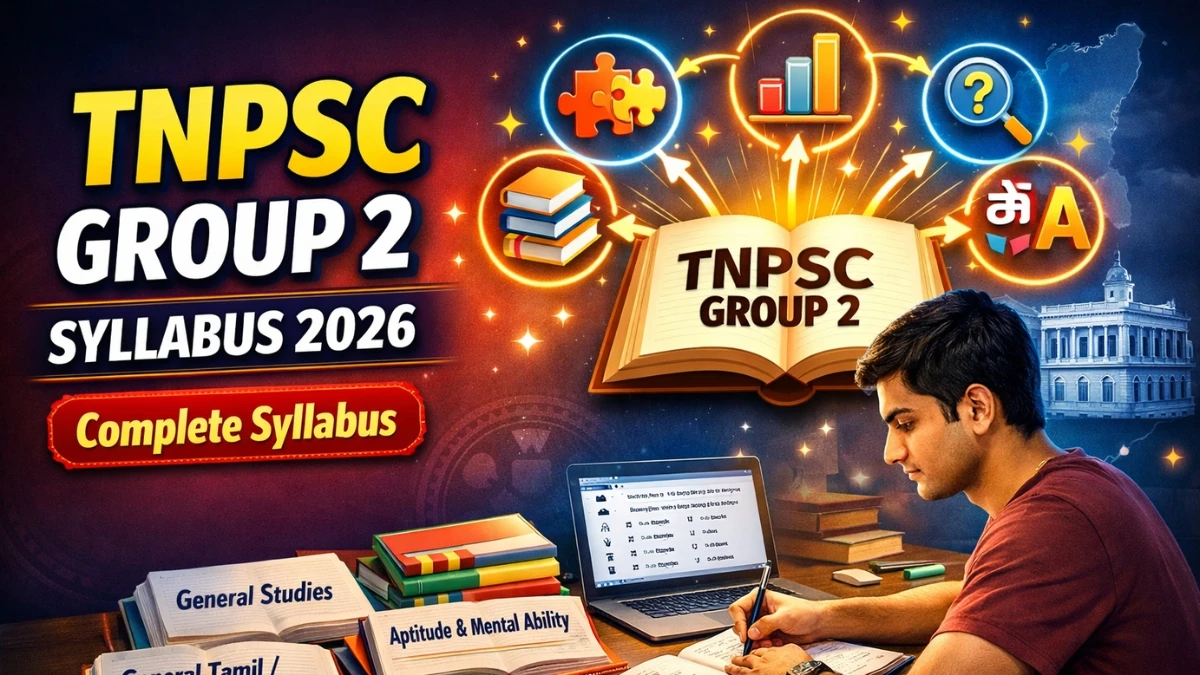
The TNPSC Group 2 Syllabus 2026 has been released by the Tamil Nadu Public Service Commission (TNPSC) along with the revised exam pattern for the Combined Civil Services Examination – II (Group II and IIA Services). The selection process includes a Preliminary Examination (objective type), Main Written Examination, and Interview (for Group II posts only). The Prelims exam covers General Tamil/General English, General Studies, and Aptitude & Mental Ability. The Mains includes a qualifying Tamil Eligibility Test and a scoring General Studies paper. Aspirants must follow the unit-wise detailed syllabus given below for effective preparation in 2026.
Prelims Syllabus 2026: Click Here
Mains Syllabus 2026: Click Here
TNPSC Group 2 Exam Overview
| Particulars | Details |
|---|---|
| Conducting Body | Tamil Nadu Public Service Commission (TNPSC) |
| Exam Name | Combined Civil Services Examination – II |
| Posts | Group 2 & Group 2A Services |
| Selection Process | Prelims + Mains + Interview (Group 2 only) |
| Prelims Mode | Objective Type |
| Mains Mode | Descriptive (Group 2) / Objective (Group 2A) |
| Official Website | tnpsc.gov.in |
TNPSC Group 2 2026: Preliminary Exam Pattern
| Subjects | Number of Questions | Maximum Marks | Duration |
|---|---|---|---|
| General Tamil (S.S.L.C. Standard) or General English (S.S.L.C. Standard) | 100 | 300 | 3 hours |
| General Studies (Degree Standard) | 75 | - | |
| Aptitude and Mental Ability Test (S.S.L.C. Standard) | 25 | - | |
| Total | 200 | 300 |
Note: Minimum qualifying marks for Prelims is 90 out of 300 (no negative marking).
Unit-wise TNPSC Group 2 Prelims Syllabus 2026
| Unit | Topics |
|---|---|
| Part A: General Studies | |
| Unit I: General Science | Scientific knowledge, reasoning, conceptual learning, universe, scientific laws, mechanics, matter, force, motion, energy, electricity, magnetism, light, sound, heat, nuclear physics, electronics, elements & compounds, acids, bases, fertilizers, life science, evolution, genetics, health, diseases, environment, latest inventions, current affairs |
| Unit II: Geography of India | Location, physical features, climate, monsoon, water resources, rivers, soil, minerals, forests, agriculture, transport, population, tribes, disasters, pollution, climate change, green energy, landmarks, current affairs |
| Unit III: History & Culture of India | Indus Valley, Guptas, Delhi Sultanate, Mughals, Marathas, Vijayanagara, Bahmani Kingdoms, freedom struggle, leaders like Gandhi, Nehru, Ambedkar, Subash Chandra Bose, movements, Indian culture, unity in diversity, secularism, personalities |
| Unit IV: Indian Polity | Constitution, Preamble, Fundamental Rights & Duties, DPSP, Parliament, Judiciary, Local Government, Panchayat Raj, Elections, Federalism, RTI, Lokpal, Human Rights, Women empowerment, political system, current affairs |
| Unit V: Indian Economy & TN Development | Indian economy, NITI Aayog, RBI, GST, fiscal policy, employment, agriculture, industry, education, health, Tamil Nadu development, e-Governance, welfare schemes, socio-economic issues |
| Unit VI: Tamil Nadu History & Movements | Sangam literature, Thirukkural, Tamil culture, archaeological discoveries, freedom struggle, Justice Party, Self-Respect Movement, Dravidian movement, Periyar, Anna |
| Part B: Aptitude & Mental Ability | |
| Unit I: Aptitude (15 Questions) | Simplification, Percentage, HCF, LCM, Ratio, Interest, Area, Volume, Time & Work |
| Unit II: Reasoning (10 Questions) | Logical reasoning, puzzles, dice, visual reasoning, alpha-numeric reasoning, number series |
| Part C: Language | |
| General Tamil / General English | Grammar, literature, proverbs, poetry, Tamil/English language usage (candidate choice) |
| General English – Grammar | Parts of speech, tenses, voice, sentence types, articles, prepositions, conjunctions, direct & indirect speech, punctuation, synonyms, antonyms, error spotting |
| Vocabulary & Writing Skills | Idioms, phrases, sentence rearrangement, paragraph writing, précis, letter writing |
| Reading & Literature | Comprehension passages, poetry, figures of speech, biographies, literary works, authors, British vs American English |
TNPSC Group 2 Mains Exam Pattern 2026 (Revised)
For Group 2 Services (Interview Posts)
| Paper | Paper Name | Level | Type of Exam | Nature | Total Marks |
|---|---|---|---|---|---|
| I | Tamil Eligibility Test | SSLC | Descriptive | Qualifying | 100 |
| II | General Studies | Degree | Descriptive | Scoring | 300 |
Marks Distribution for Paper II – General Studies (Descriptive – 300 Marks)
| Unit | Subject | Marks |
|---|---|---|
| I | Modern History of India with specific reference to Tamil Nadu | 40 |
| II | Tamil Society – Culture and Heritage | 30 |
| III | Social Issues in India with specific reference to Tamil Nadu | 50 |
| IV | Science and Technology in Development | 40 |
| V | Constitution, Polity, and Governance in India with specific reference to Tamil Nadu | 60 |
| VI | Geography of India, Environment, Biodiversity and Disaster Management in India with specific reference to Tamil Nadu | 40 |
| VII | Indian Economy with specific reference to Tamil Nadu | 40 |
| Total | 300 | |
Paper 1: Tamil Eligibility Test (SSLC Standard – Qualifying Paper – 100 Marks)
This is a compulsory qualifying paper. Candidates must secure minimum qualifying marks to have their Paper 2 evaluated.
Main Topics Covered:
- Tamil to English Translation
- English to Tamil Translation
- Precis Writing
- Hints Development / Expansion of ideas
- Essay Writing on Thirukkural (Significance as secular literature, Relevance to everyday life, Impact on humanity, Universal values, Socio-political & economic relevance, Philosophical content)
- Grammar, Vocabulary, Proverbs, Poetry appreciation, and Tamil language proficiency at SSLC level
Full Unit-wise TNPSC Group 2 Mains Syllabus – Paper II General Studies (Degree Standard)
TNPSC Group 2 Mains Syllabus 2026 – Paper II (General Studies – Degree Standard)
| Unit | 940 Marks)Topics |
|---|---|
| Unit I: Modern History of India(40 Marks) | Advent of Europeans (Portuguese, Dutch, English, Danish, French), Carnatic Wars, Poligar Revolt, South Indian Rebellion, Vellore Mutiny, INC (Moderates & Extremists), Tamil Nadu leaders (Kattabomman, Maruthu Brothers, Pulithevan), Freedom struggle in TN (VOC, Bharathiyar, Rajaji, Kamaraj), role of women, British impact (education, judiciary, police), social justice movements, socio-religious movements |
| Unit II: Tamil Society, Culture & Heritage (30 Marks) | Ancient Tamil society, archaeological sites (Keezhadi, Adichanallur), Sangam literature, Thirukkural, Tamil reforms, Justice Party, Self-Respect Movement, Dravidian Movement, Periyar, Anna, Tamil arts, cultural heritage, folk traditions |
| Unit III: Social Issues (India & Tamil Nadu) (50 marks) | Population issues, health care, nutrition, public health, rural & urban development, child labour, women issues, media role, law & order, alcoholism, drug abuse, environmental issues, unemployment, poverty, welfare schemes, terrorism, communalism, current affairs |
| Unit IV: Science & Technology in Development (40 marks) | Robotics, nuclear physics, electronics, polymers, nanotechnology, biotechnology (DNA, GM crops, tissue culture), IVF techniques, computer science (AI, ML, cloud computing, IoT, cyber security), digital technology, GIS, current affairs |
| Unit V: Constitution, Polity & Governance (60 marks) | Indian Constitution, Preamble, Fundamental Rights & Duties, Parliament, President, PM, State Govt, Panchayat Raj, Judiciary, Election Commission, Federalism, RTI, Lokpal, e-Governance, TN administration, political system |
| Unit VI: Geography, Environment & Disaster Management (40 marks) | India’s geography, climate, rivers, soil, agriculture, transport, population, pollution, climate change, biodiversity, disaster management, floods, cyclones, environmental policies, TN-specific geography |
| Unit VII: Indian Economy (with TN focus) (40 marks) | Indian economy, NITI Aayog, RBI, GST, fiscal policy, agriculture, industry, services, employment, poverty, education, health, TN economy, welfare schemes, industrial growth, e-Governance, socio-economic issues |
TNPSC Group 2 Selection Process 2026
- Preliminary Examination
- Main Written Examination
- Interview (only for Group 2 posts)
- Document Verification & Medical Test