
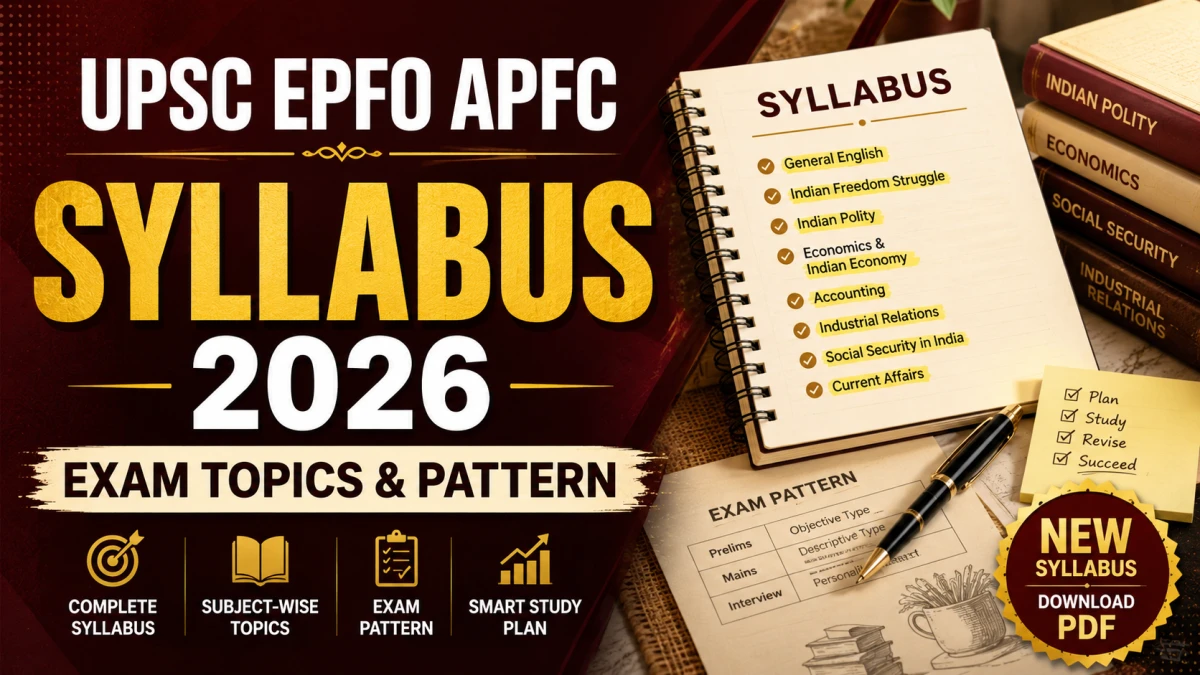
The Union Public Service Commission (UPSC) has released the recruitment notification for Assistant Provident Fund Commissioner (APFC) in the Employees' Provident Fund Organisation (EPFO), Ministry of Labour & Employment, under Special Advertisement No. 52/2026. Candidates preparing for this Group 'A' post need a clear picture of both the UPSC EPFO APFC syllabus and the exam pattern together, since the Recruitment Test carries 75% weightage in the final merit and covers a wide mix of general and specialized subjects. This article breaks down the official exam structure, subject-wise trend, detailed topic list, and a practical preparation strategy.
UPSC EPFO APFC Syllabus and Exam Pattern 2026 - Overview
| Particulars | Details |
|---|---|
| Recruiting Body | Union Public Service Commission (UPSC) |
| Post Name | Assistant Provident Fund Commissioner (APFC) |
| Organisation | Employees' Provident Fund Organisation (EPFO) |
| Advertisement No. | Special Advertisement No. 52/2026 |
| Total Vacancies | 80 |
| Pay Scale | Level-10 in Pay Matrix (7th CPC) |
| Selection Stages | Recruitment Test (RT) + Personality Test (Interview) |
| RT Total Marks | 300 |
| RT Duration | 2 Hours (120 Minutes) |
| Exam Mode | Pen & Paper (OMR-based), Objective Type |
| Medium of Exam | Bilingual (English & Hindi) |
| Negative Marking | 1/3rd (0.33) mark deducted per wrong answer |
| Recruitment Test Date | 20 December 2026 |
| Official Website | upsc.gov.in |
UPSC EPFO APFC Selection Process 2026
Selection to the APFC post is a two-stage process, and marks from both stages are combined for the final merit list.
- Stage 1 - Recruitment Test (RT): An objective, multiple-choice written test worth 300 marks, carrying 75% weightage in the final result. Only candidates who clear this stage move to the interview.
- Stage 2 - Personality Test (Interview): Worth 100 marks, carrying 25% weightage. Candidates must also clear category-wise minimum suitability marks in the interview (see table below).
The final merit is calculated using a fixed 75:25 ratio between the Recruitment Test and the Interview not a simple addition of raw marks.
Also Read: HTET Result 2026
UPSC EPFO APFC Exam Pattern 2026
Recruitment Test (RT) Pattern
| Exam Parameter | Details |
|---|---|
| Test Duration | 2 Hours (120 Minutes) |
| Question Format | Objective (Multiple Choice) |
| Total Marks | 300 |
| Medium | Bilingual (English & Hindi) |
| Marking | Equal marks assigned to every question |
| Negative Marking | 1/3rd mark deducted for each wrong answer; marking more than one option is also treated as wrong |
| Unattempted Questions | No penalty |
Subject-Wise Marks Distribution (Based on Previous Cycle)
The table below is based on the UPSC EPFO APFC 2023 previous-year paper analysis and is shown only as an indicative trend, not as the officially confirmed 2026 distribution. In the 2023 paper, 120 questions carried 300 marks, i.e. 2.5 marks per question.
| S. No. | Subject | No. of Questions (2023 trend) | Marks (2023 trend) |
|---|---|---|---|
| 1 | General English | 20 | 50 |
| 2 | Quantitative Aptitude & Reasoning | 15 | 37.5 |
| 3 | General Accounting Principles | 15 | 37.5 |
| 4 | Industrial Relations & Labour Laws | 14 | 35 |
| 5 | Computer Applications | 10 | 25 |
| 6 | General Science | 10 | 25 |
| 7 | Indian History & Culture | 10 | 25 |
| 8 | Indian Polity | 9 | 22.5 |
| 9 | Current Affairs & Development Issues | 8 | 20 |
| 10 | Social Security | 5 | 12.5 |
| 11 | Population & Globalization | 3 | 7.5 |
| 12 | Indian Economy | 1 | 2.5 |
| Total | 120 | 300 |
The official 2026 notification may revise this candidates should verify the exact question-wise breakdown against the latest UPSC notification once the exam is over, since UPSC does not always publish a subject-wise split in advance.
Minimum Qualifying Marks for Interview (Category-Wise)
| Category | Minimum Qualifying Marks (out of 100) |
|---|---|
| General / EWS | 50 |
| OBC (Non-Creamy Layer) | 45 |
| SC / ST / PwBD | 40 |
UPSC EPFO APFC Syllabus 2026
The APFC syllabus blends conventional civil services subjects with specialized knowledge of labour law, accounting, and social security. It is organized into nine broad sections.
1. General English
- Vocabulary, idioms, and phrases
- Grammar, sentence structure, and error correction
- Comprehension and precise use of language
2. Indian Culture, Heritage & Freedom Movements
- Art forms, literature, architecture, and cultural trends
- Freedom movement, key events, socio-religious reform movements, and national struggle milestones
3. Governance and Constitution of India
- Indian polity, constitutional provisions, rights, and executive framework
- Governance machinery, public policies, and administrative structures
4. Developmental Issues & Present Trends in Indian Economy
- Core macroeconomic concepts, fiscal policy, inflation, and monetary policy
- Sustainable development, social infrastructure, demographic trends, and economic updates
5. Industrial Relations, Labour Codes & Social Security in India
- Principles of Industrial Relations (IR) and trade union acts
- New Labour Codes enacted by the Government of India
- Social Security schemes, Provident Fund legislation, gratuity, maternity benefits, and statutory welfare measures
6. Principles of Accountancy, Auditing & Insurance
- Financial accounting principles, trial balance, ledger posting, and profit & loss statements
- Auditing fundamentals, auditing standards, and financial verification
- Fundamentals of risk management and types of insurance
7. General Science & Computer Applications
- General scientific concepts covering everyday physics, chemistry, and biology
- Basic computer hardware, operating systems, networking fundamentals, cybersecurity, and software applications
8. Elementary Mathematics, Statistics & Mental Ability
(A) Mathematics
- Arithmetic, percentages, ratio & proportion, time & work, basic algebra, geometry
(B) Statistics
- Data representation, measures of central tendency, variance, and probability
(C) General Mental Ability
- Logical reasoning, analytical capability, and pattern recognition
9. Current Events of National and International Importance
- Major global news, international summits, bilateral agreements, national policies, and major government initiatives
How to Prepare for UPSC EPFO APFC Exam 2026
- Prioritize the specialized subjects first: Labour Codes, Industrial Relations, Accounting, and Social Security are what set APFC apart from generic Civil Services exams build these before generic GK.
- Drill Quantitative Aptitude & Reasoning with past papers: Since these questions reward speed as much as accuracy, timed practice matters more than only reading theory.
- Cover Polity and Economy at a standard reference level: These sections overlap heavily with other civil services exams, so standard textbooks are sufficient no need for exhaustive depth.
- Practice negative-marking discipline: With a 1/3rd mark deduction per wrong answer, take OMR-based mock tests to sharpen your elimination strategy and avoid guesswork on unfamiliar questions.
- Track daily and monthly current affairs separately: National and international current events are a distinct scoring section maintain monthly compilations rather than cramming close to the exam.
- Revisit the 2023 previous paper trend for subject-wise time allocation: While the 2026 split isn't officially confirmed, using the previous cycle's weightage as a rough study-time guide is reasonable, provided you don't treat it as fixed.
UPSC EPFO APFC Syllabus 2026 - Important Links
| Resource | Link |
|---|---|
| UPSC EPFO APFC Syllabus PDF | Download Syllabus PDF |
| Official UPSC Website | upsc.gov.in |