
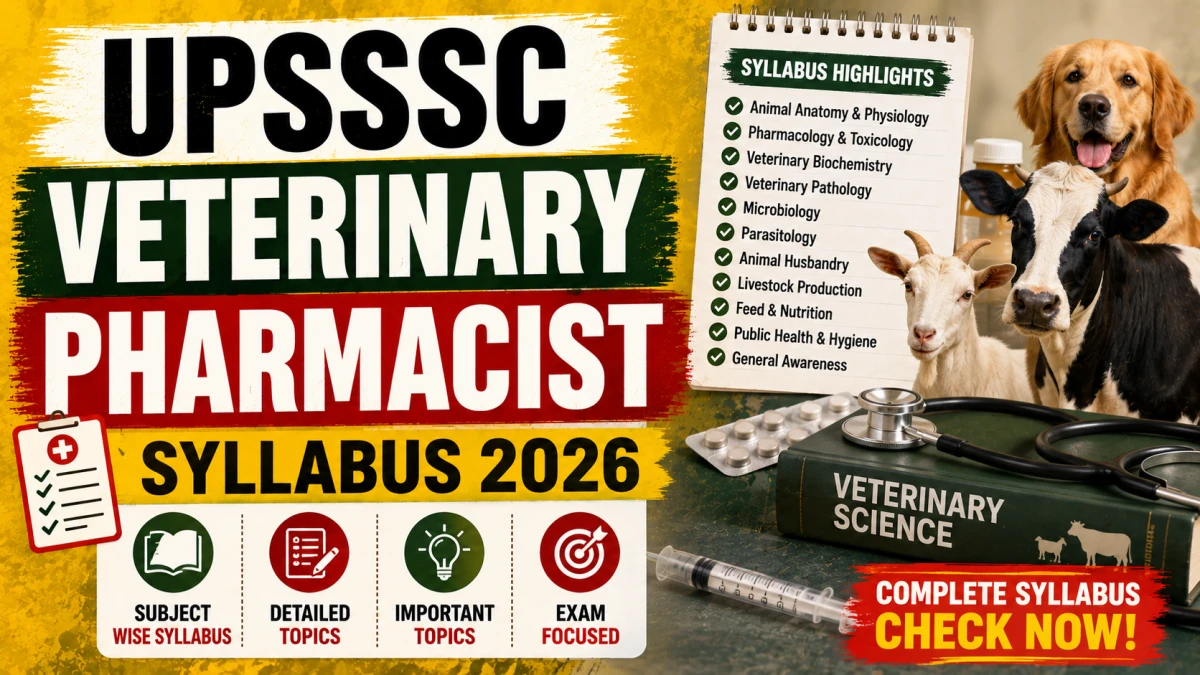
The Uttar Pradesh Subordinate Services Selection Commission (UPSSSC) has released the syllabus and exam pattern for the Veterinary Pharmacist Main Examination 2026 (PET-2025) under Advertisement No. 18-Pariksha/2026. This article covers the complete UPSSSC Veterinary Pharmacist Syllabus 2026, subject-wise topics, exam pattern, marking scheme, and selection process, so that candidates can plan their preparation in the right direction.
UPSSSC Veterinary Pharmacist Syllabus and Exam Pattern 2026 - Overview
| Particulars | Details |
|---|---|
| Conducting Body | Uttar Pradesh Subordinate Services Selection Commission (UPSSSC) |
| Post Name | Veterinary Pharmacist |
| Advertisement No. | 18-Pariksha/2026 |
| Exam Stage | Main Written Examination (PET-2025 based shortlisting) |
| Total Questions | 100 objective-type MCQs |
| Total Marks | 100 |
| Exam Duration | 2 hours (120 minutes) |
| Negative Marking | 0.25 mark deducted per wrong answer |
| Official Website | upsssc.gov.in |
UPSSSC Veterinary Pharmacist Selection Process 2026
Selection for the Veterinary Pharmacist post is based on the following stages, as per the official notification:
- PET Shortlisting: Only candidates who appeared in the Preliminary Eligibility Test (PET) 2025 and hold a valid, non-negative normalized score are eligible to apply. Shortlisting for the Main Examination is done purely on the basis of the candidate's normalized PET-2025 score, in category-wise merit order.
- Written (Main) Examination: A single objective-type question paper of 100 questions and 100 marks, as detailed in the exam pattern below.
- Document Verification: Shortlisted candidates are required to produce original documents for verification.
- Final Selection: Based on the candidate's performance in the Main Written Examination and successful document verification.
Final merit is determined solely by marks scored in the Main Written Examination; there is no separate interview stage for this post.
UPSSSC Veterinary Pharmacist Exam Pattern 2026
Main Written Exam Pattern
| Part | Subject | Marks |
|---|---|---|
| Part 1 | Subject-related Knowledge (Veterinary Pharmacist subjects) | 65 |
| Part 2 | Computer & Information Technology Concepts | 15 |
| Part 3 | General Information Related to Uttar Pradesh | 20 |
| Total | 100 |
Important points:
- The written examination consists of 100 objective-type multiple-choice questions carrying 100 marks in total.
- Each question carries 1 mark.
- Total exam duration is 2 hours (120 minutes).
- Negative marking is applicable: 0.25 mark (¼) is deducted for every wrong answer.
- If the exam is conducted across multiple shifts or days, scores will be normalized as per the Commission's notified procedure (Essential Information No. 42/05/Vigyapan Anu.(Eleven)/2019 dated 22/05/2019).
- Part 1 (Subject-related Knowledge) carries the highest weightage of the three parts, at 65 out of 100 marks.
Also Read: UP Home Guard PET Date Notice 2026
UPSSSC Veterinary Pharmacist Syllabus 2026
The syllabus is divided into three parts Veterinary Pharmacist subject knowledge, Computer & Information Technology, and General Information related to Uttar Pradesh. The detailed subject-wise and topic-wise breakdown is given below.
1. Anatomy of Livestock and Poultry
- Study of the skeletal system, major bones, and joints
- Structural layout of digestive, respiratory, and circulatory systems
- Location of uro-genital systems
- Nervous systems
- Sense organs
- Superficial lymph nodes
2. Introduction to Livestock Management
- Basic terminology for managing cattle, buffalo, sheep, goat, horses, camels, and pigs
- Animal housing designs
- Daily routine management such as grooming, washing, dipping, and shearing
- Handling pregnant animals
- Newborn calf rearing
- Methods such as dehorning and castration
3. Introduction to Livestock Breeds and Economic Traits
- Identification of popular native, exotic, and crossbred livestock breeds
- Basic systems of breeding, including in-breeding and cross-breeding
- Maintaining essential livestock farm records
- Farm economics
4. Basics of Animal Nutrition and Health
- Types of livestock feeds
- Fodders
- Balanced ration formulation
- Nutritional deficiencies
- Primary signs of poor health in farm animals
5. Basics of Animal Physiology
- Elementary knowledge of the physiological functions of various organs of livestock and poultry
6. Basics of Clinical Pathology
- Introduction to common laboratory tools
- Sterilization practices
- Routine sample processing
- Blood analysis
- Urine analysis
- Fecal analysis
7. Elementary Parasitology
- Identification of common internal parasites, including worms and flukes
- Identification of external parasites, including ticks, mites, and lice
- Life cycles of parasites
- Common deworming schedules
8. Fundamentals of Pharmacology
- Basic classification of veterinary medicines and their sources
- Methods of drug administration, including oral administration, injections, and ointments
- Basic concepts of drug dosage calculation
- Side effects of medicines
- Storage rules for medicines
9. Clinical Biochemistry & Introduction to Gynaecology
- Understanding blood serum parameters
- Elementary knowledge of livestock reproduction
- Pregnancy diagnosis assistance
10. Basics of Clinical Veterinary Medicine
- Basic knowledge of different livestock and poultry diseases
- Identification of diseases on the basis of gross physical examination
- Identification based on physiological parameters and their methods
- General principles of prevention and control of diseases
11. Veterinary Clinical Pharmacy
- Compounding techniques
- Preparation of mixtures, lotions, ointments, powders, and tinctures
- Dispensing science
- Correct labelling of medicines
- Reading prescriptions correctly
- Packing medicines
- Inventory control
- Cold-chain management for vaccines
- Tracking expiry dates
- Maintaining narcotic drug registers
12. Preliminary Surgical Procedures
- Introduction to surgical instruments
- Sterilization
- Autoclave operations
- Preparing animals for surgery, including shaving and antiseptic cleaning
- Wound dressing
- Bandaging
- Post-operative animal monitoring
- Suture care
13. Pharmacist Jurisprudence
- Laws governing the sale, storage, and distribution of animal medicines in India
- Ethics of a veterinary pharmacy practitioner
14. Farm Management & Extensions
- Maintaining daily hygiene on a dairy or poultry farm
- Bio-security on a dairy or poultry farm
- Communicating basic health practices to farmers
- Helping organize animal health camps
15. Hospital Practice Training
- Complete hands-on training inside a veterinary polyclinic setup
- Handling emergency cases
- Assisting veterinarians during physical examinations
- Managing incoming pharmacy stock
16. Computer and Information Technology Concepts (Part 2)
- History, introduction, and application of Computer, Information Technology, Internet, and World Wide Web (WWW)
- Hardware and Software
- Input and Output devices
- Internet Protocol / IP Address
- IT gadgets and their application
- Creation of e-mail ID and use/operation of e-mail
- Operation of Printer, Tablet, and Mobile
- Important elements of Word Processing (MS-Word) and Excel Processing (MS-Excel)
- Operating System, Social Networking, and e-Governance
- Digital Financial Tools and Applications
- Future Skills and Cyber Security
- Technological Development and Innovation in Computer and IT, including Artificial Intelligence, Big Data Processing, Deep Learning, Machine Learning, and Internet of Things (IoT)
- India's achievements in the field of Computer and Information Technology
17. General Information Related to the State of Uttar Pradesh (Part 3)
- History and culture of Uttar Pradesh
- Art, architecture, festivals, and folk dance
- Literature, regional languages, and heritage
- Social customs and tourism
- Geographical landscape, environment, natural resources, climate, soil, forest, and wildlife
- Mines and minerals
- Economy, agriculture, industry, business, and employment
- Polity and administration of Uttar Pradesh
- Current events and achievements of Uttar Pradesh in various fields
Also Read: Haryana Court Clerk Admit Card 2026
How to Prepare for UPSSSC Veterinary Pharmacist Exam 2026
- Start with Part 1 first, since it carries the highest weightage (65 of 100 marks) build strong basics in animal anatomy, pharmacology, and clinical veterinary medicine before moving to other sections.
- Make a subject-wise timetable that gives proportionate time to each part based on its marks share, rather than spending equal time on all three parts.
- Practice MCQs on computer fundamentals and current government IT initiatives for Part 2, since it tests applied digital literacy rather than deep technical knowledge.
- Revise Uttar Pradesh general knowledge (history, geography, current affairs) regularly for Part 3, as this section changes with recent developments.
- Attempt full-length mock tests within the 2-hour time limit to build speed and accuracy, keeping the 0.25 negative marking rule in mind while attempting questions.
- Revise weak topics identified from mock test performance instead of repeatedly studying only familiar areas.
UPSSSC Veterinary Pharmacist Syllabus 2026 - Important Links
| UPSSSC Veterinary Pharmacist Official Notification PDF | Click Here |
| UPSSSC Official Website | Click Here |