
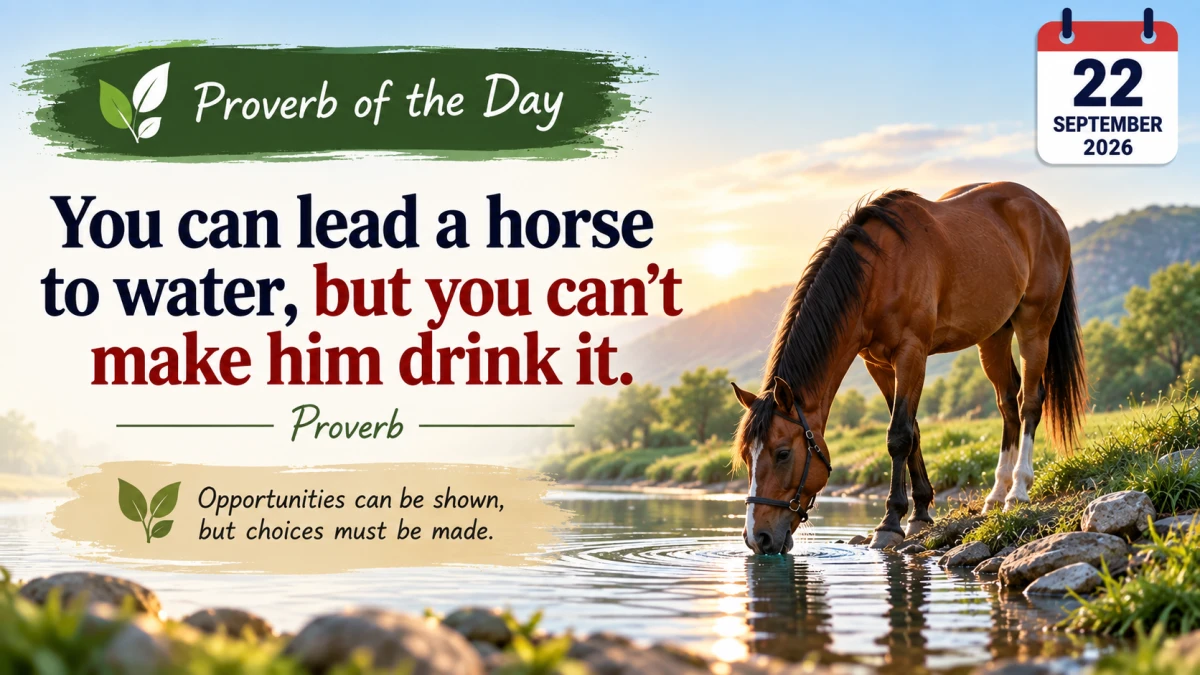
Proverb of the Day
“You can lead a horse to water, but you can’t make him drink it.”
This well-known English proverb teaches an important lesson about choice, willingness, and personal responsibility. You may give someone an opportunity, advice, help, or guidance, but you cannot force that person to accept it or act on it.
In simple words, we can show people what is good for them, but the final decision is theirs.
Meaning of “You Can Lead a Horse to Water, but You Can’t Make Him Drink It”
The proverb means that you can provide someone with an opportunity or useful advice, but you cannot force them to take advantage of it.
Just as a person can take a horse to a place where water is available but cannot force the horse to drink, we can guide or encourage people without being able to control their decisions.
Simple Meaning
You can help or advise someone, but you cannot force them to do what is best for them.
Detailed Explanation
There are many situations in life where people try to help others.
A teacher may explain an important lesson to a student. A parent may advise a child to study regularly. A doctor may recommend a healthier lifestyle. A friend may suggest a good career opportunity.
However, after receiving the advice or opportunity, the individual must decide whether to act on it.
For example, a teacher can provide notes, books, practice questions, and guidance to a student. But if the student does not study, the teacher cannot force the student to learn.
This is exactly what the proverb “You can lead a horse to water, but you can’t make him drink it” expresses.
It reminds us that guidance has limits. People must make their own choices and take responsibility for their actions.
Example of the Proverb
Imagine that Rahul is preparing for a competitive examination.
His friend gives him useful books, a study schedule, mock tests, and preparation tips. However, Rahul spends most of his time watching videos and does not study seriously.
His friend has provided all the necessary help, but Rahul must decide whether to use it.
In this situation, we can say:
“You can lead a horse to water, but you can’t make him drink it.”
The opportunity and guidance are available, but the final action depends on Rahul.
Real-Life Examples
Example 1: Education
A teacher provides students with study material and explains every topic clearly. However, some students may still choose not to study.
The teacher can provide the opportunity to learn, but students must make the effort themselves.
Example 2: Career
A friend tells someone about an excellent job opening and even helps prepare the application. However, the person never submits the application.
The opportunity was available, but the person chose not to use it.
Example 3: Health
A doctor may advise a patient to exercise regularly and eat healthier food. However, the patient must decide whether to follow that advice.
The doctor can guide the patient but cannot control every decision.
Example 4: Financial Advice
Someone may explain the importance of saving money to a friend who spends everything they earn.
The advice can be given, but the friend must decide whether to change their habits.
Use of the Proverb in a Sentence
Here are a few examples:
-
I gave him all the study materials, but he still refuses to prepare. You can lead a horse to water, but you can’t make him drink it.
-
Her parents encouraged her to attend the training program, but she was not interested. You can lead a horse to water, but you can’t make him drink it.
-
The manager provided the team with excellent tools, but some employees did not use them properly. You can lead a horse to water, but you can’t make him drink it.
-
We explained the benefits of the course several times, but the final decision is his. After all, you can lead a horse to water, but you can’t make him drink it.
Moral of the Proverb
The main lesson behind this proverb is that people must make their own decisions.
You can:
-
provide guidance,
-
share knowledge,
-
offer opportunities,
-
encourage someone,
-
explain the benefits,
-
and support them.
But ultimately, that person must decide whether to take action.
The proverb also reminds us not to become frustrated when someone refuses good advice. Sometimes, people need to learn from their own experiences before they are ready to change.
Why This Proverb Is Important
This proverb remains relevant because it applies to many areas of everyday life, including education, careers, relationships, health, parenting, and personal development.
It teaches two important ideas.
First, helping others is valuable. Giving someone useful information or an opportunity can make a real difference.
Second, every person has responsibility for their own choices.
Successful guidance requires both support from others and willingness from the individual receiving that support.
Origin of the Proverb
“You can lead a horse to water, but you can’t make him drink” is one of the oldest commonly used English proverbs.
Its wording has changed slightly over the centuries, but the basic idea has remained the same: an opportunity can be offered, but acceptance cannot be forced.
Today, the proverb is commonly used whenever someone refuses to follow helpful advice or take advantage of an opportunity placed before them.
Similar Proverbs and Expressions
Several sayings communicate a similar idea:
“Advice is easier given than followed.”
People may receive good advice but choose not to act on it.
“You can’t help someone who doesn’t want to help themselves.”
Real improvement usually requires willingness from the individual.
“Every man is the architect of his own fortune.”
A person's choices and actions play an important role in shaping their future.
When Can You Use This Proverb?
You can use this proverb when:
-
someone ignores useful advice,
-
a student refuses to study despite receiving help,
-
someone fails to use a good opportunity,
-
a person refuses to change an unhealthy habit,
-
an employee ignores training or guidance,
-
or someone repeatedly rejects support.
It is especially useful when you want to explain that help can be offered, but action cannot be forced.
Short Story Based on the Proverb
A teacher noticed that one of her students, Arun, was struggling with mathematics.
She gave him additional notes, explained difficult problems after class, recommended useful practice exercises, and even created a simple study timetable for him.
However, Arun rarely practiced at home.
When the examination arrived, he received low marks.
Another teacher asked why he had performed poorly despite receiving so much support.
The teacher replied:
“I gave him every opportunity to improve, but you can lead a horse to water, but you can’t make him drink it.”
The story shows that guidance is useful only when a person is willing to act on it.
Proverb of the Day Lesson
Today’s lesson: Help people whenever you can, but remember that everyone must ultimately make their own choices.
Opportunities, advice, education, and encouragement can open the door, but the individual must decide to walk through it.
The proverb “You can lead a horse to water, but you can’t make him drink it” reminds us that advice and opportunities alone are not enough. A person must be willing to take action.
Whether in education, career, health, or everyday life, we can encourage and support others, but their final decisions remain their own.
That is why this proverb continues to be relevant even today: guidance can show the way, but willingness determines whether a person moves forward.