
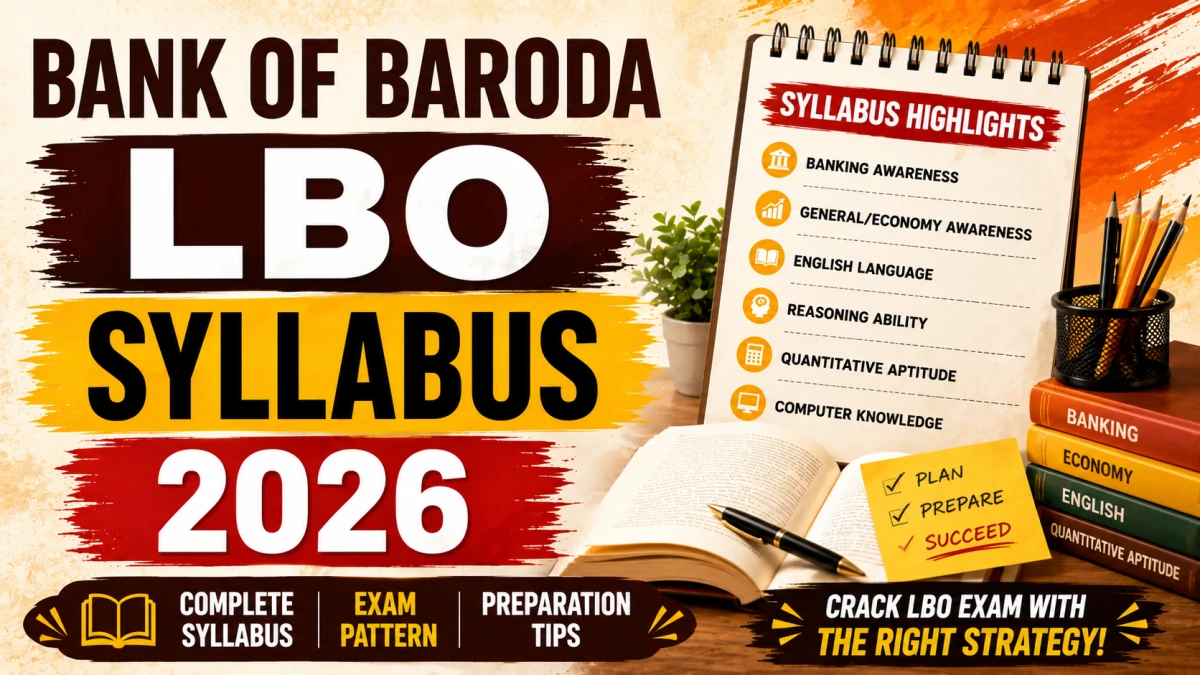
The Bank of Baroda LBO Syllabus 2026 is the starting point for anyone preparing for the Local Bank Officer recruitment exam. Bank of Baroda conducts this exam to select officers for local banking operations, and candidates who understand the syllabus and exam pattern together tend to plan their preparation far more effectively than those who don't. This article covers the complete Bank of Baroda LBO Syllabus and Exam Pattern 2026, subject-wise topics, marking scheme, and a practical preparation strategy, based on the official exam pattern released for this recruitment cycle.
Bank of Baroda LBO Syllabus and Exam Pattern 2026 - Overview
Before getting into subject-wise details, here is a quick snapshot of the Bank of Baroda LBO exam.
| Particulars | Details |
|---|---|
| Conducting Body | Bank of Baroda |
| Post Name | Local Bank Officer (LBO) |
| Selection Process | Online Written Exam, Group Discussion & Interview |
| Exam Mode | Online |
| Exam Medium | English and Hindi |
| Question Type | Multiple Choice Questions (MCQ) |
| Total Questions | 120 |
| Total Marks | 120 |
| Total Duration | 120 Minutes |
| Negative Marking | 0.25 marks deducted per wrong answer |
| Official Website | bankofbaroda.bank.in |
Bank of Baroda LBO Selection Process 2026
The Bank of Baroda LBO recruitment is completed in stages, and candidates need to clear each one to move ahead in the process.
- Online Written Exam: This is the first and only objective stage. It consists of 120 MCQ-based questions across four sections, and candidates must clear the qualifying marks in this stage to be considered for shortlisting.
- Shortlisting for Group Discussion & Interview: Candidates who score above the minimum qualifying marks in the online exam, based on category-wise cut-offs, are shortlisted for the next stage.
- Group Discussion & Interview: Shortlisted candidates are called for a Group Discussion and/or Interview round. Final selection is based on performance across the stages applicable to this recruitment.
Marks scored in the four sections of the written exam are combined to prepare the merit list used for shortlisting candidates to the next stage.
Also Read: Bank of Baroda LBO Recruitment 2026 Notification Out
Bank of Baroda LBO Exam Pattern 2026
The BOB LBO Exam Pattern 2026 has a single online test stage covering four sections. Here are the complete details.
Online Written Exam Pattern
| Section | Name of the Test | No. of Questions | Maximum Marks | Duration | Medium |
|---|---|---|---|---|---|
| 1 | English Language | 30 | 30 | 30 Minutes | English |
| 2 | Banking Knowledge | 30 | 30 | 30 Minutes | Bilingual |
| 3 | General / Economic Awareness | 30 | 30 | 30 Minutes | Bilingual |
| 4 | Reasoning Ability & Quantitative Aptitude | 30 | 30 | 30 Minutes | Bilingual |
| Total | 120 | 120 | 120 Minutes | - | |
Key points about the exam pattern:
- All sections except English Language are available in both English and Hindi.
- Each section has its own separate timing within the total 120-minute duration.
- There is a penalty of 0.25 marks for every wrong answer. There is no penalty for questions left unanswered.
- Marks from all four sections are added together to determine the overall merit for shortlisting.
Minimum Qualifying Marks by Category
| Category | Minimum Qualifying Marks |
|---|---|
| General & EWS | 40% |
| Reserved Categories (SC/ST/OBC/PwBD) | 35% |
Bank of Baroda LBO Syllabus 2026
The Bank of Baroda LBO Syllabus is spread across four sections. Below is the detailed, topic-wise breakdown for each subject.
1. English Language
- Reading Comprehension
- Cloze Test
- Para Jumbles
- Error Spotting
- Sentence Improvement
- Fill in the Blanks
- Vocabulary
- Synonyms & Antonyms
- Idioms & Phrases
- Active-Passive Voice
- Direct-Indirect Speech
2. Banking Knowledge
- Basics of Banking & Financial Terms
- Types of Accounts
- RBI & its Functions
- Monetary Policy
- Basel Norms
- Digital Banking & UPI
- NPA, CRR, SLR, Repo & Reverse Repo Rates
- Latest Developments in the Banking Sector
- Banking Abbreviations
- Important Acts related to Banking (Banking Regulation Act, Negotiable Instruments Act, etc.)
3. General / Economic Awareness
- Current Affairs (last 4-6 months) - National & International
- Government Schemes & Policies
- Union Budget & Economic Survey
- Important Appointments & Awards
- India's GDP, Inflation, Fiscal Deficit
- Static GK (Important Days, Capitals, Currencies, etc.)
- International Financial Institutions (IMF, World Bank, ADB, etc.)
4. Reasoning Ability & Quantitative Aptitude
(A) Reasoning Ability
- Puzzles & Seating Arrangement
- Syllogism
- Coding-Decoding
- Blood Relations
- Inequality
- Direction Sense
- Input-Output
- Statement & Conclusion
- Order & Ranking
(B) Quantitative Aptitude
- Simplification & Approximation
- Number Series
- Data Interpretation (Tables, Bar, Pie Charts)
- Ratio & Proportion
- Percentage
- Profit & Loss
- Simple & Compound Interest
- Time & Work
- Time, Speed & Distance
- Average
- Mixtures & Allegations
Also Read: SSC CHSL 2025 FRTA Result
How to Prepare for Bank of Baroda LBO Exam 2026
- Map the syllabus to a timetable first: Break the four sections into weekly targets instead of studying randomly, and give more days to sections you find weaker.
- Prioritise Banking Knowledge and Economic Awareness early: These two sections need consistent daily reading, so start them at the very beginning of your preparation rather than saving them for later.
- Practise Reasoning and Quant topic-by-topic: Master one topic (like Puzzles or Data Interpretation) with timed practice before moving to the next, rather than mixing all topics together.
- Solve previous year papers and full-length mocks: Once the syllabus is covered, simulate the actual 120-minute, section-timed format so you get used to the sectional time limits.
- Track wrong answers, not just scores: Since there's a 0.25 negative mark per wrong answer, review every mock test to identify guesswork mistakes versus genuine knowledge gaps.
- Revise current affairs weekly: General/Economic Awareness content changes fast, so set aside a fixed weekly slot to revise the last 4-6 months of current affairs rather than reading it only once.