
GPRB PSI Motor Transport Syllabus 2026
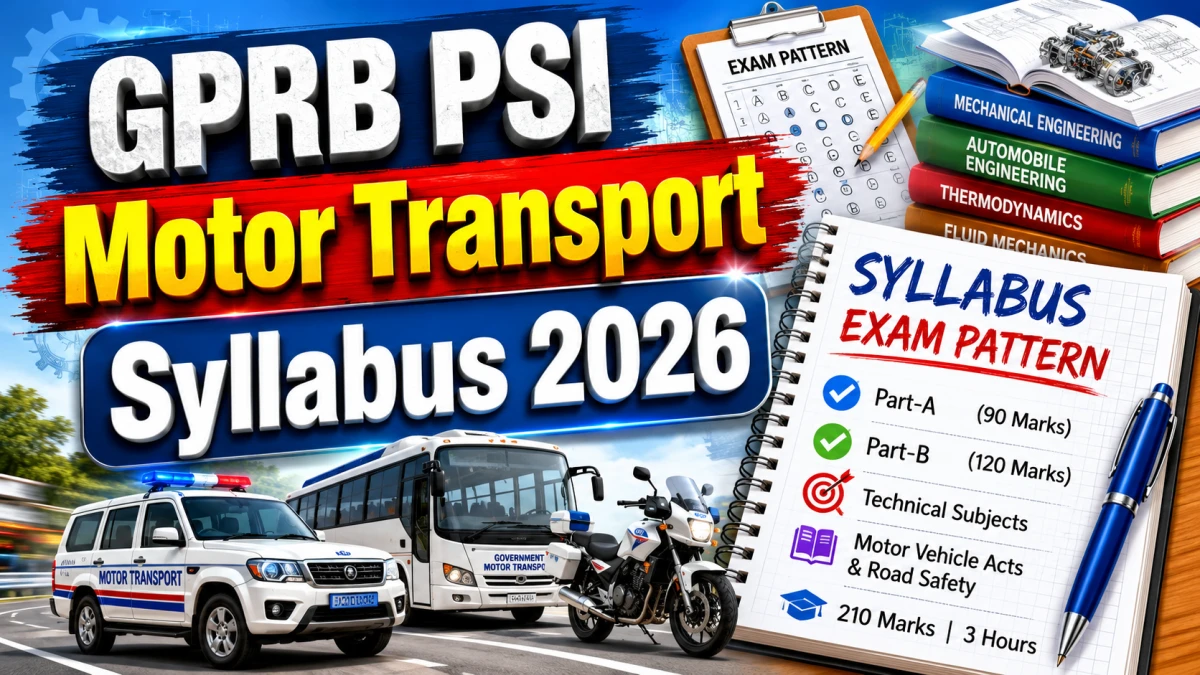
GPRB PSI Motor Transport Syllabus and Exam Pattern 2026 has been officially released by the Gujarat Police Recruitment Board for candidates preparing for the PSI Motor Transport recruitment examination. The written exam will be conducted for a total of 210 marks with objective-type multiple-choice questions divided into Part-A and Part-B.
Candidates preparing for the exam should carefully check the latest subject-wise syllabus, marking scheme, negative marking rules, qualifying marks, and technical topics before starting preparation. The syllabus includes important subjects such as Reasoning, Quantitative Aptitude, Current Affairs, Automobile Engineering, IC Engines, Thermodynamics, Fluid Mechanics, Motor Vehicle Acts, and Road Safety Rules. Candidates can also download the official GPRB PSI Motor Transport Syllabus 2026 PDF to prepare according to the latest exam pattern and improve their chances of selection.
GPRB PSI Motor Transport Syllabus Overview
| Particulars | Details |
|---|---|
| Organization Name | Gujarat Police Recruitment Board (GPRB) |
| Exam Name | GPRB PSI Motor Transport Exam 2026 |
| Advertisement No. | GPRB/202526/3 |
| Category | Syllabus |
| Exam Type | Objective Type (MCQ) |
| Total Questions | 210 Questions |
| Total Marks | 210 Marks |
| Duration | 3 Hours |
| Negative Marking | 0.25 Marks Deducted for Each Wrong Answer |
Download GPRB PSI Motor Transport Syllabus 2026 PDF
The official GPRB PSI (Wireless) and Technical Operator Syllabus PDF 2026 is available for download. Candidates can access the complete syllabus with all subject-wise topics, weightage, and exam pattern details.
Click Here to GPRB PSI Motor Transport Syllabus 2026 PDF
Note: This is the official link from GPRB website. The PDF includes the complete and updated syllabus for 2026 exam.
GPRB PSI Motor Transport Exam Pattern 2026
Part‑A Pattern (90 Marks)
| S.NO | /Subject | Marks |
|---|---|---|
| 1 | Reasoning), Data Interpretation | 30 |
| 2 | (Quantitative Aptitude) | 30 |
| 3 | Comprehension (Constitution of India, Current affairs, English & Gujarati Comprehension) | 30 |
| Total | 90 |
Part‑B Pattern (120 Marks)
Part‑B has 120 questions for 120 marks, split into:
-
Mechanical / Automobile / Production / Thermal core subjects -100 marks (Sr. 1–20 below).
-
Acts, Rules, Guidelines & Policies related to Motor Vehicles & Road Safety -20 marks (Sr. 21–27).
Total of Part‑B = 100 + 20 = 120 marks.
GPRB PSI Motor Transport Syllabus 2026 - Part‑A
Part‑A is common aptitude and general awareness.
1. Reasoning & Data Interpretation (30 Marks)
- Logical reasoning (analogy, classification, series, coding–decoding, blood relations, direction sense, order & ranking, syllogism)
- Analytical puzzles and seating arrangements (as per PSI‑level pattern)
- Data Interpretation: basic tabular, bar, line or pie‑chart based sets aligned to mechanical/transport examples where applicable
2. Quantitative Aptitude (30 Marks)
- Number system and arithmetic basics
- Percentage, ratio & proportion
- Average
- Profit and loss, discount
- Simple & compound interest
- Time, speed & distance
- Time & work
- Simple data interpretation/calculations
3. Constitution, Current Affairs, English & Gujarati Comprehension (30 Marks)
- Constitution of India: Preamble, Fundamental Rights & Duties, Directive Principles, Union & State government structure, basic provisions relevant to police/administration.
- Current Affairs: Major state, national and international events; government schemes; important appointments; sports; awards.
- English & Gujarati Comprehension: Reading passages and questions to test understanding, vocabulary, and simple grammar in both languages.
GPRB PSI Motor Transport Syllabus 2026 -Part‑B (Technical & Acts)
Below is exactly the topic list from the official syllabus.
1. Engineering Drawing (100 marks starts with this subject) -part of 100‑mark technical block
- Engineering curves
- Projection of points, lines and planes
- Orthographic projections
- Isometric projections
2. Engineering Mechanics
- Free‑body diagrams and equilibrium
- Friction and its applications including rolling friction; belt–pulley, brakes, clutches, screw jack, wedge, vehicles, etc.
- Trusses and frames
- Virtual work
- Kinematics and dynamics of rigid bodies in plane motion
- Impulse and momentum (linear and angular) and energy formulations
- Lagrange’s equation
3. Mechanics of Materials
- Stress and strain, elastic constants, Poisson’s ratio
- Mohr’s circle for plane stress and plane strain
- Thin cylinders
- Shear force and bending moment diagrams
- Bending and shear stresses; concept of shear centre
- Deflection of beams
- Torsion of circular shafts
- Euler’s theory of columns
- Energy methods
- Thermal stresses
- Strain gauges and rosettes
- Testing of materials with universal testing machine
- Testing of hardness and impact strength
4. Theory of Machines
- Displacement, velocity & acceleration analysis of plane mechanisms
- Dynamic analysis of linkages
- Cams
- Gears and gear trains
- Flywheels and governors
- Balancing of reciprocating and rotating masses
- Gyroscope
5. Vibrations
- Free and forced vibration of single degree‑of‑freedom systems
- Effect of damping
- Vibration isolation
- Resonance
- Critical speeds of shafts
6. Machine Design
- Design principles of machine elements such as:
- Bolted, riveted and welded joints
- Shafts and gears
- Rolling and sliding contact bearings
- Brakes and clutches
- Springs
7. Fluid Mechanics
- Fluid properties
- Fluid statics; forces on submerged bodies; stability of floating bodies
- Control‑volume analysis of mass, momentum and energy; fluid acceleration
- Differential equations of continuity and momentum; Bernoulli’s equation
- Dimensional analysis
- Viscous flow of incompressible fluids; boundary layer; elementary turbulent flow
- Flow through pipes; head losses in pipes, bends and fittings
- Basics of compressible fluid flow
8. Heat Transfer
- Modes of heat transfer -conduction, convection, radiation
- Heat exchangers
- Two‑phase heat transfer
9. Thermodynamics
- Thermodynamic systems and processes
- Properties of pure substances; behaviour of ideal and real gases
- Zeroth and first laws of thermodynamics; calculation of work and heat in various processes
- Second law of thermodynamics
- Thermodynamic property charts and tables, availability and irreversibility
- Thermodynamic relations
10. Applications
Power Engineering
- Air and gas compressors
- Vapour and gas power cycles
- Concepts of regeneration and reheat
I.C. Engines
- Air‑standard Otto, Diesel and dual cycles
Refrigeration & Air‑Conditioning
- Vapour and gas refrigeration and heat pump cycles
- Properties of moist air
- Psychrometric chart and basic psychrometric processes
11. Materials and Manufacturing
- Structure and properties of engineering materials
- Heat treatment
- Casting, forming and joining processes
- Conventional manufacturing processes
12. Metrology and Inspection
- Limits, fits and tolerances
- Linear and angular measurements
- Tolerance analysis in manufacturing and assembly
13. Computer Integrated Manufacturing
- Basic concepts of CAD/CAM
- Integration tools
- Additive manufacturing
14. Production Planning and Control
- Forecasting models
- Aggregate production planning
- Scheduling
- Materials requirement planning (MRP)
- Lean manufacturing
15. Internal Combustion Engine
- IC engine parts and their functions
- Types and classification of IC engines
- Types of fuels used in IC engines and their properties
- Working of petrol and diesel engines
- Fuel injection systems -petrol, diesel, LPG, CNG; MPFI
- Cooling & lubricating system of IC engines
- Combustion process
- Performance test on IC engine
- Eco‑friendly fuels -conventional, LPG, CNG, bio‑fuel
16. Automobile Engineering
- Anatomy of vehicles
- Automobile systems
- Clutch -necessity, types, constructional & functional details
- Necessity and types of transmission system
- Brake and suspension systems
- Control systems
- Conventional steering and power steering
- Electrical systems -starting, ignition and lighting
- Repairs and maintenance of automobiles
17. Pollution & Vehicle Insurance
- Exhaust gases emission control systems
- CNG conversion
- Vehicle noise and its control
- National and international standard norms for exhaust gas pollution control
- PUC certification
- Licensing, regulation of motor vehicles
- Motor vehicle insurance
18. Diagnosis & Testing of Vehicle
- Testing and diagnosis of various elements of the automobile engine
- Testing & diagnosis of transmission, electrical and electronic systems
- Performance testing
19. Electric & Hybrid Vehicle
- Electric vehicles and hybrid vehicles
- Electric propulsion systems
- Energy storage devices
- Fuel cell and solar‑powered vehicles
20. AI & ML in Automotive Industry
- Role of AI & ML in the automotive sector
- Predictive vehicle technology and future of automobiles (self‑driving technology)
- Cruise control for driverless cars
- Collision avoidance technology (CA system)
Note: The official syllabus clearly states that the above topics cover current trends and recent advancements in the relevant field.
Acts, Rules, Guidelines & Judgments (20 Marks)
These carry 20 marks within Part‑B.
-
The Motor Vehicles Act, 1988 (with amendments) -core provisions relevant to licensing, registration, regulation and offences.
-
The Central Motor Vehicles Rules, 1989 (CMVR) –
-
Chapter I: Preliminary
-
Chapter II: Licensing of Driving of Motor Vehicles
-
Chapter III: Registration of Motor Vehicles
-
Chapter IV: Control of Transport Vehicles
-
Chapter V: Construction, Equipment & Maintenance of Motor Vehicles
-
-
The Gujarat Motor Vehicles Rules, 1989 –
-
Chapter I: Preliminary
-
Chapter II: Licensing of Drivers of Motor Vehicles
-
Chapter III: Licensing of Conductors of Stage Carriages
-
Chapter IV: Registration of Motor Vehicles
-
Chapter V: Control of Transport Vehicles
-
Chapter VII: Construction, Equipment & Maintenance of Motor Vehicles
-
-
Gujarat Road Safety Policy 2016‑17
-
Motor Vehicle (Driving) Regulations, 2017
-
Gujarat Road Safety Authority Act, 2018
-
Supreme Court Committee on Road Safety guidelines
GPRB PSI Motor Transport Exam 2026 Preparation Tips
- Before starting preparation, carefully understand the official exam pattern including Part-A, Part-B, negative marking, and qualifying marks. Focus more on technical subjects as Part-B carries 120 marks.
- Technical topics like Automobile Engineering, Thermodynamics, IC Engines, Fluid Mechanics, and Machine Design are very important. Prepare short notes and revise formulas regularly.
- Since the exam is objective type, solve topic-wise MCQs and previous year questions daily. This improves speed and accuracy.
- The Motor Vehicles Act, CMVR Rules, Gujarat Motor Vehicle Rules, and Road Safety Policies carry dedicated marks. Read important sections and amendments carefully.
- The exam has 210 questions in 180 minutes. Practice mock tests regularly to improve speed and avoid spending too much time on difficult questions.
- Each wrong answer deducts 0.25 marks, so avoid random guessing. Attempt only questions you are reasonably confident about.
- Part-A includes Current Affairs and Constitution of India topics. Read daily current affairs and revise important constitutional articles and amendments.