
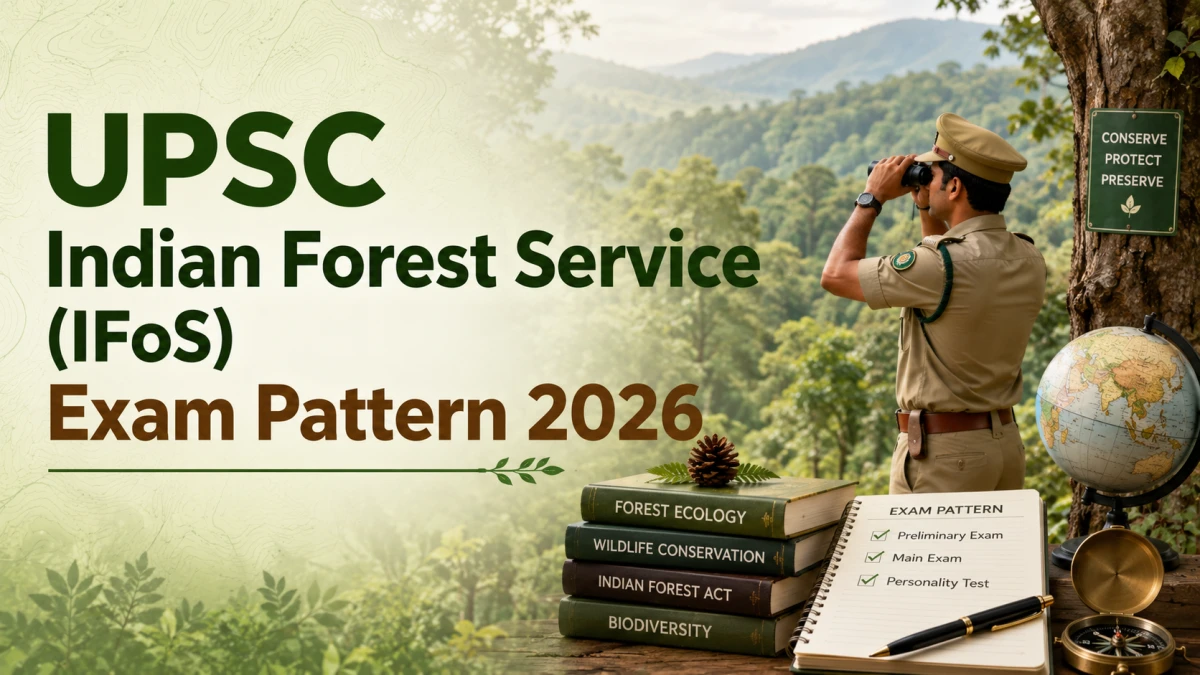
The UPSC Indian Forest Service (IFoS) Exam Pattern 2026 is a highly competitive three-stage examination conducted by the Union Public Service Commission to recruit officers for forest management, wildlife conservation, and environmental governance. It consists of Prelims (objective, common with IAS), Mains (6 descriptive papers totaling 1400 marks), and a 300-mark Interview.
Understanding the exact pattern and full detailed syllabus for every subject is crucial for success. This comprehensive guide provides the complete UPSC IFoS Exam Pattern 2026 along with exhaustive syllabus tables for all optionals.
UPSC Indian Forest Service (IFoS) Exam Pattern 2026: Click Here
Overview Table
| Stage | Papers | Type | Total Marks | Duration | Nature |
|---|---|---|---|---|---|
| Prelims | GS Paper I + CSAT Paper II | Objective | 400 | 4 hours (2+2) | Qualifying |
| Mains | 6 Papers (2 Compulsory + 4 Optional) | Descriptive | 1400 | 3 hours each | Merit |
| Interview | Personality Test | Oral | 300 | - | Final Merit |
UPSC IFoS Exam Pattern for Preliminary Examination
| Paper | Subject | Type | Marks | Duration | Qualifying Criteria | Negative Marking |
|---|---|---|---|---|---|---|
| Paper I | General Studies | Objective MCQ | 200 | 2 Hours | Counts for merit | 1/3rd |
| Paper II | CSAT | Objective MCQ | 200 | 2 Hours | Minimum 33% | 1/3rd |
UPSC IFoS Exam Pattern for Mains Examination
- Total Papers: 6 (All descriptive/essay-type)
- Paper I: General English – 300 marks
- Paper II: General Knowledge – 300 marks
- Papers III to VI: Two optional subjects (2 papers each, 200 marks per paper)
- Total Mains: 1400 marks
- Medium: English only
List of Optional Subjects
Agriculture, Agricultural Engineering, Animal Husbandry & Veterinary Science, Botany, Chemistry, Chemical Engineering, Civil Engineering, Forestry, Geology, Mathematics, Mechanical Engineering, Physics, Statistics, Zoology.
UPSC IFoS Interview / Personality Test
The Interview carries 300 marks. It assesses the candidate’s mental calibre, intellectual qualities, social traits, interest in current affairs (especially forestry & environment), and suitability for the service. Final merit is prepared on the basis of Mains (1400) + Interview (300) = 1700 marks.
UPSC IFS Mains Syllabus
General English (Paper I – 300 Marks)
| Topic | Details |
|---|---|
| Essay Writing | Essay in English on given topics |
| Comprehension | Questions to test understanding of passages |
| English Usage | Grammar, vocabulary, précis writing, summary, sentence correction |
General Knowledge (Paper II – 300 Marks)
| Topic | Details |
|---|---|
| Current Events | National and international |
| Indian Polity & Constitution | Political system, governance |
| History of India | Major events and movements |
| Geography of Nature | Physical, social & economic aspects |
Agriculture
Agriculture Paper I
| Topic | Key Details |
|---|---|
| Ecology & Environment | Relevance to man, natural resources, sustainable management, conservation, pollution hazards |
| Cropping Patterns | Agro-climatic zones, multiple cropping, intercropping, package of practices for major crops |
| Soil | Physical, chemical & biological properties, fertility, fertilizers, problem soils & reclamation |
| Water Management | Irrigation, drainage, water-use efficiency, watershed management |
| Farm Management & Extension | Economics, marketing, mechanization, extension programmes |
Agriculture Paper II
| Topic | Key Details |
|---|---|
| Cell Biology & Genetics | Cell theory, heredity, plant breeding, seed technology |
| Plant Physiology | Photosynthesis, respiration, growth regulators |
| Horticulture & Pests | Fruit & vegetable cultivation, preservation, diseases & pest management |
| Food Production | Major crops, biotechnology applications |
Agricultural Engineering
Paper I
| Topic | Key Details |
|---|---|
| Soil & Water Conservation | Techniques, planning, erosion control |
| Irrigation & Drainage | Principles, engineering practices, water management |
Paper II
| Topic | Key Details |
|---|---|
| Farm Machinery & Power | Mechanization, tools, energy sources |
| Process Engineering | Post-harvest technology, processing techniques |
Animal Husbandry & Veterinary Science
Paper I
| Topic | Key Details |
|---|---|
| Animal Nutrition | Requirements, diets, feeds |
| Genetics & Breeding | Reproductive genetics, breeding programmes |
Paper II
| Topic | Key Details |
|---|---|
| Health & Hygiene | Disease control, prevention, veterinary public health |
| Dairy & Meat Technology | Processing, hygiene, products technology |
Botany
Paper I
| Topic | Key Details |
|---|---|
| Plant Pathology | Microbiology, plant diseases |
| Morphogenesis | Developmental biology of plants |
Paper II
| Topic | Key Details |
|---|---|
| Genetics & Evolution | Molecular biology, genetic principles |
| Ecology & Plant Geography | Plant-environment interactions |
Chemistry
Paper I
| Topic | Key Details |
|---|---|
| Atomic Structure | Quantum models |
| Chemical Bonding | Types, molecular orbital theory |
| Thermodynamics | Laws, statistical applications |
| Electrochemistry | Ionic equilibria, electrode processes |
Paper II
| Topic | Key Details |
|---|---|
| Reaction Mechanisms | Kinetics, organic reactions |
| Polymer Chemistry | Properties, synthesis |
| Spectroscopy | Structure determination |
Chemical Engineering
Paper I
| Topic | Key Details |
|---|---|
| Fluid & Particle Dynamics | Flow behaviour |
| Heat & Mass Transfer | Conduction, convection, diffusion |
Paper II
| Topic | Key Details |
|---|---|
| Thermodynamics Applications | In chemical engineering |
| Environmental Engineering | Pollution control, waste management |
Civil Engineering
Paper I
| Topic | Key Details |
|---|---|
| Mechanics & Materials | Structural analysis |
| Fluid Mechanics | Hydraulics, fluid flow |
Paper II
| Topic | Key Details |
|---|---|
| Construction Technology | Equipment, planning, management |
| Environmental Engineering | Water supply, sanitation, pollution control |
Forestry
Forestry Paper I
| Topic | Key Details |
|---|---|
| Silviculture & Agroforestry | Techniques, systems, mangrove, social forestry |
| Forest Soils & Watershed | Soil conservation, watershed management |
| Environmental Conservation | Biodiversity, climate change |
| Tree Improvement | Seed technology |
Forestry Paper II
| Topic | Key Details |
|---|---|
| Forest Management | Working plans, mensuration, remote sensing |
| Forest Engineering & Survey | GIS, surveying |
| Forest Resources & Utilization | Wood technology, NTFP |
| Forest Protection & Wildlife | Pest control, wildlife biology |
| Forest Economics & Legislation | Policies, Forest Conservation Act |
Geology
Paper I
| Topic | Key Details |
|---|---|
| General Geology | Earth structure, processes |
| Stratigraphy & Paleontology | Rock layers, fossils |
Paper II
| Topic | Key Details |
|---|---|
| Mineralogy & Petrology | Minerals, rocks formation |
| Economic & Mining Geology | Resources, extraction |
Mathematics
Paper I
| Topic | Key Details |
|---|---|
| Linear Algebra | Matrices, vector spaces |
| Calculus | Differential & integral |
Paper II
| Topic | Key Details |
|---|---|
| Algebra & Analysis | Abstract algebra, real analysis |
| Numerical Analysis | Computational methods |
Mechanical Engineering
Paper I
| Topic | Key Details |
|---|---|
| Theory of Machines | Mechanisms, kinematics |
| Manufacturing Science | Processes, techniques |
Paper II
| Topic | Key Details |
|---|---|
| Thermodynamics | Thermal systems |
| Heat Transfer | Refrigeration, air-conditioning |
Physics
Paper I
| Topic | Key Details |
|---|---|
| Mechanics & Optics | Classical mechanics, physical optics |
| Electricity & Magnetism | Electromagnetic principles |
Paper II
| Topic | Key Details |
|---|---|
| Quantum Mechanics | Atomic physics |
| Solid State Physics | Crystallography, materials |
Statistics
Paper I
| Topic | Key Details |
|---|---|
| Probability | Theories, models |
| Sampling | Theory & design |
Paper II
| Topic | Key Details |
|---|---|
| Industrial Statistics | Production applications |
| Optimization Techniques | Operations research |
Zoology
Paper I
| Topic | Key Details |
|---|---|
| Non-Chordata & Chordata | Anatomy, classification |
| Ecology & Ethology | Ecosystems, animal behaviour |
Paper II
| Topic | Key Details |
|---|---|
| Genetics & Evolution | Heredity, evolutionary principles |
| Biochemistry & Physiology | Cellular processes, systems |
How to Prepare for UPSC IFoS Exam 2026 – Smart Preparation Tips?
- Understand the Exam Pattern Thoroughly: Go through the complete Prelims, Mains, and Interview pattern. Know that Prelims is only qualifying while Mains and Interview decide your final selection.
- Strengthen Prelims Foundation: Since Prelims is common with IAS, focus on NCERT books (Class 6–12) for General Studies. Solve previous year papers and attempt mock tests regularly.
- Focus on CSAT: Don’t ignore CSAT (Paper II). Practice comprehension, maths, and reasoning daily to secure minimum 33% marks easily.
- Choose Optional Subjects Wisely: Select subjects based on your graduation background and interest. Forestry and Agriculture are highly recommended for IFoS as they are scoring and relevant to the service.
- Build Answer Writing Skills for Mains: Practice writing descriptive answers daily. Focus on clarity, structure, and presentation. Join a test series for Mains answer evaluation.
- Special Focus on Forestry & Environment: Read current affairs related to forests, wildlife, climate change, and environmental policies regularly. Follow Ministry of Environment, Forest and Climate Change updates.
- Make Short Notes: Prepare concise notes for General English, General Knowledge, and both optional subjects. Revise them multiple times.
- Current Affairs is the Key: Read The Hindu or Indian Express daily. Make notes on national and international environment-related news.
- Practice Previous Year Papers: Solve last 10 years’ UPSC IFoS question papers to understand the type of questions asked.
- Time Management & Consistency: Make a realistic timetable and follow it strictly. Give at least 8–10 hours daily. Take short breaks to avoid burnout.
- Prepare for Interview Early: Develop knowledge about forestry issues, your DAF (Detailed Application Form), and current environmental challenges. Improve communication and confidence.
- Stay Healthy & Motivated: Take care of your physical and mental health. Regular exercise and proper sleep are important during long preparation.