
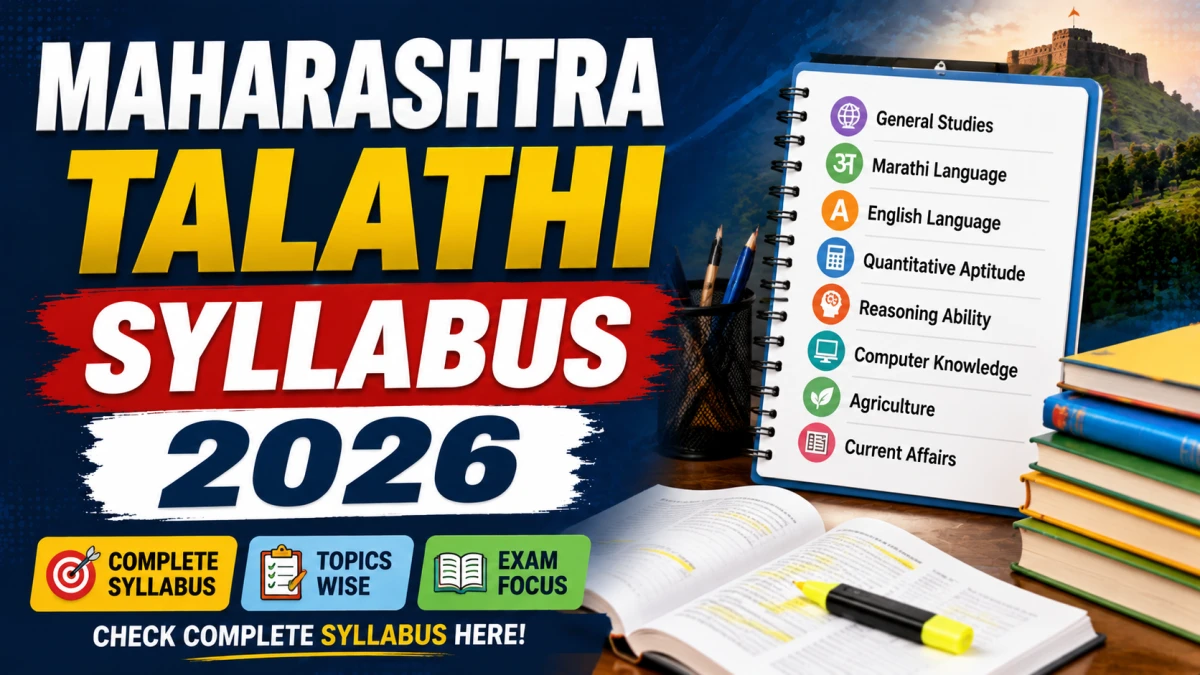
Maharashtra Talathi Syllabus 2026 has been released by the Maharashtra Public Service Commission for candidates preparing for the upcoming Talathi Bharti recruitment exam. The Talathi exam 2026 is conducted in Computer Based Test (CBT) mode and covers four key subjects - Marathi, English, General Knowledge, and General Intelligence/Mathematics. Candidates must go through the detailed Maharashtra Talathi syllabus and exam pattern to understand the topic-wise weightage, total marks, and exam duration before starting their preparation. This article covers the complete Talathi syllabus 2026 PDF details, subject-wise topics, marking scheme, and preparation tips to help candidates crack the exam with a strong strategy.
Maharashtra Talathi Syllabus 2026 - Overview
| Particulars | Details |
|---|---|
| Conducting Body | Maharashtra Public Service Commission |
| Post Name | Talathi |
| Exam Mode | Online (CBT) |
| Selection Process | Written Examination + Document Verification |
| Subjects Covered | Marathi, English, General Knowledge, General Intelligence/Mathematics |
| Total Questions | 100 (as per previous Talathi exam pattern) |
| Total Marks | 200 (as per previous Talathi exam pattern) |
| Duration | 120 minutes (as per previous Talathi exam pattern) |
| Negative Marking | No negative marking (as per previous Talathi exam pattern) |
| Official Website | mahabhumi.gov.in |
Maharashtra Talathi Exam Pattern 2026
Talathi CBT Exam Pattern
| Subject | Questions | Marks | Duration |
|---|---|---|---|
| Marathi | 25 | 50 | 120 minutes |
| English | 25 | 50 | |
| General Knowledge | 25 | 50 | |
| General Intelligence / Mathematics | 25 | 50 | |
| Total | 100 | 200 |
- The question paper consists of objective-type (MCQ) questions.
- Each correct answer carries 2 marks.
- There is no negative marking for incorrect answers.
- Qualifying marks/minimum percentage category-wise are not specified in the official notification.
Maharashtra Talathi Syllabus 2026
Below is the subject-wise Talathi syllabus based on the official syllabus PDF, translated into English for easy reference.
1. Marathi Language
- Synonyms
- Antonyms
- Tense and types of tense
- Types of words, Noun
- Pronoun
- Verb
- Adjective
- Adverb
- Vibhakti (case/declension)
- Sandhi and types of Sandhi, idioms (म्हणी)
- Meaning and use of phrases (वाक्प्रचार)
- One word substitution for a group of words
2. English Language
- Vocabulary
- Synonyms & Antonyms
- Proverbs
- Tense & Kinds of Tense
- Question Tag
- Use of Proper Form of Verb
- Spot the Error
- Verbal Comprehension Passage, etc.
- Spelling
- Sentence Structure
- One Word Substitution
- Phrases
3. General Knowledge
- Work of social reformers in Maharashtra
- Information about India’s neighbouring countries
Additional General Knowledge topics are not specified in the official notification. Candidates are advised to also cover current affairs, Maharashtra history and geography, Indian polity, and general science as commonly asked in similar Maharashtra government exams, and confirm against the latest official notification once released.
4. Arithmetic / Mathematics
- Mathematics - Arithmetic
- Addition
- Subtraction
- Multiplication
- Division
- Time-Work-Speed related examples
- Average
- Currency
- Units of measurement
- Clock
5. Reasoning / General Intelligence
- Number series
- Letter series
- Identifying the odd word/number
- Analogy - Numbers
- Letters
- Figures
- Conclusion from statements
- Venn diagrams
How to Prepare for Maharashtra Talathi Exam 2026
- Start with the official syllabus and mark topics you are weak in before making a study timetable.
- Give extra time to Marathi grammar rules (Vibhakti, Sandhi, phrases) since this section is often scoring for native speakers but tricky in exact rules.
- Practice arithmetic topics like averages, time-work-speed, and simplification daily to build speed for the reasoning-heavy question style.
- Solve previous year Talathi question papers and take mock tests to get used to the CBT format and 120-minute time limit.
- Revise weak areas every week instead of only moving forward with new topics.
- Keep a separate short-notes file for Maharashtra-specific General Knowledge, such as social reformers and neighbouring countries of India, since these are directly listed in the syllabus.