
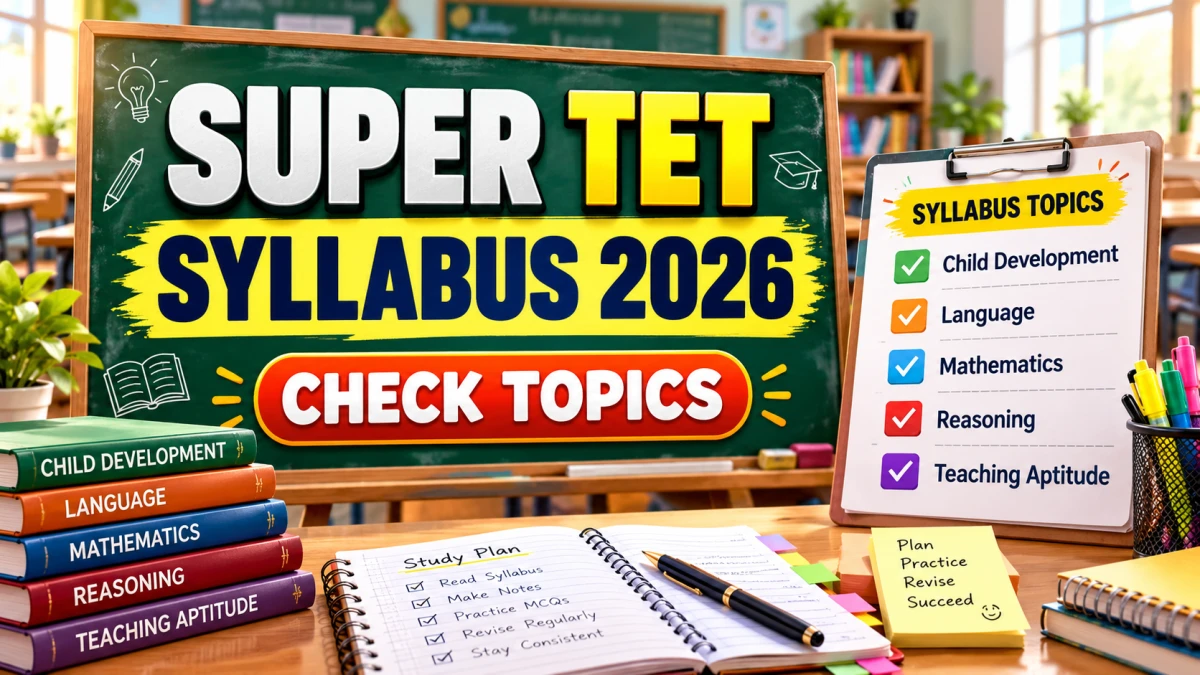
Super TET Syllabus 2026 has been published for candidates preparing for the Uttar Pradesh Assistant Teacher Recruitment Examination conducted by the Uttar Pradesh Education Service Selection Commission (UPESSC). The revised syllabus covers Primary Teachers for Classes 1 to 5 and Upper Primary Teachers for Classes 6 to 8. According to the published 2026 examination pattern, the paper contains 120 multiple-choice questions for 360 marks, with a duration of two hours. Candidates receive 3 marks for each correct answer, while 1 mark is deducted for every incorrect response. Candidates can check the complete subject-wise syllabus, Primary and Junior Teacher exam patterns, negative marking, important topics and official syllabus PDF download information below.
Super TET Syllabus 2026 PDF Download
The Super TET 2026 syllabus is organised separately for Primary and Upper Primary teaching posts. Candidates should follow the syllabus applicable to the classes and teaching subjects for which they are applying.
| Syllabus | Official Information |
|---|---|
| Super TET Primary Syllabus 2026 (Classes 1–5) | Check Official Primary Syllabus |
| UPESSC Recruitment Notifications | Visit Official Website |
Super TET Syllabus 2026 Overview
| Particulars | Details |
|---|---|
| Examination Name | Super TET / UP Assistant Teacher Recruitment Examination 2026 |
| Recruiting Authority | Uttar Pradesh Education Service Selection Commission (UPESSC) |
| Posts | Assistant Teacher / Primary Teacher |
| Teaching Levels Covered | Primary (Classes 1–5) and Upper Primary (Classes 6–8) |
| Examination Type | Objective Multiple-Choice Questions |
| Total Questions | 120 |
| Total Marks | 360 |
| Exam Duration | 2 Hours (120 Minutes) |
| Marks for Correct Answer | +3 |
| Marks Deducted for Wrong Answer | 1 |
| Question Paper Languages | Hindi and English |
| Official Website | upessc.up.gov.in |
Super TET Primary Teacher Exam Pattern 2026
The Super TET Primary Teacher examination is designed for teaching posts covering Classes 1 to 5. According to the revised examination pattern, the written paper consists of 120 questions across ten subject groups.
| Subject | Questions | Marks |
|---|---|---|
| General Knowledge and Current Affairs | 25 | 75 |
| Logical Reasoning | 5 | 15 |
| Hindi, Sanskrit and English | 30 | 90 |
| Science | 8 | 24 |
| Mathematics | 16 | 48 |
| Environmental and Social Studies | 8 | 24 |
| Teaching Skills | 8 | 24 |
| Child Psychology | 8 | 24 |
| Information Technology | 4 | 12 |
| Life Skills, Management and Attitude | 8 | 24 |
| Total | 120 | 360 |
The examination duration is 120 minutes. Candidates receive 3 marks for a correct answer and lose 1 mark for an incorrect answer.
Super TET Primary Syllabus 2026 Subject-Wise
The Primary Teacher syllabus covers general subjects, teaching-related knowledge and aptitude. The following sections provide the detailed syllabus topics and their question weightage.
1. General Knowledge and Current Affairs – 25 Questions
This section carries 75 marks and includes general awareness and contemporary events.
- Important national and international events
- Current affairs related to Uttar Pradesh
- Important places and personalities
- Books, authors and notable works
- National and international awards
- Sports and sporting achievements
- Indian culture and art
- Important developments in India and abroad
2. Logical Reasoning – 5 Questions
The Logical Reasoning section carries 15 marks and assesses candidates' analytical and problem-solving abilities.
- Analogies and classification
- Assertion and Reason
- Binary logic
- Clock and calendar problems
- Coding and decoding
- Coded inequalities
- Critical reasoning
- Number and letter series
- Puzzles
- Venn diagrams and dice
- Symbols and notations
- Data interpretation
- Direction sense
- Grouping and selection
3. Hindi, Sanskrit and English – 30 Questions
The language section carries 90 marks and includes questions from Hindi, Sanskrit and English.
- Language grammar
- Reading comprehension
- Unseen prose passages
- Unseen poetry passages
- Language understanding and usage
Candidates should prepare grammar and comprehension across the prescribed languages.
4. Science – 8 Questions
The Science section carries 24 marks and focuses on fundamental scientific concepts and everyday applications.
- Science in daily life
- Motion, force and energy
- Distance and measurement
- Light and sound
- Living organisms
- Human body and health
- Hygiene and nutrition
- Environment and natural resources
- Matter and its states
5. Mathematics – 16 Questions
The Mathematics section contains 16 questions carrying 48 marks.
- Number system and numerical operations
- Place value
- Fractions and decimals
- Divisibility and factorisation
- Ratio and proportion
- Percentages
- Average
- Profit, loss and discount
- Simple interest
- Unitary method
- Basic algebra
- Algebraic identities
- Area and volume
- Basic geometry
- Elementary statistics
6. Environmental and Social Studies – 8 Questions
The Environmental and Social Studies section carries 24 marks.
- Structure of the Earth
- Rivers, mountains and oceans
- Continents and natural resources
- Latitude and longitude
- Solar system
- Indian geography
- Indian freedom struggle
- Indian Constitution
- Social reformers
- Indian culture and heritage
- Government and administration
- Transportation and road safety
- Indian economy and current challenges
- Environmental protection
- Natural disaster management
7. Teaching Skills – 8 Questions
Teaching Skills is a 24-mark section covering teaching methodology, learning processes and school education.
- Teaching methods and skills
- Planning and management of teaching
- Principles of teaching and learning
- Contemporary Indian society and elementary education
- Inclusive education
- New initiatives in elementary education
- Educational assessment and measurement
- Early reading skills
- Educational management and administration
8. Child Psychology – 8 Questions
Child Psychology includes 8 questions for 24 marks.
- Individual differences among children
- Factors affecting child development
- Identification of learning needs
- Creation of a suitable learning environment
- Learning theories
- Classroom applications of learning theories
- Special educational arrangements for children with disabilities
9. Information Technology – 4 Questions
The Information Technology section carries 12 marks and assesses the use of digital technology in education.
- Basic computer knowledge
- Internet and smartphones
- Educational applications
- Information technology in classroom teaching
- Information technology in school management
- Open Educational Resources
- Audio-visual teaching materials
- Digital teaching and learning resources
10. Life Skills, Management and Attitude – 8 Questions
This section carries 24 marks and assesses the professional and personal competencies required of teachers.
- Professional conduct and ethics
- Motivation
- Teacher as facilitator and guide
- Teacher as a leader and counsellor
- Listening and communication skills
- Constitutional and human values
- Reward and punishment systems
- Classroom management and professional attitude
Also Read: Nagaland Police Constable Syllabus 2026
Super TET Primary Syllabus 2026 – Question Difficulty Level
The published 2026 syllabus specifies the following subject-content levels:
| Subjects | Prescribed Level |
|---|---|
| Hindi, Sanskrit and English | Up to Class 12 |
| Science | Up to Class 12 |
| Mathematics | Up to Class 12 |
| Environmental and Social Studies | Up to Class 12 |
| Teaching Skills | D.El.Ed Curriculum Level |
| Child Psychology | D.El.Ed Curriculum Level |
| Information Technology | D.El.Ed Curriculum Level |
| Life Skills, Management and Attitude | D.El.Ed Curriculum Level |
Candidates should use this distinction while selecting study materials and preparing subject-wise questions.
Super TET Upper Primary Exam Pattern 2026
The published Super TET Upper Primary syllabus for Classes 6 to 8 follows a separate examination structure. The written paper contains 120 questions divided into two sections.
| Section | Subject | Questions | Marks |
|---|---|---|---|
| Section I | General Knowledge | 30 | 90 |
| Section II | Selected Teaching Subject | 90 | 270 |
| Total | 120 | 360 |
All candidates attempt the compulsory General Knowledge section. The remaining 90 questions are based on the relevant teaching post or selected subject.
Super TET Upper Primary Syllabus 2026 Subject-Wise
The Upper Primary examination covers general knowledge and one of the prescribed subject groups.
Section I: General Knowledge – 30 Questions
- National and international current affairs
- Indian history and the freedom movement
- Indian geography
- Indian polity and governance
- Indian Constitution
- Panchayati Raj
- Economic and social development
- Sustainable development
- Population and poverty-related issues
- Environment and ecology
- Biodiversity and climate change
- General Science
Section II: Selected Teaching Subject – 90 Questions
Candidates must prepare the subject group relevant to their teaching post.
| Teaching Post | Prescribed Subject |
|---|---|
| Language Teacher | Hindi, English or Sanskrit, as applicable |
| Social Studies Teacher | Social Studies |
| Science and Mathematics Teacher | Science and Mathematics |
Super TET Upper Primary Language Syllabus 2026
Candidates preparing for Language Teacher posts should study the subject corresponding to their application.
| Language | Major Topics |
|---|---|
| Hindi | History of Hindi language and literature, grammar, unseen prose and poetry passages, important writers, poets and literary works |
| English | History of English language and literature, grammar, unseen passages, important writers, poets and literary works |
| Sanskrit | History of Sanskrit language and literature, grammar, unseen prose and poetry passages, major writers, poets and literary works |
Super TET Upper Primary Social Studies Syllabus 2026
The Social Studies syllabus covers history, geography, Indian governance, society and economics.
History
- Sources of history and prehistoric cultures
- Chalcolithic and Vedic cultures
- Early Indian kingdoms
- Mauryan and Gupta periods
- Rajput history
- Delhi Sultanate and Mughal Empire
- European arrival in India
- British rule and Indian nationalism
- Freedom movement, independence and partition
Geography
- Earth and solar system
- Globe and movements of the Earth
- Maps and major landforms
- Physical geography of India
- Soil, climate, vegetation and wildlife
- Geography of Uttar Pradesh
- Agriculture, industries and mineral resources
- Environmental conservation
Polity, Society and Economy
- Indian Constitution
- Democracy and citizenship
- Central and State Governments
- Local self-government and district administration
- Rural and urban society
- Indian economy
- Population and urbanisation
- Environmental and disaster management
Super TET Upper Primary Mathematics Syllabus 2026
The Mathematics syllabus includes arithmetic, algebra, geometry, mensuration and data-related concepts.
- Natural, whole, rational and irrational numbers
- Integers and number system
- LCM and HCF
- Squares, cubes and their roots
- Ratio and proportion
- Percentage
- Profit and loss
- Simple and compound interest
- Algebraic expressions and identities
- Linear and quadratic equations
- Parallel lines, triangles and quadrilaterals
- Circles and tangents
- Statistics: mean, median and mode
- Bar graphs and pie charts
- Probability
- Mensuration
- Basic trigonometry
Super TET Upper Primary Science Syllabus 2026
The Science syllabus contains topics from Biology, Physics, Chemistry and environmental science.
Biology
- Living and non-living things
- Classification of plants and animals
- Adaptation in organisms
- Cells, tissues and organ systems
- Microorganisms and diseases
- Food, nutrition and health
- Human reproduction and adolescence
- Respiration, excretion and hormones
- Blood and blood groups
Physics
- Units and measurement
- Motion, force and energy
- Simple machines
- Sound and light
- Electricity and magnetism
- Static electricity
- Heat and temperature
- Optical instruments
- Alternative sources of energy
Chemistry and Environmental Science
- Matter and its properties
- States of matter
- Separation of substances
- Acids, bases and salts
- Metals and minerals
- Carbon and its compounds
- Periodic table
- Air and its composition
- Water conservation and pollution
- Ozone layer and greenhouse effect
- Plastics, glass and soap
Super TET 2026 Marking Scheme and Negative Marking
According to the published revised examination pattern, candidates receive 3 marks for each correct answer and lose 1 mark for each incorrect answer. No marks are awarded or deducted for unanswered questions.
| Response | Marks |
|---|---|
| Correct Answer | +3 |
| Incorrect Answer | -1 |
| Unattempted Question | 0 |
| Maximum Marks | 360 |
| Total Questions | 120 |
The examination score can be calculated using the formula:
Total Score = (Number of Correct Answers × 3) − (Number of Incorrect Answers × 1)
For example, a candidate answering 80 questions correctly and 20 incorrectly will score 220 marks.
Difference Between Super TET Primary and Upper Primary Syllabus 2026
The Primary and Upper Primary examinations have the same total number of questions and maximum marks, but their subject structures differ.
| Particulars | Primary Teacher | Upper Primary Teacher |
|---|---|---|
| Classes | 1 to 5 | 6 to 8 |
| Total Questions | 120 | 120 |
| Total Marks | 360 | 360 |
| Duration | 120 Minutes | 120 Minutes |
| Examination Sections | 10 Subject Groups | 2 Sections |
| General Knowledge | 25 Questions | 30 Questions |
| Language | Combined Language Section | Post-Specific Language Subject, if Applicable |
| Teaching Subject | Multiple General and Teaching Subjects | 90 Questions from Selected Teaching Subject |
| Correct Answer | +3 Marks | +3 Marks |
| Incorrect Answer | -1 Mark | -1 Mark |
How to Download Super TET Syllabus 2026 PDF?
Candidates can check the official syllabus and recruitment information through the UPESSC website by following these steps:
- Visit the official Uttar Pradesh Education Service Selection Commission website at upessc.up.gov.in.
- Open the relevant Assistant Teacher recruitment notification section.
- Select the advertisement applicable to the 2026 Primary or Upper Primary Teacher recruitment.
- Locate the syllabus or examination scheme document.
- Check the syllabus for the relevant class level and teaching post.
- Download the official syllabus PDF where provided.
- Verify the question distribution, marking scheme and examination duration.
- Save the PDF for preparation and future reference.
Super TET Exam Date 2026
The published 2026 recruitment schedule mentions 3 and 4 December 2026 for the Assistant Teacher written examinations.
Candidates should verify the examination date applicable to their advertisement and post through the latest UPESSC notice and admit card instructions.
Super TET Syllabus 2026 Preparation Tips
Candidates should prepare according to the prescribed weightage and subject difficulty levels.
- Start with the complete syllabus and identify high-weightage subjects.
- Give sufficient time to General Knowledge and Current Affairs.
- Practise Hindi, Sanskrit and English grammar and comprehension.
- Revise Mathematics through regular numerical problem-solving.
- Prepare Science and Environmental Studies using subject fundamentals.
- Study Teaching Skills and Child Psychology at the prescribed D.El.Ed level.
- Practise objective questions with the +3 and -1 marking system.
- Attempt 120-question mock tests within 120 minutes.
- Upper Primary candidates should focus strongly on their selected 90-question subject paper.
- Check official recruitment updates for changes in examination instructions.
Super TET Syllabus 2026 Important Links
| Description | Official Link |
|---|---|
| Super TET Primary Syllabus 2026 | Check Official Syllabus |
| UPESSC Official Website | Visit Official Website |