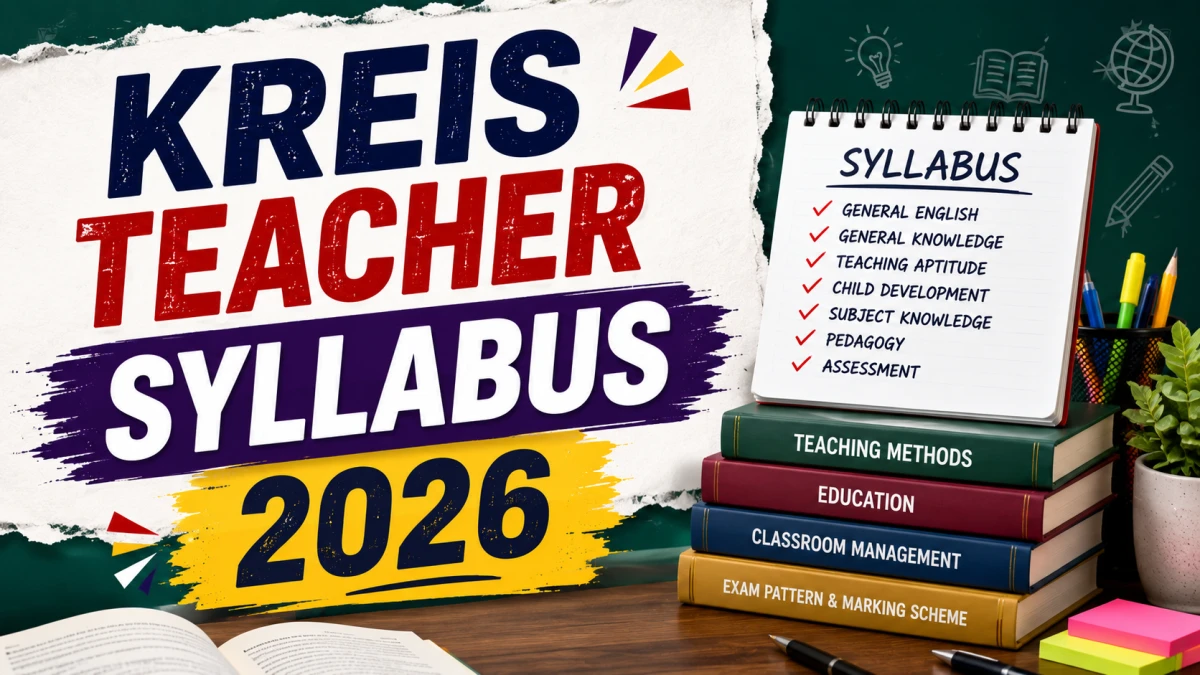
KREIS (Karnataka Residential Educational Institutions Society) conducts a Combined Competitive Examination for the recruitment of Principals and Teachers in Morarji Desai, Kittur Rani Chennamma, and Ekalavya Model Residential Schools, along with Warden and First Division Assistant (FDA) cum Computer Operator posts. Candidates can check the KREIS Teacher Recruitment 2026 notification, including vacancy details, eligibility criteria, age limit, selection process, and application dates before beginning their preparation. This article presents the complete syllabus exactly as laid out in the official KREIS syllabus document, organized paper-wise and subject-wise for easy reference.
KREIS Teacher Syllabus 2026 - Overview
| Particulars | Details |
|---|---|
| Organization | Karnataka Residential Educational Institutions Society (KREIS) |
| Article Type | Syllabus |
| Exam Name | KREIS Combined Competitive Examination 2026 |
| Posts Covered | Principal, Teacher, Warden, FDA cum Computer Operator |
| Exam Mode | Objective Type (MCQs) |
| Subjects Included | General Studies, Education, Subject-Specific Papers, Computer Knowledge |
| Official Syllabus | Available |
| Official Website | kreis.karnataka.gov.in |
KREIS Teacher Syllabus 2026
Candidates applying for the KREIS Teacher Recruitment 2026 should carefully go through the official syllabus before starting their preparation. The syllabus generally covers subject-specific topics, General Knowledge, General Kannada, General English, Reasoning, Computer Knowledge, and Pedagogy (as applicable to the post). The detailed post-wise syllabus and exam pattern are available in the official notification and syllabus PDF.
Download Official KREIS Teacher Syllabus 2026 PDF
KREIS Exam Pattern
The examination is objective-type (Multiple Choice Questions) and is divided into papers depending on the post applied for.
Exam Pattern for Principal Post
| Paper | Subject |
|---|---|
| Paper 1 | General Studies |
| Paper 2 | Education - 1 |
| Paper 3 | Education - 2 |
Exam Pattern for Subject Teacher Posts
For Kannada, English, Hindi, Mathematics, Science, Social Science, Physical Education, and Computer Teacher posts, Paper 2 is the subject-specific Optional Paper, with syllabus details provided separately for each subject below.
Exam Pattern for Warden and FDA cum Computer Operator
Paper II is a Specific Paper set at Degree standard, consisting of three sections:
| Section | Subject | Maximum Marks |
|---|---|---|
| (a) | General Kannada | 70 |
| (b) | General English | 70 |
| (c) | Computer Knowledge | 60 |
KREIS Principal Syllabus - Paper 1: General Studies
Objective-type MCQs covering General Awareness, General Intelligence and Reasoning, Numerical Ability, Mental Ability, Teaching Aptitude, General English, General Kannada, and General Knowledge. The General English and General Kannada sections are expected to conform to the standard of a university Bachelor's Degree examination, testing grammar, vocabulary, spelling, synonyms, comprehension, and correct/incorrect usage.
General Knowledge Topics
- Famous Books and Authors
- Important Inventions and Discoveries
- Basic Science - Scientific Phenomena
- Hygiene and Physiology (Human)
- Chronology of Events in World History
- Glimpses of Indian History
- Geographical Terms (basic)
- Sports - International and National Figures
- Awards, Honours and Prizes
- Indian Culture - Land and People - Festivals; Physical Geography - Population - Literacy - Natural Regions - Natural Resources - Food Crops - Non-Food Crops - Major Industries - Projects - Public Undertakings - Indian Art - Recognized Artists - Classical Awards - National Policy on Education - Constitution of India (major provisions) - Union and State Government - Cabinets - Indian Leaders of International and National Recognition (Who's Who - India)
- Current International Affairs - India's Foreign Relations
- Current National Affairs
KREIS Principal Syllabus - Paper 2: Education-1
Educational Administration
- Constitutional provisions and directive principles for education in the Indian Constitution; measures for fulfilling constitutional obligations
- Role of different agencies (society, home, school) and their interrelationship in the administration of education
- Education in relation to fundamental rights, democracy, secularism and social justice
- Critical analysis of the aims of education in relation to national understanding
- Content and methodology changes; educational administration and educational planning
- School-community relationship in quantitative and qualitative development in education
- Role of the Head of the Educational Institution as an Administrator, Academic Leader, and Leader for institutional development
- Classroom organization and management; physical facilities; school environment; teacher role; leadership style of the headmaster and its influence on teacher role performance
- Classroom management: mechanisms for coordinated functioning in school
Psychological Foundations
- Child development - physical, intellectual, emotional and social
- Problems of adolescence - role of home, school and society in dealing with them
- Learning: concept; factors affecting learning; motivation and measures for creating an effective learning situation
New Initiatives in Karnataka
- Quality improvement programme in education
- Compulsory Primary Education and Incentive Scheme for compulsory primary education
- Incentive programmes of the Department of Public Instruction and Social Welfare Department (textbooks, uniforms, midday meals, residential schools, etc.)
- School development and monitoring committees
- Systems of examination; computer education in schools
- Sarva Shiksha Abhiyan (SSA) and Rashtriya Madhyamik Shiksha Abhiyan (RMSA) - goals and objectives
- In-service teacher training programmes
- Role of District Institute of Education and Training (DIET) and College for Teacher Education (CTE)
- Student/teacher welfare programmes
- Examination reforms - efforts to improve quality; action research
- Innovative experiments in distance education - Keli Kali, Edusat, etc.
- Inclusive education programme
- Environment education and health education in schools
- Recent programmes to promote universal access, universal enrollment, universal retention, and universal achievement
KREIS Principal Syllabus - Paper 3: Education-2
- Education for national development
- Emerging interface between political process and education
- Right of Children to Free and Compulsory Education Act
- Implementation of educational policy - political will and effort, macro-level requirements, action plans, programme guidelines, State and Centrally Sponsored Schemes of Education
- Education and economic development; education and individual development; education and socio-cultural context
- Learning environment - the changing scenario
- Systems and structures in school education
- Universalisation of Secondary Education (USE) - access, enrolment, participation, achievement, issues, concerns, and strategies for realization of targets
Equity, Equality and Quality in Education
What is "Quality Education"? Indicators of quality related to the learning environment and student outcomes; outcome improvement through setting performance standards, supporting inputs known to improve achievement, adapting flexible strategies for acquisition and use of inputs, and monitoring performance; enhancement of quality in secondary schools.
Other Topics in Paper 3
- Education for conservation of environment - integrating environmental concerns into the curriculum and the teacher's role in promoting conservation
- Nature of the learner: child and adolescent
- Organizational learning: issues and concerns in understanding teaching
- Teaching as a planned activity - elements of planning and assumptions underlying teaching
- Phases of teaching: pre-active, interactive and post-active; proficiency in teaching (awareness, skills, competencies, commitment)
- General and subject-related skills and competencies required in teaching; impact of socialization processes and shifting identities as "student," "adult," and "student teacher" on becoming a teacher
- Teacher's professional identity
- Assessment and evaluation: perspectives, assessment of learning, assessment for learning, and current issues, concerns and trends
KREIS Optional Subject Syllabus for Teacher Posts (Paper 2)
1. Kannada Language Teacher Syllabus
- Unit 1 - History of Kannada Literature: Old Kannada period, Middle Kannada period, Modern Kannada period - poets and works
- Unit 2 - Poetics (Kavya Mimamse) and Prosody (Chandassu)
- Unit 3 - Kannada Language and Grammar
2. English Language Teacher Syllabus
Pronunciation, Spelling, Parts of Speech, Time and Tense, Modals, Prepositions, Articles, Phrasal Verbs, Reported Speech, Agreement, Grammar and Usage, Functional English, Synonyms, Antonyms, Idioms and Phrases, Prefixes and Suffixes, Error Detection, Comprehension, Cloze Test, Shuffling of Sentence Parts, Shuffling of Sentences in Paragraphs, Testing and Evaluation, Methods/Techniques, and ELT Terms.
3. Hindi Teacher Syllabus
- Bhasha Vigyan (Linguistics)
- Sahityaka Ithihas (Literary History)
- Adikal
- Bhakthikal
- Reetikal
- Adhunik Kal (Gadhya - Prose)
- Adhunik Kal (Padhya - Poetry)
4. Mathematics Teacher Syllabus
Physics: Mechanics, Properties of Matter, Heat and Thermodynamics, Waves, Sound, Light, Optics, Electricity and Magnetism, Electronics and Modern Physics, Theory of Active and Passive Networks and Devices, Filters, Power Supply, Digital Electronics, Atomic Spectroscopy, Atomic Structure, Charge, Mass and e/m, Molecular Spectra, Lasers and Masers, X-rays and Crystal Structure, Free Electronic Theory, Semiconductors - Band Theory, Magnetic Materials, Quantum Mechanics (Wave Mechanics, Matter Waves, Eigen Functions, Schrödinger Wave Function), Special Theory of Relativity (Lorentz Contraction, Time Dilation, Doppler Effect, Ultimate Speed, Aberration, Variation of Mass), Properties of Nucleus, Detectors, Accelerators, Nuclear Decays, Nuclear Models, Fission and Fusion, Nuclear Reactions - Binding Energy, Cosmic Rays, Fundamental Particles.
Mathematics: Numbers and Numerals - Number Systems, Number Sets, Basic Operations and Properties, Square Numbers and Square Roots, Cube Numbers and Cube Roots, Irrational Numbers, Sets, Matrices, Mathematics in Day-to-Day Activities, Statistics, Permutations and Combinations, Modular Arithmetic, Algebra - Basic Concepts, Operations and Properties, Exponents, Factors and Factorization, Surds, Equations - Linear and Quadratic, Geometry - Basic Concepts, Axioms and Postulates, Theorems, Triangles, Circles, Quadrilaterals and Polygons (definitions, properties and theorems), Mensuration, Polyhedra and Networks.
5. Science Teacher Syllabus
Chemistry:
- Inorganic Chemistry: Atomic structure, periodic table, chemical bonding, metallurgy, d-block elements, f-block elements, co-ordination chemistry, industrial chemistry, analytical chemistry
- Physical Chemistry: Gases, colloids, surface chemistry, thermodynamics, nuclear chemistry, electrochemistry, indicators
- Organic Chemistry: Alkanes, alkenes and alkynes - IUPAC nomenclature, isomerism, functional groups, aromaticity, vitamins, hormones, alkaloids, carbohydrates
Biology:
- Living World, Cytology, Micro-organisms, Life Processes, Food Production and Management, Environmental Science
- Non-Chordata Phylum: Protozoa, Porifera, Cnidaria, Acnidaria, Helminthes, Aschelminthes, Annelida, Arthropoda, Mollusca, Echinodermata
- Chordata: characteristic features and classification, Prochordata (Urochordata, Hemichordata, Cephalochordata), and Vertebrata features of Agnatha, Pisces, Amphibia, Reptilia, Aves, Mammalia
- Cell Biology: cell and its organelles, mitosis and meiosis, fertilization, parthenogenesis, sex determination (including in humans), genetics
- Biochemistry and Physiology: carbohydrates, proteins, lipids, vitamins, enzymes, physiology, histology, environmental biology, terrestrial ecology
- Evaluation of Life, Introduction to Genetics and Biotechnology: Protista, viruses, bacteria, mycology, bryophytes, pteridophytes, gymnosperms, plant anatomy, tissues, embryology, ecology, plant succession and communities, phytogeography, taxonomy of angiosperms, economic botany, plant propagation, cytology, chromosomes, cell division, polyploidy, genetics, evolution, plant physiology, enzymes, photosynthesis, respiration, protein synthesis, growth, and plant biotechnology
6. Social Science Teacher Syllabus
History: Medieval India, religious and social reform movements, Delhi Sultans, Bhakti movement, Vijayanagar Empire, Bahamani Sultans, Great Mughals, Marathas, Renaissance, Reformation, geographical discoveries, foreign invasions, rise of the English, Mysore Sultans, Wodeyars of Mysore, First War of Independence, National Movement (Gandhian Era, Partition and Independence), pre-historic period, ancient civilizations, Vedic age, birth of new religions, Mauryans, Kushans, Guptas, Vardhana dynasty, southern dynasties, rise of Christianity and Islam, Medieval Europe, Rajputs, rise of revolutions and equality, constitutional development in India, and the modern world including the First and Second World Wars and the contemporary world.
Civics: Social and economic development, man as a citizen, democracy, local self-government, democracy at work in India, government at state and central levels, defense of the country, challenges and problems of India, India and the world, world problems and India's policy, and the Constitution of India.
Geography: Physical geography, environment, layers of the earth, resources, natural regions of the earth, world climate, world natural vegetation, human occupations, human interaction with the environment, physical divisions and climate of Asia, Africa, North America, South America, Australia, Europe and Antarctica, natural vegetation and animal life, agriculture, mineral and power resources, industrial development, transport and communication, layers of the atmosphere, and the universe.
Economics: Meaning and definition of economics, basic concepts, national income, forms of economic systems, institutional set-up, infrastructure of the Indian economy, agricultural development in India, relation between agriculture and industry, domestic and foreign trade of India, state and economic development, sociology, and political science.
7. Physical Education Teacher Syllabus
Scientific foundation of physical education, history of physical education, anatomy, physiology, health education, safety education and first aid, organisation and administration in physical education, tests and measurements in physical education, psychological principles in physical education, major games and sports, principles of officiating in games such as football, hockey, kho-kho, kabaddi, basketball, volleyball, table tennis, shuttle badminton and cricket, recreation and camping, minor games, yoga, individual special activities, national ideals, integration, and sports current affairs.
8. Computer Teacher Syllabus
Computer Fundamentals and C Programming:
- Introduction to C: history of C, structure of a C programme, character set, constants, variables and keywords, data types
- C Instructions: type declaration and arithmetic instructions, integer and float conversions, type conversion in assignment, operators and their hierarchy, control instructions, formatted and unformatted input-output statements
- Control Structures: decision control, logical/conditional/relational operators, loop control (while, do-while, for), break, continue, switch-case, goto statement
- Arrays: one-dimensional and multidimensional arrays, declaration, initialization, array manipulation, bubble sort, strings and library functions
- Functions: definition, prototyping, types of functions and arguments, recursion, passing arrays to functions, storage classes (automatic, register, external, static)
- Pointers: definition, notation, pointers and arrays, arrays of pointers, call by value and call by reference, pointers to pointers
- Structures and Unions: definitions, declaration, accessing elements, arrays of structures, pointers and structures, enum, bit fields
- Bitwise Operators: AND, OR, XOR, complement, right shift, left shift
- C Preprocessor: directives, macros, file inclusion
- Files: file operating modes, text and binary files, high-level and low-level file operations, command line arguments
Data Structures:
- Introduction to data structures: definition, classification, operations, time and space complexity
- Primitive data structures: integer, character, float, strings, memory representation and string manipulation using pointers
- Arrays: storage representation for 1D and 2D arrays, insertion and deletion, advantages and disadvantages
- Linked Lists: pointers, dynamic memory allocation, singly linked lists, insertion and deletion of nodes, circularly and doubly linked lists
- Stacks: concepts, operations, sequential and linked implementation, applications, recursion, Tower of Hanoi, infix to postfix conversion, evaluation of postfix expressions
- Queues: concepts, operations, sequential and linked implementation, circular queues, priority queues, dequeues
- Trees: binary trees, sequential and linked representation, insertion, deletion, and traversal
- Graphs: concepts, sequential and linked representation, BFS and DFS traversal
- Searching and Sorting: linear and binary search, selection sort, insertion sort, quick sort, merge sort
Operating System:
- History of operating systems, simple batch systems, multi-programmed batch systems, time-sharing systems, personal computer systems, distributed systems, real-time systems, OS structures, command interpreter system, OS services, system calls, system programs
- Process Management: process concept, process control block, process scheduling, CPU scheduling algorithms (FIFO, RR, SJF, multi-level, multi-level feedback)
- Storage Management: logical and physical address space, swapping, contiguous allocation, paging, segmentation, virtual memory, demand paging, page replacement algorithms, allocation of frames, thrashing, demand segmentation
- File System: file concept, access methods, directory structure, protection, file system structure, allocation methods, free-space management
- Input/Output Systems: overview of I/O systems, I/O interfaces, secondary storage structure, disk structure and scheduling
Other Topics: OOPS using C++, Database Management System, Software Engineering, Software Internet Technology, basic Java and UNIX programming, Internet Lab, Computer Graphics, and Computer Networks.
KREIS Warden and FDA cum Computer Operator Syllabus (Paper II - Specific Paper)
This paper is set at Degree standard and includes three sections:
| Section | Subject | Maximum Marks |
|---|---|---|
| (a) | General Kannada | 70 |
| (b) | General English | 70 |
| (c) | Computer Knowledge | 60 |
The syllabus document does not provide further topic-wise breakdown for this specific paper beyond the section names and marks shown above.