
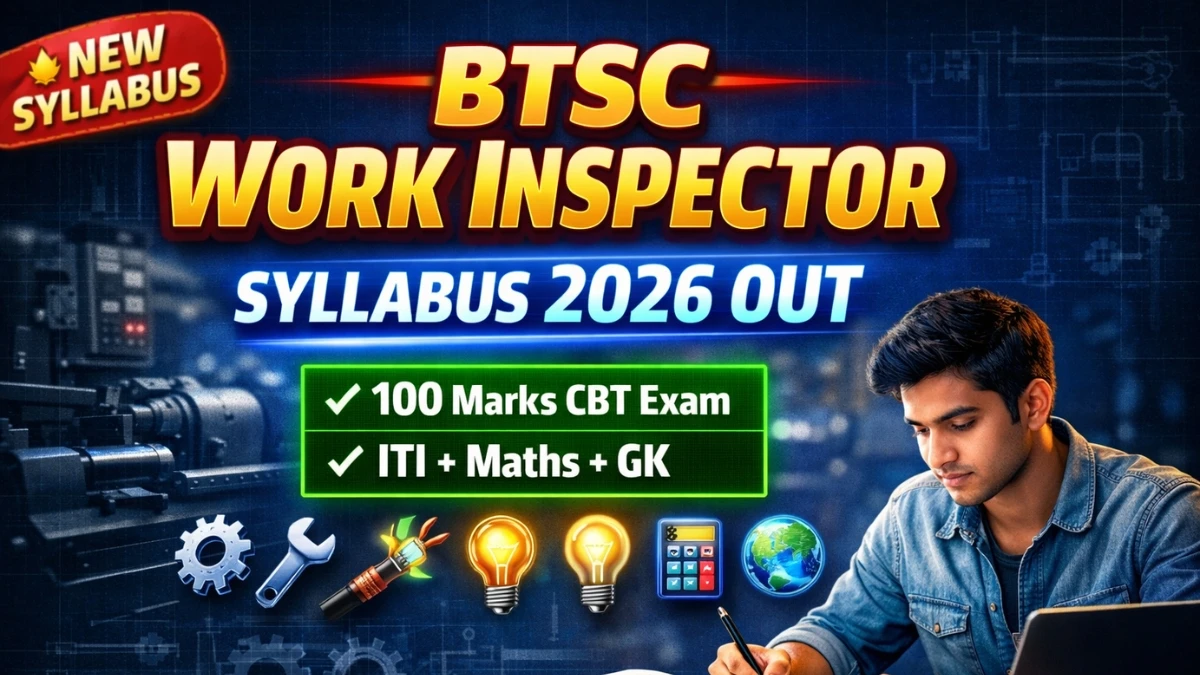
The BTSC Work Inspector Syllabus for the 2026 recruitment (Mechanical) is now officially available, focusing on ITI-level technical trades combined with Matric-level Mathematics and General Knowledge.
As per the latest update from the Bihar Technical Service Commission (BTSC), the syllabus for Work Inspector (Mechanical) was published on 26 February 2026.
The exam is a 100-mark Computer-Based Test (CBT) with objective questions. Candidates can download the official BTSC Work Inspector Syllabus PDF directly from the BTSC website
BTSC Work Inspector Syllabus
The BTSC Work Inspector Syllabus includes four ITI trades (Machinist, Fitter, Wireman, Electrician) at 15 marks each, Mathematics at Matric level (20 marks), and General Knowledge (20 marks), totaling 100 marks in a single CBT paper. This tests workshop skills for public works supervision along with basic aptitude.
BTSC Work Inspector Syllabus 2026 Overview
The exam targets candidates with ITI qualifications in relevant trades, assessing practical technical knowledge alongside foundational academics.
| Exam Name | BTSC Work Inspector Recruitment Exam (Mechanical) |
| Conducting Body | Bihar Technical Service Commission (BTSC) |
| Post Name | Work Inspector (Mechanical) |
| Exam Type | Computer-Based Test (CBT), Objective (MCQ) |
| Total Marks | 100 Marks (single paper) |
| Subjects | Machinist, Fitter, Wireman, Electrician, Mathematics, General Knowledge |
| Official Website | https://btsc.bihar.gov.in |
BTSC Work Inspector Exam Pattern
The exam follows a clear marks distribution aligned with official patterns for this recruitment.
| S.No. | Subject | Marks | Level |
|---|---|---|---|
| 1 | Machinist | 15 | ITI Level (Mechanical Trade) |
| 2 | Fitter | 15 | ITI Level (Mechanical Trade) |
| 3 | Wireman | 15 | ITI Level (Electrical Trade) |
| 4 | Electrician | 15 | ITI Level (Electrical Trade) |
| 5 | Mathematics | 20 | Matriculation/BSEB Level |
| 6 | General Knowledge | 20 | General Awareness (India + Bihar) |
BTSC Work Inspector Subject-wise Syllabus Overview (Short, Scannable)
Machinist (15 Marks | ITI Level)
-
Fitting operations, marking, and measuring
-
Limits, fits, tolerances, surface finish
-
Lathe operations (turning, facing, threading, tapering)
-
Milling, indexing basics
-
Grinding, cutting tools, and fluids
-
CNC/VMC fundamentals, maintenance
Fitter (15 Marks | ITI Level)
-
Hand tools, files, chisels, hacksaws
-
Sheet metal work, welding, and soldering basics
-
Drilling, reaming, tapping, and threading
-
Limits, fits, gauges
-
Power transmission, bearings, couplings
-
Pneumatics/hydraulics basics
Wireman (15 Marks | ITI Level)
-
Electrical basics, Ohm’s law, circuits
-
AC fundamentals, wiring systems
-
Earthing, protection (fuse, MCB, RCCB)
-
Domestic/industrial wiring, fault testing
-
Solar, batteries, inverters basics
Electrician (15 Marks | ITI Level)
-
Electrical measurements, DC machines
-
Transformers, AC machines
-
Power Electronics Basics
-
Wiring, protection, IE rules
-
Illumination, transmission/distribution
Mathematics (20 Marks | Matric Level)
-
Number system, HCF/LCM, percentages
-
Ratio, profit/loss, interest
-
Time/work, speed/distance
-
Algebra basics, geometry, and mensuration
-
Statistics, basic probability
General Knowledge (20 Marks | General Awareness)
-
Current affairs (national, international, and Bihar)
-
Bihar GK (geography, history, culture, schemes)
-
Indian polity, constitution basics
-
Economy, government schemes
-
General science
BTSC Work Inspector Detailed Syllabus (Full Topic Lists)
Machinist – Detailed Syllabus (15 Marks)
-
Fitting operations: marking, sawing, filing, chiselling, scraping, drilling
-
Measuring instruments: steel rule, vernier calliper, micrometre, height gauge, dial gauge
-
Limits, fits and tolerances; interchangeability and surface finish
-
Lathe: components, work holding devices, cutting tools, speeds and feeds, turning, facing, parting, threading, knurling, taper turning
-
Milling: types of milling machines, cutters, up and down milling, indexing, gear cutting fundamentals
-
Grinding: cylindrical, surface, tool and cutter grinding; wheel selection, balancing, dressing
-
CNC basics: principles of CNC turning and machining centres, coordinate systems, basic G and M codes
-
VMC fundamentals, jigs and fixtures, process planning
-
Heat treatment of metals: annealing, normalising, hardening, tempering
-
Maintenance, lubrication, common machine faults and safety
-
Basic sensors used in machine tools (limit switches, proximity sensors, encoders)
Fitter – Detailed Syllabus (15 Marks)
-
Hand tools: hammers, files, chisels, punches, hacksaws, spanners, screwdrivers
-
Bench work: marking, measuring, cutting, chipping, filing, scraping, fitting of mating parts
-
Sheet metal operations: shearing, bending, folding, rolling, seams and joints
-
Welding fundamentals: gas welding, arc welding basics, soldering and brazing techniques
-
Riveting and fasteners: types of rivets, bolts, nuts, screws, lock nuts, washers
-
Drilling operations: drilling, reaming, counterboring, countersinking, tapping, thread cutting
-
Limits, fits, tolerances, surface finish, use of gauges (plug, snap, ring gauges)
-
Lathe basics for fitters: centre turning, boring, simple threading
-
Power transmission: shafts, keys, couplings, belts, chains, gears, bearings, and lubrication
-
Basic pneumatics and hydraulics: symbols, components, simple circuits and applications
-
Preventive maintenance, fault diagnosis and safety precautions in the workshop
Wireman – Detailed Syllabus (15 Marks)
-
Basic electrical concepts: charge, current, voltage, resistance, power and energy
-
Ohm’s law, series and parallel circuits, Kirchhoff’s laws
-
AC fundamentals: RMS and average values, power factor, single-phase and three-phase concepts
-
Types of wiring: CTS, batten, conduit, casing-capping, industrial wiring, panel wiring
-
Earthing: necessity, types (plate, pipe, strip), earth resistance testing
-
Electrical machines basics: transformers, motors in domestic/industrial use
-
Domestic installation: meter board, distribution board, sub-circuits, load calculation
-
Testing and fault finding: continuity test, insulation resistance, polarity test
-
Solar power basics, batteries, inverters and UPS systems
-
LED lighting, rectifiers, SMPS basics, simple power supplies
-
Underground cable laying, jointing, fault location methods
Electrician – Detailed Syllabus (15 Marks)
-
Electrical fundamentals: units, measurements, instruments (ammeter, voltmeter, wattmeter, energy meter)
-
DC machines: construction, working, characteristics, applications of DC motors and generators
-
Transformers: single-phase, three-phase, efficiency, regulation, basic tests
-
AC machines: induction motors, synchronous machines fundamentals and applications
-
Power electronics: rectifiers, choppers, inverters, basic drives and their control
-
Protection devices: fuses, MCB, MCCB, relays, contactors, overload protection
-
Wiring systems: domestic, commercial and industrial wiring standards, cable sizing, demand factor
-
Earthing and lightning protection, safety rules as per IE and NEC basics
-
Illumination: laws of illumination, types of lamps, LED technology, lighting schemes
-
Transmission and distribution basics: substation components, feeders, safety in T&D work
Mathematics – Matric Level (20 Marks)
-
Number system, HCF, LCM, prime and composite numbers
-
Simplification, BODMAS, fractions, decimals, percentages
-
Ratio and proportion, partnership, averages
-
Profit and loss, discount, simple and compound interest
-
Time and work, time, speed and distance, problems on trains and pipes
-
Algebra: linear equations in one or two variables, simple quadratic expressions
-
Arithmetic progression (AP) fundamentals, simple series
-
Geometry: basic theorems on triangles, circles, quadrilaterals, area and perimeter
-
Mensuration: surface area and volume of cube, cuboid, cylinder, cone, sphere
-
Statistics: mean, median, mode; simple data interpretation (tables, bar graphs, pie charts)
-
Probability basics: simple events, elementary problems
General Knowledge – General Awareness (20 Marks)
-
Current affairs: national, international and Bihar-specific events (economy, sports, awards, appointments)
-
Bihar General Knowledge: geography, rivers, districts, historical movements, culture, festivals, personalities
-
Indian polity and constitution: fundamental rights and duties, directive principles, parliament, state legislature, local governance, Panchayati Raj
-
Indian economy and Bihar economy basics: agriculture, industries, welfare schemes
-
General science: basic concepts from physics, chemistry, biology, relevant to daily life and technology
-
Government schemes and policies (central and state-level, especially in Bihar)
-
Environment, ecology, disaster management basics
Click Here - BTSC Work Inspector (Mechanical) Syllabus
BTSC Work Inspector Best Preparation Strategy (Practical + Marks-Based)
Focus on high-weight sections (40 marks – Maths + GK):
-
Target strong command in Matric-level Mathematics and General Knowledge, since together they form 40% of the paper and are relatively predictable with practice.
Trade subjects (60 marks – Machinist/Fitter/Wireman/Electrician):
- Revise ITI core topics from standard trade books and practice objective questions regularly; maintain formula sheets and key principles for each trade topic.
Revision approach:
-
Prepare concise notes for formulas, definitions and key concepts.
-
Solve topic-wise MCQs and full-length mock tests to simulate a CBT environment.
-
Analyse mistakes and revise weak topics weekly; use previous papers or model sets where available for BTSC and similar ITI-based exams.
Best Books for BTSC Work Inspector Preparation
These recommendations draw from popular and aligned resources for the subjects and patterns.
1. Trade Subjects (Machinist, Fitter, Electrician, Wireman)
-
Official NCVT/SCVT ITI Trade Theory Books (for core concepts and diagrams).
-
“2025-26 BTSC Work Inspector Mechanical Study Material” by YCT Expert Team (covers all trades + Maths + GK with MCQs).
-
Trade-specific objective question banks (used for RRB/PSU/ITI exams).
2. Mathematics (Matric Level)
-
NCERT Mathematics Class 9 & 10 (builds strong basics in algebra, geometry, mensuration).
-
General arithmetic/quantitative aptitude books for competitive exams (focus on speed topics like percentage, time/work).
3. General Knowledge
-
Lucent's General Knowledge or similar compendiums.
-
Bihar-specific GK books (covering state history, geography, schemes).
-
Monthly current affairs magazines (national + Bihar focus).
4. Combined Guides
-
BTSC Work Inspector-specific practice sets or e-books from publishers like YCT or Kiran (verify latest edition matches 2026 pattern).
-
Online platforms offering topic-wise MCQs and mocks tailored to BTSC.