
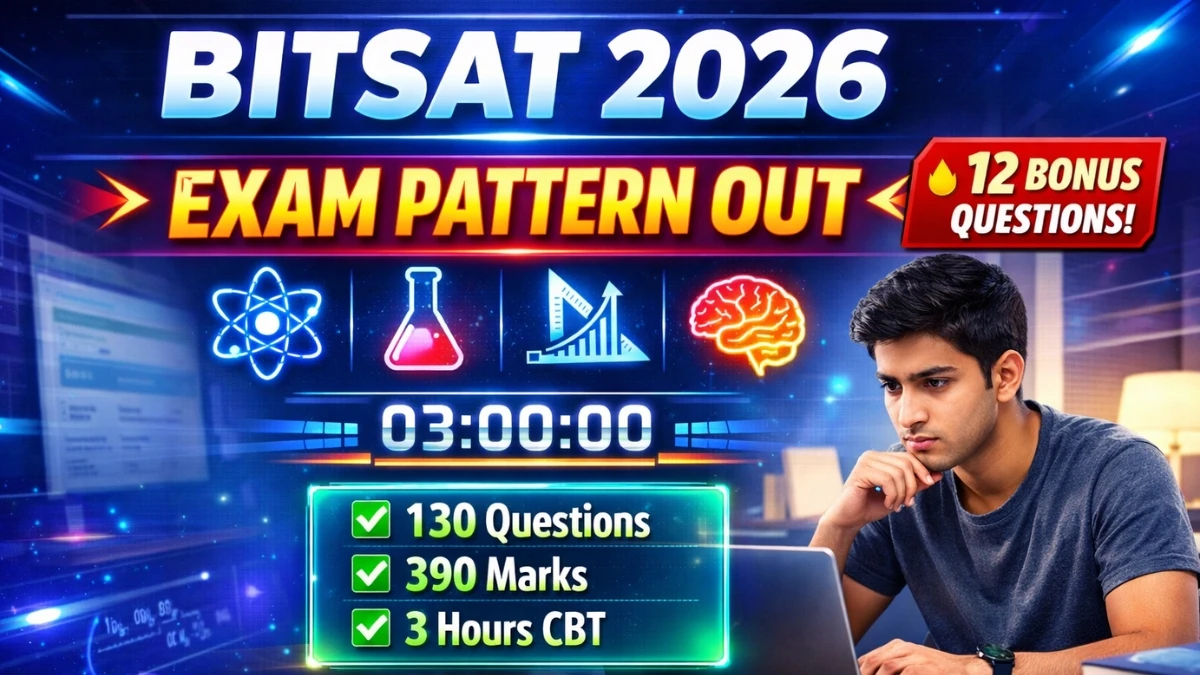
The BITSAT Exam Pattern 2026 features a computer-based online test with 130 multiple-choice questions across Physics, Chemistry, English Proficiency & Logical Reasoning, and Mathematics (or Biology for B.Pharm candidates), totaling 390 marks and lasting 3 hours.
As confirmed in the official BITSAT-2026 brochure from BITS Pilani (released early 2026), the exam emphasizes speed, accuracy, and NCERT-based concepts, with an option for 12 bonus questions for high performers.
BITSAT Exam Pattern 2026 Overview
| Exam Name | Birla Institute of Technology and Science Admission Test (BITSAT) 2026 |
| Conducting Body | BITS Pilani |
| Exam Mode | Computer-Based Test (CBT) / Online |
| Duration | 3 hours (180 minutes, no break) |
| Total Questions | 130 (objective MCQs) |
| Total Marks | 390 |
| Sections | Physics, Chemistry, English Proficiency & Logical Reasoning, Mathematics/Biology |
| Negative Marking | −1 for each incorrect answer |
| Official Website | https://www.bitsadmission.com |
BITSAT Exam Pattern 2026 (Section-wise Distribution)
| Part | Subject | No. of Questions |
|---|---|---|
| I | Physics | 30 |
| II | Chemistry | 30 |
| III | (a) English Proficiency | 10 |
| III | (b) Logical Reasoning | 20 |
| IV | Mathematics (for B.E./M.Sc.) OR Biology (for B.Pharm & specific programs) | 40 |
| Total | — | 130 |
BITSAT Marking Scheme 2026
-
+3 marks for every correct answer.
-
−1 mark for every incorrect answer.
-
0 marks for unanswered or unattempted questions.
-
Bonus questions: After completing all 130 questions (without skipping any), candidates get an option to attempt 12 extra questions (3 each from Physics, Chemistry, Mathematics/Biology, and Logical Reasoning) if time remains. Once bonus questions are accessed, no changes to the original 130 answers are allowed.
BITSAT Exam Duration & Mode
The BITSAT 2026 is a fully online computer-based test lasting 3 hours. There is no sectional time limit, allowing candidates to navigate freely between sections, review answers, and change responses anytime during the exam.
Subject-wise Weightage in BITSAT
-
Physics & Chemistry — Balanced conceptual and numerical focus (30 questions each).
-
Mathematics/Biology — Highest weightage (40 questions), emphasizing problem-solving.
-
English Proficiency & Logical Reasoning — Tests vocabulary, grammar, comprehension, pattern recognition, and analytical skills (30 questions combined).
Tip: Allocate preparation time based on marks weightage and personal strengths, with extra practice for speed in high-scoring sections like Mathematics.
Bonus Questions in BITSAT
- These 12 optional extra questions unlock only after all 130 main questions are answered. They offer a chance for top scorers to boost ranks but carry the same +3/−1 marking. Attempt them only with high accuracy and remaining time, as no revisions to prior answers are possible afterward.
Important Instructions for Candidates
-
No calculators or electronic devices allowed.
-
Rough worksheets/scratch pads provided at the center (return before leaving).
-
Freely switch between sections and change answers within the 3-hour window.
-
Manage time to attempt maximum questions accurately.
-
Follow on-screen instructions; report any suspected incorrect questions to the invigilator immediately.
BITSAT 2026 Exam Dates (Official Schedule)
BITSAT 2026 is conducted in two sessions:
-
Session 1: April 15 to April 17, 2026
-
Session 2: May 24 to May 26, 2026
Key related dates (as per the official brochure):
-
Application start: December 15, 2025 (ongoing)
-
Last date to apply for Session 1 or both sessions: March 16, 2026
-
Application editing window (Session 1): March 18–20, 2026
-
Test center/slot booking: March 27–31, 2026 (for Session 1)
-
Hall ticket download (Session 1): From April 5, 2026
-
Session 2 application window: April 20–May 2, 2026
-
Application editing (Session 2): May 4–6, 2026
-
Slot booking (Session 2): May 13–15, 2026
-
Hall ticket (Session 2): From May 20, 2026
BITSAT Syllabus 2026 Overview
The syllabus is based on the current NCERT Class 11 and 12 curriculum. Download the official detailed PDF from the BITS admissions portal (link: BITSAT_Syllabus.pdf, released January 2026).
Key Subject-wise Highlights
-
Physics (30 questions): Units & Measurement, Kinematics, Newton's Laws, Work & Energy, Rotational Motion, Gravitation, Mechanics of Solids & Fluids, Oscillations, Waves, Heat & Thermodynamics, Electrostatics, Current Electricity, Magnetic Effect of Current, Electromagnetic Induction, Optics, Modern Physics, Electronic Devices.
-
Chemistry (30 questions): States of Matter, Atomic Structure, Chemical Bonding & Molecular Structure, Thermodynamics, Physical & Chemical Equilibria, Electrochemistry, Chemical Kinetics, Surface Chemistry, Hydrogen & s-block Elements, p-, d-, f-block Elements, Principles of Organic Chemistry, Hydrocarbons, Stereochemistry, Organic Compounds with Functional Groups Containing Oxygen & Nitrogen, Biological, Industrial & Environmental Chemistry, Theoretical Principles of Experimental Chemistry.
-
Mathematics (40 questions, for most programs): Algebra, Trigonometry, Two-dimensional Coordinate Geometry, Three-dimensional Coordinate Geometry, Differential Calculus, Integral Calculus, Ordinary Differential Equations, Probability, Vectors, Statistics, Linear Programming, Mathematical Modelling.
-
Biology (40 questions, for B.Pharm): Diversity in Living World, Cell: Structure & Function, Genetics & Evolution, Structure & Function – Plants & Animals, Reproduction, Growth & Movement in Plants, Ecology & Environment, Biology in Human Welfare, Biotechnology, Principles & Processes.
-
English Proficiency (10 questions): Grammar, Vocabulary, Reading Comprehension, Composition.
-
Logical Reasoning (20 questions): Verbal Reasoning (Analogy, Classification, Series Completion, Logical Deduction), Non-verbal Reasoning (Figure Formation, Figure Matrix, Pattern Perception, Paper Folding & Cutting).
Preparation Strategy
-
Emphasize speed via timed mocks.
-
Allocate ~45 mins per major section + time for English/Reasoning.
-
Revise NCERT thoroughly; practice bonus-style extras.