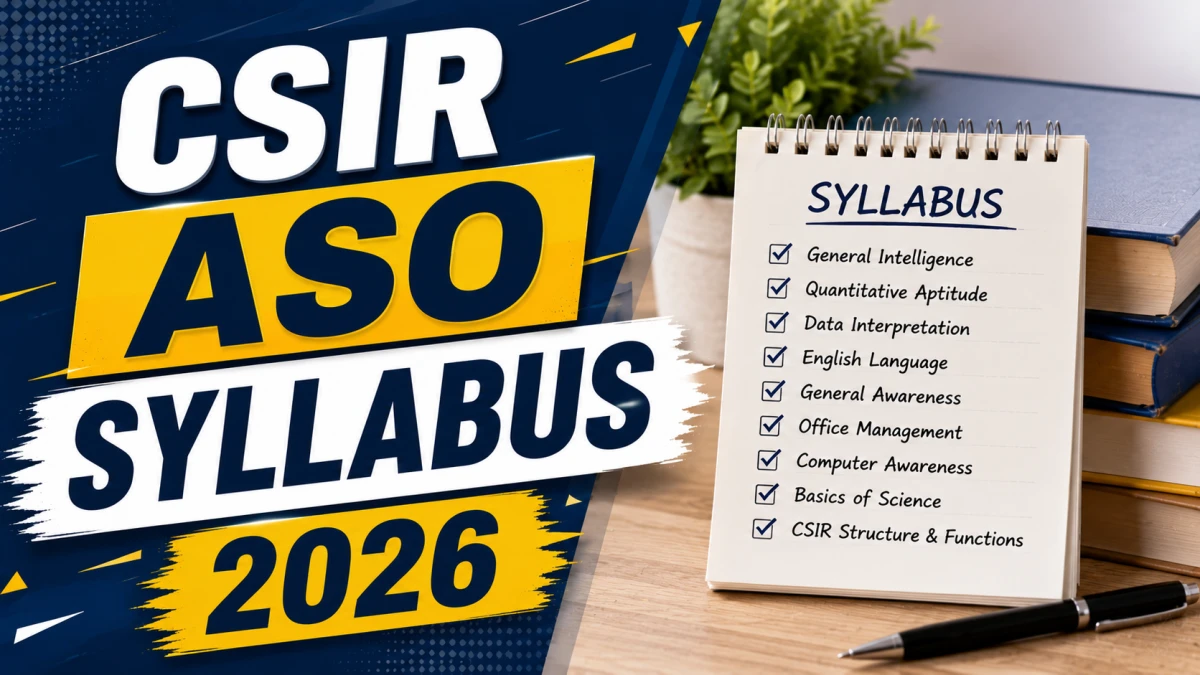
The Council of Scientific and Industrial Research (CSIR) conducts the recruitment exam for Assistant Section Officer (ASO) posts. This article covers the CSIR ASO syllabus 2026, the stage-wise exam pattern, the Computer Proficiency Test (CPT), minimum qualifying marks, and subject-wise topics. Knowing the syllabus and pattern together helps candidates decide how much time to give each paper and which sections carry the most weight.
Note on source: The details below are compiled from publicly available exam-prep content rather than a verified official CSIR notification PDF. Candidates should cross-check every figure especially marks, timings, and qualifying percentages against the latest official CSIR notification once it is released, since the underlying notification referenced by available sources appears to date to an earlier recruitment cycle.
CSIR ASO Syllabus and Exam Pattern 2026 - Overview
| Particular | Details |
|---|---|
| Conducting Body | Council of Scientific and Industrial Research (CSIR) |
| Post | Assistant Section Officer (ASO) |
| Vacancies | Reported as 100 posts in available sources not confirmed against an official CSIR notification |
| Selection Stages | Stage 1 (Paper I & Paper II - Objective), Stage 2 (Paper III - Descriptive), Stage 3 (Computer Proficiency Test) |
| Total Objective Questions (Stage 1) | 350 (Paper I: 150 + Paper II: 200) see note under Exam Pattern below on a conflicting "200 questions" figure found in source material |
| Negative Marking | 0.25 marks deducted per wrong answer in objective papers |
| CPT Duration | 1 hour |
| CPT Maximum Marks | 100 (qualifying in nature; not added to final merit) |
| Official Website | csir.res.in |
CSIR ASO Selection Process 2026
Selection for the ASO post is spread across three stages, and candidates must clear each stage to move to the next.
- Stage 1 - Objective Papers: Candidates attempt Paper I (General Awareness plus English Language and Comprehension) and Paper II (General Intelligence, Reasoning and Mental Ability). Both are multiple-choice papers with negative marking.
- Stage 2 - Descriptive Paper: Candidates who clear Stage 1 attempt Paper III, a descriptive test in English or Hindi covering essay, precis, and letter/application writing.
- Stage 3 - Computer Proficiency Test (CPT): Candidates who meet the required threshold in Stage 2 take the CPT, a practical, computer-based test of office software skills. It is qualifying only CPT marks are not counted toward final merit, but candidates must clear the prescribed minimum percentage for their category.
Final merit is drawn from the objective and descriptive stages, with the CPT acting as a qualifying gate rather than a merit-scoring stage.
CSIR ASO Exam Pattern 2026
Stage 1 & Stage 2: Written Exam Pattern
| Stage | Paper | Section | Type | Maximum Marks | Duration |
|---|---|---|---|---|---|
| Stage 1 | Paper I | General Awareness | Objective | 100 Marks | 1 Hour |
| English Language and Comprehension | Objective | 100 Marks | 1 Hour | ||
| Paper II | General Intelligence, Reasoning and Mental Ability | Objective | 100 Marks | 1 Hour | |
| Stage 2 | Paper III | English/Hindi - Descriptive | Descriptive | 100 Marks | 1 Hour |
Important discrepancy to verify: The source material states in one place that "the CSIR exam comprises a total of 200 multiple-choice questions," while the stage-wise breakup above (taken from the same source) totals 350 objective questions across Paper I and Paper II. I have not resolved this conflict by guessing candidates should confirm the exact question count against the official notification before relying on it.
Each wrong answer in the objective papers carries a deduction of 0.25 marks.
Stage 3: Computer Proficiency Test (CPT) Pattern
| Particular | Details |
|---|---|
| Exam Name | Computer Proficiency Test (CPT) |
| Nature | Qualifying only marks not added to final merit |
| Mode | Computer-based practical test |
| Duration | 1 Hour |
| Maximum Marks | 100 |
| Purpose | Assesses basic computer skills needed for routine office work |
The CPT covers four practical areas:
| Section | Topics Covered |
|---|---|
| Word Processing | Typing a passage, document creation, text formatting and editing exercises |
| Spreadsheet | Spreadsheet creation, data entry, formatting, basic formulas and calculations |
| Presentation (PowerPoint) | Creating slides, formatting content, inserting images/tables |
| Office Skills | Practical tasks assessing day-to-day office computer proficiency |
Minimum Qualifying Marks (CPT) - Category Wise
| Category | Minimum Percentage | Minimum Marks (out of 100) |
|---|---|---|
| UR | 40% | 40 |
| EWS | 37% | 37 |
| OBC | 37% | 37 |
| SC | 35% | 35 |
| ST | 35% | 35 |
| PwBD (all categories) | 30% | 30 |
Tie-Breaking Criteria
If candidates score equally, merit is decided in this order:
- Older candidate ranked higher
- Higher marks in the UPSC Civil Services (Main) Examination 2024, where applicable, ranked higher
- Candidate who completed the required educational qualification earlier ranked higher
- Alphabetical order of first name, if the tie still persists
CSIR ASO Syllabus 2026
The written exam is split into three papers. Below is the subject-wise topic breakdown as found in available source material.
1. Paper I - General Awareness
History of India & Indian National Movement: Sources of Indian history, the Harappan civilisation, the Vedic and Mauryan periods, the post-Mauryan period (200 BC-300 AD), Gupta and post-Gupta society/economy/polity, medieval India from 750-1200, the Delhi Sultanate, the Mughals, the Marathas, medieval saints, 18th-century India, rise of regional powers, economic impact of British rule, the Indian Renaissance and reform movements, early uprisings against the British, the Revolt of 1857, causes of the national movement, the neo-nationalist/extremist phase, and the beginning of the Gandhian era.
Constitution of India, Polity, Governance and Social Justice:
- Historical evolution, features, amendments and basic structure of the Indian Constitution
- Union-State functions, federal structure, devolution of powers to local levels
- Comparison of India's constitutional scheme with other countries
- Separation of powers, dispute redressal mechanisms and institutions
- Parliament and State Legislatures structure, functioning, powers and privileges
- Appointments and powers of Constitutional Bodies
- Structure and functioning of the Executive and Judiciary; role of pressure groups
- Government policies and welfare schemes, including for vulnerable sections
- Health, education and human resource development
- Role of NGOs, SHGs and other stakeholders in development
- Governance, transparency, accountability and e-governance
- Issues relating to poverty and hunger
Current Events of National and International Importance:
- National: National issues, economy, polity, judiciary, environment, science and technology, states, social schemes, sports, reports/committees/commissions, awards and honours, accidents and calamities, "firsts" in India
- International: Major summits, international awards, "firsts" in the world, international leadership, reports and committees, global geographical events
English Language and Comprehension (part of Paper I)
- Comprehension passages
- Transformation exercises (active-passive, direct-indirect, etc.)
- Prepositions and fill-in-the-blanks
- Synonyms and antonyms
- Sentence correction and common errors
- Punctuation, idioms and phrases
2. Paper II - General Intelligence, Reasoning and Mental Ability
(A) General Intelligence & Reasoning and Mental Ability
Analogies, similarities and differences, space visualisation, problem-solving, analysis, judgement, decision-making, visual memory, discriminating observation, relationship concepts, arithmetical reasoning, verbal and figure classification, arithmetical and non-verbal number series, classification, coding-decoding, blood relations, direction sense, logical Venn diagrams, alphabet test, sitting arrangements, mathematical operations, inserting the missing character, ranking and time-sequence tests, and eligibility tests.
(B) Arithmetical and Numerical Ability
Simplification, decimals, data interpretation, fractions, LCM/HCF, ratio and proportion, percentage, average, profit and loss, discount, simple and compound interest, mensuration, time and work, time and distance, and reading tables/graphs.
(C) General Science
- Physics: Mechanics, heat, magnetism, electricity, light, sound, modern physics
- Chemistry: Composition of substances, atomic structure, radioactivity, chemical bonds, oxidation, acids/bases/salts, valency, gas laws, electrochemistry, thermochemistry, chemical kinetics, periodic classification, metals and non-metals, organic chemistry, alloys, fertilizers, cement
- Biology: Plant diseases, plant tissue, plant genetics, cell biology, ecology, pollution, health and nutrition, human physiology, animal classification
- Computer/IT: Basic computer fundamentals, word processing, spreadsheets, slide creation, email
(D) Economic & Social Development and Environmental Issues
Basic concepts of economy and economics, resource distribution, macro and micro economic policy, growth versus development, indices such as HDI, HPI/MPI, PQLI, GEM, GDI/GII and TAI, sustainable development, and India's ranking on these indices. Also covers climate change, ecosystems, natural disasters, and how environment topics link to geography, biology and governance.
(E) Ethics and Human Interface
Determinants and consequences of ethics in human actions, dimensions of ethics in private and public relationships, human values drawn from the lives of leaders and reformers, and the role of family, society and education in inculcating values.
(F) Decision Making and Problem Solving
Identifying the problem, identifying possible solutions, selecting the best solution, eliminating alternatives, and making the decision.
(G) Management Principles & Practices
Planning, organising, directing and control; job analysis, description and design; recruitment; communication; leadership; motivation; negotiation; financial management; delegation; project appraisal; procurement; stores and inventory management; facilities management.
(H) National Geography
Physical features of India, river systems, climate, minerals and industries, agriculture, natural vegetation and fauna, economic infrastructure, and human geography.
3. Paper III - English/Hindi Descriptive Paper
- Essay writing
- Precis writing
- Letter/application writing
How to Prepare for the CSIR ASO Exam 2026
- Map the syllabus to a timetable first. Split preparation time across General Awareness, English, Reasoning and the descriptive paper based on the marks each carries (100, 50, 200 and 150 respectively), rather than spending equal time on all sections.
- Prioritise Paper II. It carries the highest marks (200) among the objective papers, so reasoning and mental ability topics deserve proportionally more practice sessions.
- Practise CPT tasks on an actual computer, not just in theory. Since the CPT is a hands-on test of word processing, spreadsheets and presentations, timed practice on real software matters more than reading about it.
- Build a current affairs habit early. Given the current events component in Paper I, follow a daily/weekly national and international news digest rather than cramming close to the exam.
- Time your descriptive writing. Practise essay, precis and letter writing within the 2-hour limit so pacing itself doesn't cost marks in Stage 2.
- Revise negative-marking-prone areas. With a 0.25 deduction per wrong answer in objective papers, attempt only questions you're reasonably confident about, and use mock tests to gauge your safe attempt count.
Important Links
- CSIR ASO Syllabus PDF: Click Here
- Official Website: csir.res.in