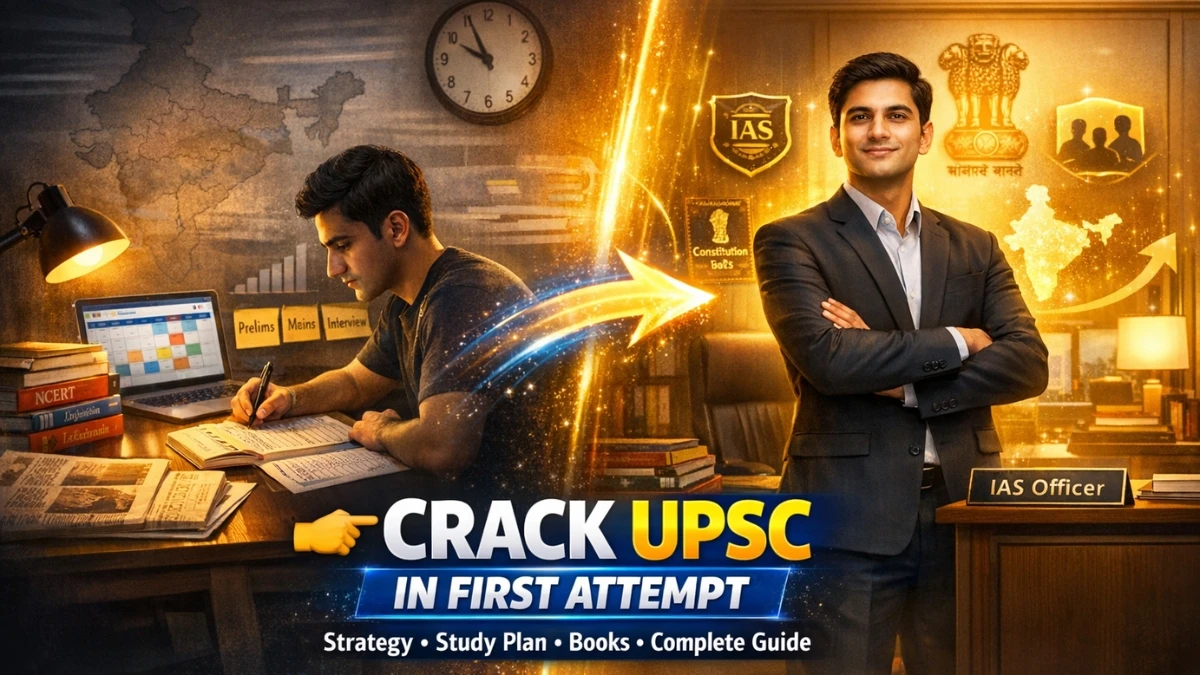
How to Crack UPSC in the First Attempt – Strategy, Study Plan, Books & Complete IAS Preparation Guide
How to Crack UPSC in the First Attempt: To clear the Union Public Service Commission (UPSC) Civil Services Examination (CSE) in the first attempt, candidates need a clear understanding of the UPSC exam pattern, detailed syllabus coverage, a structured 12‑month study plan, disciplined answer‑writing practice, consistent revision, and smart selection of limited standard books.
About UPSC Civil Services Examination (CSE)
The Civil Services Examination (CSE) is conducted annually by the Union Public Service Commission (UPSC) to recruit officers into top services like the Indian Administrative Service (IAS), Indian Police Service (IPS), Indian Foreign Service (IFS), and other Central Services.
It is a three‑stage exam: Preliminary Examination, Main Examination, and Personality Test (Interview), designed to test knowledge, analytical ability, and overall personality.
UPSC CSE is a national‑level exam with a very low overall success rate, which makes clarity of pattern, syllabus, and strategy crucial for first‑attempt candidates.
As per the official UPSC calendar 2026, the CSE (IAS) Prelims 2026 is scheduled for 24 May 2026, and the Mains is set to commence from 21 August 2026, giving aspirants a clear timeline to backwards-plan their preparation.
UPSC Exam Pattern (Prelims, Mains & Interview)
The UPSC CSE selection process has three stages with a total of 1750 marks in Mains plus 275 marks in the Interview for final merit.
UPSC Prelims Exam Pattern
The Preliminary Examination is an objective‑type screening test with two papers.
| Paper | Marks | Type |
|---|---|---|
| General Studies Paper I | 200 | Objective (MCQ) |
| CSAT – General Studies Paper II | 200 | Objective (MCQ), Qualifying |
-
General Studies Paper I decides the Prelims cut‑off and selection for Mains.
-
CSAT (Paper II) is qualifying; candidates must score at least 33% to have their Paper I evaluated for merit.
-
There is negative marking in both papers (usually one‑third of the marks assigned to the question), and each paper is of 2 hours.
UPSC Mains Exam Pattern
The Main Examination is descriptive and consists of nine papers, of which seven are counted for merit (1750 marks) and two are qualifying.
| Paper | Marks |
|---|---|
| Essay | 250 |
| General Studies I | 250 |
| General Studies II | 250 |
| General Studies III | 250 |
| General Studies IV (Ethics) | 250 |
| Optional Subject Paper I | 250 |
| Optional Subject Paper II | 250 |
| Qualifying Indian Language | 300 (Qualifying) |
| Qualifying English Language | 300 (Qualifying) |
-
The total marks for merit in Mains are 1750 (Essay + GS I–IV + Optional I & II).
-
Each paper is of 3 hours and is conducted in an offline, pen‑and‑paper mode.
UPSC Interview (Personality Test)
The Personality Test (Interview) carries 275 marks, leading to a final total of 2025 marks (1750 + 275). It is conducted by a Board that assesses mental calibre, critical powers of assimilation, balance of judgement, variety and depth of interest, social cohesion and leadership, and integrity.
There is no fixed syllabus for the Interview; questions revolve around the Detailed Application Form (DAF), educational background, work profile, home state, national and international issues, and hypothetical administrative situations.
Final merit is prepared based on the combined marks of the Main Examination (1750) and the Personality Test (275).
UPSC Prelims Syllabus
UPSC Prelims General Studies Paper I broadly covers the following areas:
-
Current affairs: National and international events of importance, with focus on polity, economy, environment, science and international relations.
-
Indian Polity and Governance: Constitution, political system, Panchayati Raj, public policy, rights issues.
-
History of India and Indian National Movement: Ancient, medieval and modern history with emphasis on modern freedom struggle.
-
Indian and World Geography: Physical, social and economic geography of India and the world.
-
Economic and Social Development: Sustainable development, poverty, inclusion, demographics, and social sector initiatives.
-
Environment and Ecology: Biodiversity, climate change, environmental issues, conservation.
-
General Science & Science and Technology: Basic science concepts and recent developments affecting daily life and policy.
CSAT (Paper II) tests comprehension, logical reasoning, analytical ability, data interpretation, decision‑making, numeracy and basic maths up to Class X level.
UPSC Mains Syllabus
General Studies I (GS 1)
- GS 1 covers Indian Heritage and Culture, History and Geography of the World and Society. Major components include Indian art and culture, modern Indian history, world history, Indian society and social issues, and geography (physical, resources, distribution, and climate).
General Studies II (GS 2)
- GS 2 focuses on Polity, Governance and International Relations. Topics include the Constitution, Parliament and State Legislatures, Executive and Judiciary, federalism, devolution, statutory and regulatory bodies, welfare schemes, governance challenges, and India’s relations with neighbours and major global groupings.
General Studies III (GS 3)
- GS 3 covers Economy, Environment, Science & Technology and Internal Security. Areas include Indian economy, budgeting, agriculture, infrastructure, environment and ecology, disaster management, science and technology, and internal security issues like terrorism, cyber security and border management.
General Studies IV (GS 4)
- GS 4 is Ethics, Integrity and Aptitude, oriented towards case‑study‑based evaluation of ethical dilemmas in public life. It includes ethical theories, thinkers, emotional intelligence, public service values, probity in governance and applied ethics through case studies.
Essay Paper and Optional Subject
- The Essay paper requires writing two essays on abstract, philosophical or issue‑based topics, testing the depth of thought and structured expression. The Optional Subject (two papers) is chosen by the candidate from a notified list and demands deeper subject‑level understanding similar to graduation‑level rigor.
UPSC Preparation Strategy to Crack in First Attempt
Step 1 – Understand the Syllabus Completely
-
The most important initial step is to read and print the complete UPSC Prelims and Mains syllabus from the official notification, and keep it visible at your study desk. Break down each syllabus heading (e.g., “Indian Polity and Governance”) into micro‑topics like Fundamental Rights, Parliament, Judiciary, local bodies, etc., and map them against NCERT chapters and standard reference books.
-
Highlight previous years’ question themes against these micro‑topics to understand weightage and recurring areas. This prevents random study, helps you prioritise high‑yield areas and ensures that every study session is directly linked to the official syllabus.
Step 2 – Build Strong Foundation (Months 1–4)
-
From Months 1 to 4, focus on building a strong conceptual base with NCERT and one basic reference per subject.
-
Complete NCERTs for History, Geography, Polity, Economy and Science from Classes 6 to 12, giving special attention to Class 11–12 texts.
-
Start Indian Polity with “Indian Polity” by M. Laxmikanth as your main reference once you finish basic polity NCERTs, aligning chapters with the syllabus headings.
-
Cover basic Economy from NCERTs, NIOS or a simple macroeconomics source, ensuring you understand concepts like GDP, inflation, monetary and fiscal policy before moving to advanced texts.
-
Develop a daily newspaper habit (The Hindu or Indian Express) focusing on editorials and articles linked to the syllabus, maintaining notes topic‑wise rather than date‑wise.
Step 3 – Standard Books Strategy (Months 4–8)
From Months 4 to 8, shift to selective, high‑quality standard books instead of adding too many sources.
Suggested core list (keep it limited):
-
Polity: “Indian Polity” – M. Laxmikanth.
-
Modern History: “A Brief History of Modern India” (Spectrum) for freedom struggle and modern India.
-
Economy: A conceptual book like Ramesh Singh or a similar standard economy text, used alongside current affairs.
-
Geography: NCERTs (11–12) plus “Certificate Physical and Human Geography” by G.C. Leong for concepts and diagrams.
-
Environment & Ecology: “Environment” by Shankar IAS Academy for static topics, supported by current affairs for international conventions and reports.
-
Ethics (GS 4): Lexicon for Ethics or a similar standard text for definitions and conceptual clarity, supplemented with case‑study practice.
Avoid reading multiple books for the same topic just because toppers mention them; instead, revise a small set of trusted sources multiple times. Link each book chapter back to syllabus points and previous year questions to ensure focused reading, not passive reading.
Step 4 – Answer Writing Practice (Months 6–12)
Structured answer writing is essential to crack the Main Examination in the first attempt.
-
Begin answer writing around Month 6 once you are comfortable with basics of Polity, History, Geography and current affairs.
-
Start with writing 1–2 GS answers daily using previous year questions or standard test series questions, and focus on maintaining a simple Intro–Body–Conclusion structure.
-
Emphasise directive words like “Discuss, Critically examine, Analyse” and keep answers within word limit while using subheadings, bullet points and simple diagrams or maps where relevant.
-
Once a week, attempt a mini GS test (e.g., 10–15 questions) in 90 minutes to simulate exam‑like pressure and improve speed and coherence.
Step 5 – Prelims Mock Strategy
Prelims can eliminate even strong candidates; a smart mock‑test strategy is non‑negotiable.
-
Target 40–50 full‑length Prelims mock tests over the course of preparation, with higher density in the last 3–4 months before the exam.
-
Maintain an error notebook where you record every mistake, guess and conceptual gap, revisiting it after every 5–10 tests to ensure mistakes are not repeated.
-
Practise intelligent guessing by eliminating options logically instead of blind guessing, because of negative marking.
-
Regularly revise static subjects and current affairs in cycles (e.g., every Sunday) to convert mock‑test learning into long‑term retention.
Step 6 – Mains Writing Strategy
For the Main Examination, depth, structure and value addition in answers decide your score.
-
Manage time by practising full GS papers (20 questions in 3 hours) well before the Main Examination so you can attempt all questions with reasonable quality.
-
Use simple hand‑drawn diagrams, maps, flowcharts and tables wherever they add clarity, especially in Geography, Economy, Environment and internal security questions.
-
Integrate data points (e.g., budget figures, NITI Aayog reports, NFHS statistics), Supreme Court judgements and committee recommendations to make answers more credible, but avoid overloading facts at the cost of explanation.
-
For Ethics (GS 4), practise case studies regularly, focusing on practical, principled responses rather than memorised definitions.
Step 7 – Interview Preparation
Interview preparation should begin once you are confident about clearing Mains, but some elements can be built gradually.
-
Carefully fill and later analyse your Detailed Application Form (DAF); most questions will come from your home state, graduation subject, hobbies, work experience and service preference.
-
Stay updated with current affairs even after Mains, focusing on issues rather than events, and form balanced opinions supported by constitutional principles and ethical reasoning.
-
Attend a few mock interviews to receive feedback on body language, clarity, and articulation, but avoid over‑rehearsing to the point of sounding artificial.
-
Remember that the Personality Test aims to assess suitability for public service, not factual recall, so honesty, composure and balanced thinking are critical.
UPSC Preparation Tips to Crack the Main Exam
Mains decides ranks, focus on these:
-
Practice full GS papers (20 Qs in 3 hrs) weekly from Month 7.
-
Use Intro–Body–Conclusion; incorporate diagrams, data, judgments.
-
Balance facts with analysis; avoid rote answers.
-
For Ethics: Daily case studies; link to thinkers/values.
-
Essay: Write 1–2 weekly on diverse topics; aim for balanced, original views.
-
Optional: Treat as scoring opportunity, deep revision + past papers.
-
Time management: Attempt all; prioritise high-scoring questions first.
1-Year UPSC Study Plan for First Attempt (Sample)
Timelines vary by individual, but a realistic 12‑month plan can be structured as follows.
Months 1–3: NCERT + Basics
-
Finish core NCERTs (6–12) for History, Geography, Polity, Economy and Science, building conceptual understanding.
-
Start daily newspaper reading and basic note‑making aligned with the syllabus, avoiding excessive cutting‑pasting.
-
Identify your Optional subject and explore its syllabus and past papers.
Months 4–6: Standard Books + Optional Subject Start
-
Start standard books (Laxmikanth, Spectrum, Shankar IAS, economy and geography references) and begin your Optional subject systematically.
-
Begin limited answer writing (2–3 answers daily) and a weekly GS mini test.
-
Consolidate current affairs from a monthly compilation for these months.
Months 7–9: Answer Writing + Prelims Revision
-
Intensify answer writing with full GS papers and regular Optional tests.
-
Start serious Prelims preparation: subject‑wise MCQs, early full‑length mocks, and multiple revision cycles for static and current affairs.
-
Refine notes and reduce sources to a compact revision bundle.
Months 10–12: Mock Tests + Intensive Revision
-
Take 2–3 Prelims mocks per week initially, then almost daily in the last month, with complete analysis and error tracking.
-
After Prelims, immediately restart Mains‑oriented study with GS and Optional answer‑writing and revision, focusing on high‑yield areas.
-
Ensure at least 30–40 essays and multiple Ethics case‑study sets are practised before Mains.
Common Mistakes to Avoid
-
Book overload: Reading too many books per subject without revising any of them properly reduces retention and increases confusion.
-
Lack of revision: Many aspirants keep collecting material but do not revise 3–4 times, which is essential for both Prelims MCQs and Mains recall.
-
Ignoring Optional subject: Under‑preparing the Optional can drastically reduce final marks despite good GS performance.
-
Late answer writing: Postponing answer writing until after Prelims makes it difficult to adapt to the descriptive format in time.
-
Distractions and inconsistent schedule: Irregular study hours and excessive social media consumption fragment focus and derail the 12‑month plan.