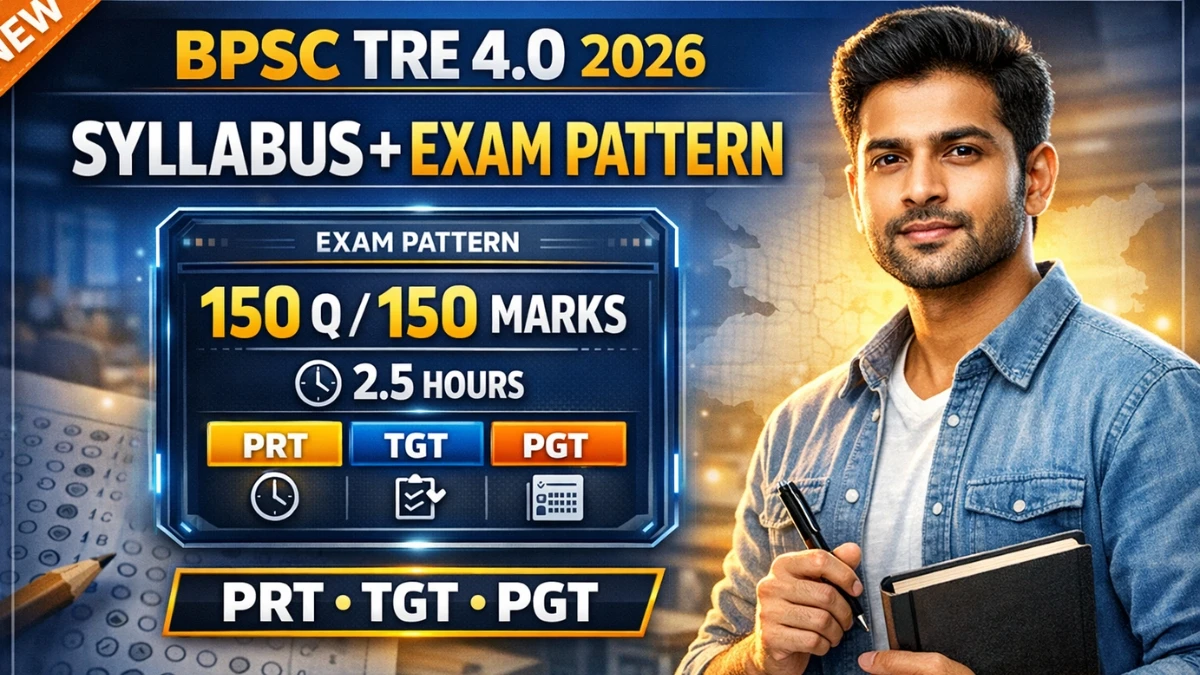
BPSC TRE 4.0 Syllabus and Exam Pattern 2026 for PRT, TGT, and PGT Posts are based on the latest Bihar Teacher Recruitment Examination structure, which includes a qualifying language section, General Studies, and a subject-specific paper depending on the level.
BPSC TRE 4.0 Overview – Bihar Teacher Recruitment Examination
The Bihar Public Service Commission (BPSC) conducts the Teacher Recruitment Examination (TRE) 4.0 to recruit teachers for Primary (PRT – Classes 1–5), Trained Graduate Teacher (TGT – typically Classes 9–10, often including middle/upper primary), and Post Graduate Teacher (PGT – Classes 11–12) positions in government schools across Bihar.
This guide covers the expected syllabus, exam pattern, marking scheme, and key differences for aspirants preparing for TRE 4.0 in 2026. The official notification for TRE 4.0 (approximately 46,595 vacancies) is expected soon, with applications likely starting in March 2026 and the exam scheduled from 22 to 27 September 2026 (as per the latest BPSC exam calendar updates).
BPSC TRE 4.0 Exam Pattern 2026 (Post-wise Complete Details)
The TRE 4.0 exam is offline (OMR-based) and MCQ-type. For most posts (TGT and PGT), it is a single paper of 150 questions for 150 marks in 2 hours and 30 minutes. PRT may follow a similar unified pattern or slight variation based on recent cycles, but the latest trends show alignment toward the 150-question structure across levels.
BPSC TRE 4.0 PRT Exam Pattern 2026 (Primary Teacher – Classes 1–5)
| Part | Subject | Total Questions | Total Marks |
|---|---|---|---|
| Part I – Language (Qualifying) | English and Hindi/Urdu/Bangla | 30 | 30 |
| Part II – General Studies | Primary Maths, Reasoning, General Awareness, General Science, Social Studies, Geography, EVS, Indian National Movement | 40 | 40 |
| Part III – Concerned Subject | Maths and Science / Social Science / Hindi / English | 80 | 80 |
| Total | — | 150 | 150 |
BPSC TRE 4.0 TGT Exam Pattern 2026 (Trained Graduate Teacher – Classes 9–10 / Secondary)
| Part | Subject | Total Questions | Total Marks |
|---|---|---|---|
| Part I – Language | English and Hindi/Urdu/Bangla | 30 | 30 |
| Part II – General Studies | Primary Maths, Reasoning, General Awareness, General Science, Social Studies, Geography, EVS, Indian National Movement | 40 | 40 |
| Part III – Concerned Subject | Maths / Science / Hindi / English / Bangla / Urdu / Sanskrit / Arabic / Persian / Fine Arts / Dance / Physical Education / Maithali / Music / Social Science | 80 | 80 |
| Total | — | 150 | 150 |
BPSC TRE 4.0 PGT Exam Pattern 2026 (Post Graduate Teacher – Classes 11–12 / Higher Secondary)
| Part | Subject | Total Questions | Total Marks |
|---|---|---|---|
| Part I – Language | English and Hindi/Urdu/Bangla | 30 | 30 |
| Part II – General Studies | Primary Maths, Reasoning, General Awareness, General Science, Social Studies, Geography, EVS, Indian National Movement | 40 | 40 |
| Part III – Concerned Subject | Maths / Science / Hindi / English / Bangla / Urdu / Sanskrit / Arabic / Pharsi / Fine Arts / Dance / Physical Education / Maithili / Music / Social Science / Maghi / Bhojpuri / Pali / Prakart / Physics / Chemistry / Botany / Zoology / History / Philosophy / Home Science / Computer Science / Business Studies / Accountancy | 80 | 80 |
| Total | — | 150 | 150 |
BPSC TRE 4.0 / Bihar Teacher Exam Key Rules (Quick Summary)
| Level | Total Questions / Marks | Overall Duration | Negative Marking | Language Rule |
|---|---|---|---|---|
| Middle Teacher | 150 / 150 | 2 hours 30 minutes | No negative marking | Qualifying (minimum 30%) |
| Secondary Teacher | 150 / 150 | 2 hours 30 minutes | No negative marking | Qualifying (minimum 30%) |
| Higher Secondary Teacher | 150 / 150 | 2 hours 30 minutes | No negative marking | Qualifying (minimum 30%) |
Final pattern, marking, and time may be updated in the official TRE 4.0 2026 notification; refer to the BPSC website.
BPSC TRE 4.0 Syllabus 2026 (Detailed Paper-wise)
The syllabus follows a common structure: Language is qualifying (minimum ~30% required, not added to merit in recent patterns), while General Studies and Subject sections determine merit ranking. Difficulty aligns with the post level (primary/basic for PRT, secondary for TGT, higher for PGT).
Language Paper Syllabus (Qualifying – Common for All Posts)
-
Part I – English (Compulsory):
-
Reading comprehension, basic grammar (tenses, articles, prepositions, voice, narration), vocabulary (synonyms, antonyms, idioms, one-word substitutions), sentence improvement, error spotting, cloze test, and rearrangement.
-
-
Part II – Hindi / Urdu / Bengali (Choose one):
-
Grammar basics (संधि, समास, कारक, काल, etc. for Hindi), vocabulary, unseen passage comprehension, correct usage, and sentence formation.
-
Candidates must secure at least 30% in Language to qualify (as per recent TRE trends).
General Studies Syllabus (Common Across Levels – Difficulty Varies)
-
Elementary Mathematics: Number system, fractions, percentages, ratio & proportion, interest, profit-loss, averages, time & work, speed-distance, basic geometry.
-
Mental Ability / Reasoning: Analogies, classification, coding-decoding, series, puzzles, directions, ranking, Venn diagrams.
-
General Awareness: Current affairs (national & Bihar-specific), important days, books & authors, government schemes, basic polity & economy.
-
General Science: Basic Physics, Chemistry, Biology (up to secondary level).
-
Social Science: History, civics, geography (India & Bihar focus).
-
Indian National Movement & Constitution basics.
-
Geography & Environment: Physical/Indian geography, environmental issues, climate basics.
Subject Paper Syllabus (TGT & PGT – 80 Marks)
The subject paper covers content up to the teaching level + pedagogy basics. Examples:
-
Mathematics: Arithmetic, algebra, geometry, trigonometry, coordinate geometry, statistics (deeper concepts for PGT).
-
Science: Physics, Chemistry, Biology concepts, experiments, and applications.
-
Social Science: History, geography, polity, economics (Bihar emphasis).
-
Languages (Hindi/English etc.): Literature (poetry/prose), grammar, comprehension.
The detailed official subject-wise syllabus appears in the TRE notification annexures.
Difference Between PRT, TGT and PGT Exam Pattern (Quick Comparison)
| Level | Post Name | Classes | Total Questions/Marks | Sections | Subject Paper? | Overall Time |
|---|---|---|---|---|---|---|
| Primary | PRT (Primary Teacher) | 1–5 | 150 / 150 | Language + GS + Subject/Aptitude | Yes (basic) | 2.5 hours |
| Secondary | TGT (Trained Graduate Teacher) | 9–10 (often 6–10) | 150 / 150 | Language + GS + Concerned Subject | Yes (80 marks) | 2.5 hours |
| Higher Secondary | PGT (Post Graduate Teacher) | 11–12 | 150 / 150 | Language + GS + Concerned Subject | Yes (deeper) | 2.5 hours |
BPSC TRE 4.0 Marking Scheme and Selection Process 2026
Marking Scheme
-
+1 mark per correct answer (total 150 marks).
-
Language: Qualifying (no/ minimal negative; ~30% minimum).
-
GS & Subject: Merit-based (negative marking may apply in some sections – confirm in notification; recent patterns often show no negative overall).
-
No negative in Language; check the official for GS/Subject.
Selection Process
-
Written exam (as above).
-
Document verification (qualifications, category certificates, TET if required).
-
Merit list based on GS + Subject marks (after qualifying Language).
Preparation Tips for BPSC TRE 4.0 Based on Syllabus
How to Start – Section Priority
-
Prioritize Language (qualifying but essential) – practice grammar & comprehension.
-
Build a strong General Studies foundation (high-scoring; use NCERTs + current affairs).
-
Dedicate major time to Subject (especially for TGT/PGT) – theory + MCQs.
Time Allocation and Strategy
-
Roughly: 20–25% Language, 35–40% GS, 35–45% Subject.
-
Take timed mocks (150 questions / 2.5 hours) for speed & accuracy.
Common Mistakes to Avoid
-
Neglecting Language (failure disqualifies despite strong scores elsewhere).
-
Mismatching preparation level (e.g., basic for PGT depth).
-
Relying only on coaching – always cross-check the official syllabus PDF.