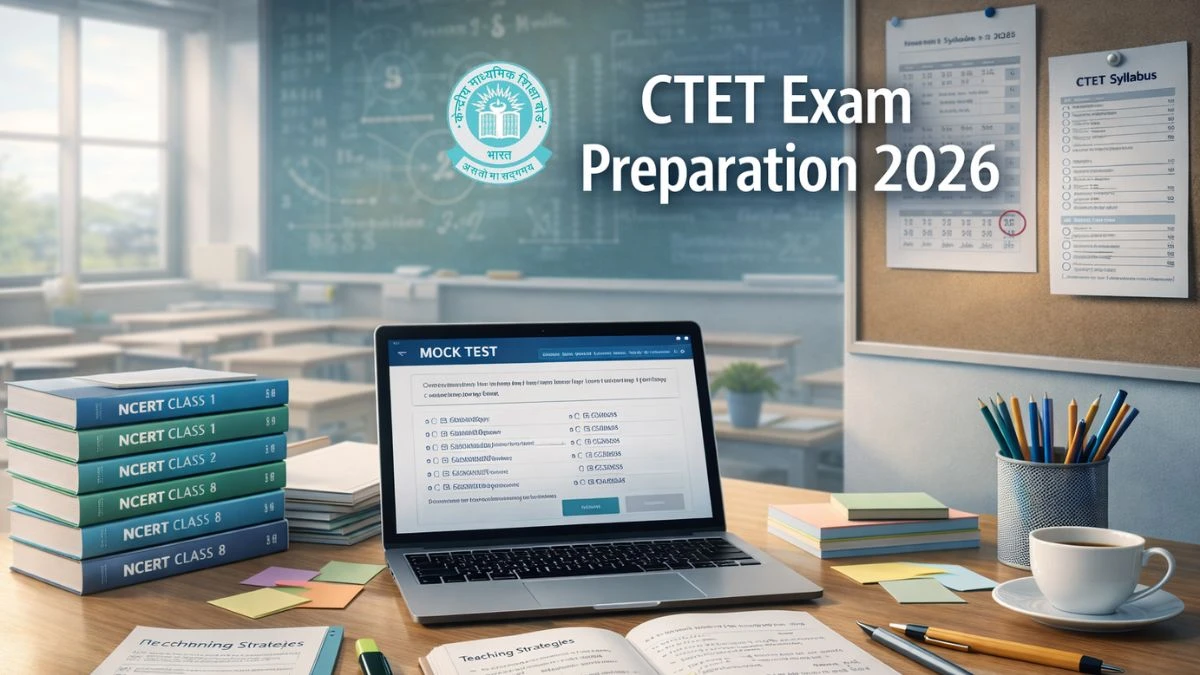
The CTET Exam Preparation 2026 demands a structured approach, a deep grasp of the syllabus, and regular practice to succeed in this national-level teacher eligibility test. Conducted by the Central Board of Secondary Education (CBSE), the Central Teacher Eligibility Test (CTET) determines eligibility for teaching positions in Classes I–V (primary) and VI–VIII (upper primary) in central government schools like KVS and NVS, as well as many state and private institutions. The certificate remains valid for a lifetime as per NCTE guidelines.
The most recent CTET (February 2026 session, 21st edition) was held on February 7 and 8, 2026, in offline OMR mode. Provisional answer keys are expected soon on the official website ctet.nic.in, followed by results. For future cycles, always check ctet.nic.in for notifications.
How to Start CTET Exam Preparation 2026?
-
Review the latest pattern and syllabus; create a topic tracker for your chosen paper(s).
-
Prioritize Child Development & Pedagogy for its conceptual weight and commonality.
-
Build strong foundations using NCERT books (Classes 1–8) for content subjects.
-
Solve previous year questions (PYQs) topic-wise to identify patterns.
-
Take weekly full-length mocks, increasing the frequency as we get closer to the exam.
-
Analyze every mock/test: note errors, revise weak areas immediately.
-
Dedicate daily time (1–2 hours) to revision of key concepts, theories, and formulas.
3-Month CTET Study Plan 2026
Month 1 – Foundation Building
Complete Child Development & Pedagogy notes. Cover NCERT-based content for Maths, EVS (Paper 1), or Maths/Science/SST (Paper 2). Build Language I & II basics (grammar, comprehension, pedagogy).
Month 2 – Intensive Practice
Solve topic-wise PYQs and chapter-wise sets. Attempt 1 full mock weekly with same-day analysis. Revise weak topics using short notes.
Month 3 – Exam Simulation
Take 2–3 full mocks per week under timed conditions. Revise short notes, high-weightage pedagogy theories, and focus on speed/accuracy. Avoid new topics; consolidate learning.
Best Books for CTET Preparation 2026
Focus on neutral, reliable resources aligned with NCERT and pedagogy:
-
Child Development & Pedagogy: Standard guides covering theories, inclusive education, and MCQs (e.g., books emphasizing application-based questions).
-
Mathematics: NCERT-aligned books with theory, pedagogy, and practice MCQs.
-
EVS/Science/SST: Concept-clear books based on NCERT with integrated pedagogy sections.
-
Languages I & II: Resources on language pedagogy, comprehension, grammar, and teaching methods.
-
Overall: Previous year solved papers, practice sets, and full mock test books for both papers.
CTET Preparation Tips to Crack in First Attempt
Emphasize conceptual understanding in pedagogy over rote learning. Questions are often scenario-based. Use NCERTs as primary sources, supplemented by CTET-specific practice. Manage time in mocks with section-wise targets. Maintain an error notebook from PYQs/mocks for regular revision. On exam day, attempt easier sections first (e.g., languages), fill OMR carefully, and stay calm.
Importance of CTET Previous Year Question Papers
PYQs reveal difficulty levels, repeated concepts (especially in Pedagogy and EVS/SST), and option-elimination techniques. Solving them in timed conditions builds speed, accuracy, and familiarity with the pattern.
CTET Exam Pattern 2026 (Paper 1 & Paper 2)
Both papers are offline, with 150 multiple-choice questions worth 150 marks and a duration of 2.5 hours (150 minutes). No negative marking applies.
Paper 1 (Classes I–V – Primary Stage)
-
Child Development & Pedagogy: 30 questions, 30 marks
-
Language I (compulsory): 30 questions, 30 marks
-
Language II (compulsory): 30 questions, 30 marks
-
Mathematics: 30 questions, 30 marks
-
Environmental Studies (EVS): 30 questions, 30 marks
-
Total: 150 questions, 150 marks
Paper 2 (Classes VI–VIII – Upper Primary Stage)
-
Child Development & Pedagogy: 30 questions, 30 marks
-
Language I (compulsory): 30 questions, 30 marks
-
Language II (compulsory): 30 questions, 30 marks
-
Mathematics & Science (for Maths/Science teachers): 60 questions, 60 marks
OR
-
Social Studies/Social Science (for SST teachers): 60 questions, 60 marks
-
Total: 150 questions, 150 marks
Qualifying marks: 60% (90/150) for General category; 55% (82/150) for OBC/SC/ST/PwD.