
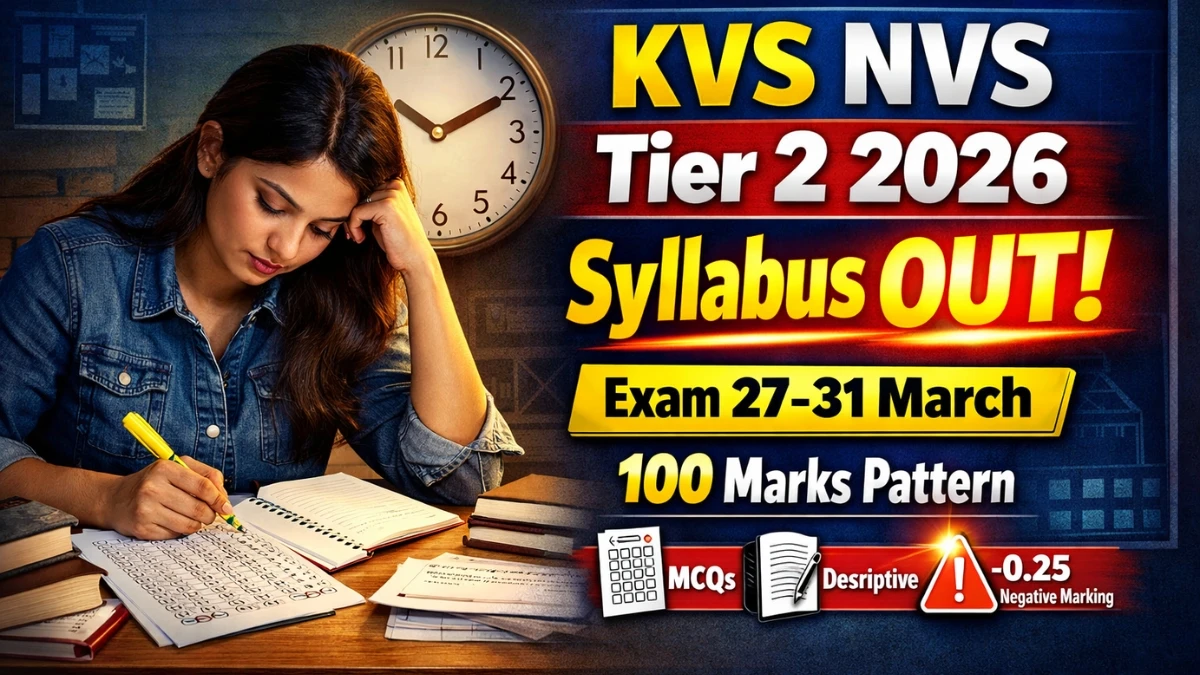
The KVS NVS Tier 2 Syllabus 2026 detailed information, including the exam pattern, subject-wise key topics, selection process, and related aspects, is now available from official sources for the ongoing recruitment cycle (primarily under KVS Advertisement No. 01/2025 and aligned NVS processes).
As of March 02, 2026, Tier 1 exams have concluded, with final answer keys, scores, shortlisting status for Tier 2, and the Tier 2 schedule (March 27–31, 2026, in multiple shifts) released. Tier 2 is the critical subject knowledge stage for shortlisted candidates in teaching posts like PGT, TGT, PRT, and others.
KVS NVS Tier 2 Exam Pattern 2026
Tier 2 is a subject-specific knowledge test combining objective (OMR-based) and descriptive (pen-and-paper) components. It applies to PGT, TGT, PRT, and various non-teaching posts in the current cycle.
-
Duration: 2.5 hours (150 minutes), no sectional time limits.
-
Total Questions: 70
-
Total Marks: 100
-
Objective Section: 60 questions × 1 mark each = 60 marks (negative marking of 0.25 marks per wrong answer).
-
Descriptive Section: 10 questions × 4 marks each = 40 marks (focus on detailed, structured explanations, examples, pedagogy applications, and subject depth).
-
Medium: Bilingual (English & Hindi), except language-specific posts (e.g., PGT English/Hindi or regional languages).
-
Mode: Combination of OMR-based (objective) and pen-paper (descriptive).
-
Nature: Qualifying for the next stage (interview/skill test where applicable); marks contribute to final merit.
KVS NVS Tier 2 Exam Pattern 2026
Both KVS and NVS follow a similar structure for Tier 2: a Subject Knowledge Test combining objective and descriptive elements. The pattern is consistent across most posts (PGT, TGT, PRT, administrative roles, etc.), though content varies by post.
-
Total Questions: 70
-
Total Marks: 100
-
Duration: 2.5 hours (150 minutes, no sectional timing)
-
Question Types:
-
Objective (MCQs): 60 questions → 60 marks (1 mark each)
-
Descriptive: 10 questions → 40 marks (typically 4 marks each)
-
| Component | Questions | Marks | Type |
|---|---|---|---|
| Objective | 60 | 60 | MCQ-based |
| Descriptive | 10 | 40 | Short/Long answers |
| Total | 70 | 100 | - |
KVS NVS Tier 2 Marking Scheme
-
Objective: +1 mark per correct answer; -0.25 marks for each wrong answer (negative marking applies only to objective section).
-
Descriptive: No negative marking; evaluated on content, structure, clarity, and relevance (full or partial marks possible).
-
Unattempted questions: No penalty.
-
Final merit for most posts: Based primarily on Tier 2 scores (often 85% weightage) + Interview/Skill Test (15% where applicable, e.g., for PGT/Principal). Tier 1 is purely qualifying/shortlisting.
KVS NVS Tier 2 Syllabus 2026 – Subject-Wise Key Topics
The Tier 2 syllabus is post-specific and draws heavily from NCERT/CBSE standards (Class 6-12 for TGT/PGT subjects), pedagogy frameworks, and education policies. Official PDFs detail exact topics per post (e.g., PGT Maths covers advanced algebra/calculus; PRT emphasizes primary-level basics + child development).
Common/Core Areas (Especially for Teaching Posts)
-
Teaching Aptitude & Pedagogy
-
Learner-centered approaches, child development stages (Piaget, Kohlberg, Vygotsky)
-
Teaching-learning theories, inclusive education, and differentiated instruction
-
Competency-based education, NEP 2020, NCF-SE 2023, RTE Act 2009
-
Classroom management, assessment techniques, and handling diverse learners
Perspectives on Education & School Management
-
Curriculum design, NIPUN Bharat, FLN mission
-
Digital education tools, school mental health, and gender sensitization
-
School administration basics, leadership, and professional ethics
Subject Knowledge (Post-Specific)
-
PGT/TGT Subjects: In-depth NCERT-level concepts + advanced applications (e.g., Physics: Mechanics, Electromagnetism; Computer Science: Python, DBMS, Networking; English: Literature, Grammar, Comprehension).
-
PRT: Foundational subjects (EVS, Maths, Language) at primary level + activity-based teaching.
-
Non-Teaching (e.g., AO, Finance Officer): GFR rules, RTI, financial administration, basic accounting, and establishment rules.
Language & Reasoning (Integrated)
-
For language posts: Advanced grammar, comprehension, essay/letter writing.
-
General reasoning/comprehension may appear in descriptive sections for analytical skills.
Focus on NEP 2020 integration, as it's frequently emphasized in descriptives.
KVS NVS Selection Process 2026
-
Tier 1: Qualifying/screening (objective MCQs, shortlisting in 1:10 ratio category-wise).
-
Tier 2: Main exam (merit base, as detailed above).
-
Interview/Skill Test: For select posts (e.g., teaching demo for PRT/TGT, panel interview for PGT/Principal; weightage 85:15 Tier 2 to Interview).
-
Document Verification: Final stage for eligibility confirmation.
-
Merit list prepared per reservation norms and vacancies.
KVS NVS Tier 2 Preparation Strategy
With the exam imminent (March 27-31, 2026), prioritize smart, focused prep:
-
Map the official post-specific syllabus first, download from kvsangathan.nic.in or navodaya.gov.in.
-
Allocate time: 60% to subject depth/pedagogy, 40% to descriptive writing practice (essays, lesson plans, case studies).
-
Solve previous Tier 2 papers daily to master the objective-descriptive balance and time management.
-
Revise NEP 2020, RTE, and inclusive education weekly; these appear in both sections.
-
Take full-length mocks (objective + timed descriptive) to build stamina and reduce negative marking errors.
-
For descriptives: Practice structured answers (intro-body-conclusion) and get feedback if possible.
-
In the last weeks: Focus on weak areas, quick revisions, and stay updated via official sites.